
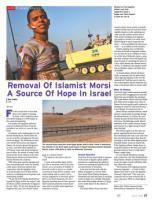

Members of the Egyptian
military and their
supporters guard a
bridge near Tahrir Square
in Cairo on July 8.
Removal Of Islamist Morsi
A Source Of Hope In Israel
i!;:i sales
Tel Aviv
F
or the second time in less than
three years, Egypt is erupting
in chaos, with a popular protest
movement leading to a swift change in
the country's leadership.
For Israelis, the Egyptian military's
removal of Mohamed Morsi from the
presidency last week is a cause for opti-
mism.
An Islamist and a leading figure in the
Muslim Brotherhood, Morsi's brief ten-
ure saw a further estrangement between
Israel and Egypt. The Brotherhood advo-
cates Israel's destruction and supports
Hamas, the terrorist group that governs
in Gaza. And while Morsi upheld the
1979 peace treaty with Israel during his
year in office, his refusal of contact with
Israel and his warm relations with other
Islamist governments portended future
tension between the countries.
With Morsi gone and the Egyptian mil-
itary reasserting itself, Israel can breathe
a little easier. Israel has enjoyed close
cooperation with the Egyptian Army
in recent decades, born of their shared
interest in combating terrorist groups and
maintaining stability.
"To get rid of the Muslim Brotherhood
is great for Egypt and for the region:' said
Zvi Mazel, Israel's ambassador to Egypt in
the late 1990s. "It's the best thing that has
happened this year. One of their central
The security fence along the Israel-Egypt border, built in 2012. Israel is monitoring
the situation in the Sinai region amid turmoil in Egypt following president Mohamed
Morsi's ouster. (JNS photo by Idobi via Wikimedia Commons)
goals is to destroy Israel:'
The takeover also poses risks for
Israel.
A weak and unstable Egypt will be
less able to maintain calm in the Sinai
Desert, act as an anchor of stability in
the Arab world or step in as a media-
tor between Israel and its enemies. And
while dealing with a country led by
secular pragmatists is obviously prefer-
able to one led by Islamists, the 2011
Egyptian uprising showed that a govern-
ment inclined positively toward Israel
may only be possible amid significant
repression at home.
Israeli Reaction
Israel thus far has stayed silent in response
to the unrest in Egypt's capital, neither
praising nor condemning the military's
actions nor reaching out publicly to the
new government in formation.
In an interview last week with the
Italian newspaper La Corriere Della
Sera, Israeli Prime Minister Benjamin
Netanyahu said only that Israel is watching
events in Egypt very carefully. Netanyahu
also made only passing reference to Egypt
in his weekly speech to the cabinet on
Sunday.
The Israel Defense Forces also have
reacted calmly. Troop activity on Israel's
southern border has not increased mean-
ingfully, despite a rocket exploding last
week near the southern resort town of
Eilat and the bombing of an Egyptian
gas pipeline to Jordan. Last week, Israel
allowed Egypt to move troops into the
Sinai — a move prohibited by their peace
treaty — as an added security measure.
Despite ongoing close coordination
between the Israeli and Egyptian militar-
ies, the Sinai has been a hotspot of terror-
ist activity since Mubarak's ouster, a situa-
tion that could get worse with Egypt's top
brass focused on containing the unrest in
Cairo, which already has claimed dozens
of lives. In addition to the pipeline bomb-
ing, an Egyptian soldier was killed there
on Sunday.
An Israeli defense official told Israel
Radio on Saturday that the global jihad
call to fight the Egyptian army over the
weekend will "lead the army to take fur-
ther action against Islamist elements and
make a determined effort to restore order."
Blow To Hamas
Last week, Egypt sealed numerous tunnels
to prevent arms smuggling from Sinai into
Egypt that may destabilize the mainland.
The Israeli defense official told Israel Radio
that while events in Egypt were a blow to
Hamas, the terror group would continue to
maintain its cease-fire with Israel because
it is in Hamas' own interests to do so.
Morsi's fall has weakened Hamas, which
enjoyed a small uptick in prestige during
his administration. In October, the emir
of Qatar became the first head of state to
visit Gaza. The following month, Morsi's
mediation of the conflict between Hamas
and Israel led to a slight easing of Israel's
Gaza blockade.
Now, Hamas again is on the ropes. Its
parent organization has been removed
from leadership after only a year and it has
lost some financial support from Iran for
choosing to back the rebels fighting Syrian
President Bashar Assad, an Iranian ally.
If the Egyptian military clamps down on
weapons transfers in the Sinai and under-
ground tunnels to Gaza, it could stanch
Hamas' supply chain.
For now, Israeli officials are reacting
with a poker face. But if the Brotherhood's
fall portends a decline in Islamist fortunes
across the region, Israelis will likely smile
and collectively exhale.
"The interests of the [Egyptian] govern-
ment are pragmatic — to work in Sinai
against terror and to revive the Egyptian
economy:' Mazel said. "They may even
cooperate with us more economically. It
was a cold peace. We'll see what happens
now:'
❑
Gideon Allon, Shlomo Cesana and Israel
Hayom/JNS.org contributed to this report.
July 11 • 2013
27