

metro
A Wearable Computer
Can Google Glass transform Jewish life?
Yaffa Klugerman
JTA
0
ver the past few weeks, strangers
have begun stopping high school
computer science teacher Chaim
Cohen on the street. A few accuse him of
recording them without their knowledge,
and some blame him for all of society's ills.
But many just want an answer to a sim-
ple question: Is he wearing Google Glass?
Cohen is among the approximately
2,000 developers throughout the United
States who are trying out the search giant's
much-hyped wearable computer, a futur-
istic Internet-connected gadget that users
wear like a pair of glasses and enables
them to stream information from the Web
directly into their field of vision.
Using voice commands and hand ges-
tures, Google Glass users can take pictures,
record videos, get directions and send
messages.
"I offer to let them try it on:' Cohen
said. "My goal is to advocate for this and
show people that this is not a bad thing.
It's a good thing."
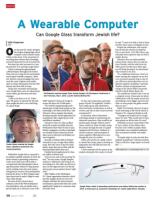
Chaim Cohen wearing his Google
Glass. (Matthew Hersh/Hub City
Communications)
Well before Google Glass is expected to
be publicly available sometime in 2014, the
device already is generating controversy.
Critics worry that users will be able to
surreptitiously take photographs with an
app that permits wearers to snap pictures
just by winking. Some bars and casinos,
citing privacy concerns, have preemptively
banned the device. In West Virginia, legis-
lators have tried to make it illegal to wear
Glass while driving.
But none of this concerns Barry
Schwartz, CEO of the Web development
firm RustyBrick, who can hardly wait to
get his hands on it. Schwartz is one of the
20 June 27 • 2013
Participants wearing Google Glass during Google's I/O Developers Conference in
San Francisco, May 1, 2013. (Justin Sullivan/Getty/JTA)
8,000 "explorers" chosen by Google to
receive the device for $1,500 apiece.
"We would be programming Jewish-
related apps to help Jewish people use the
technology to live their Jewish lives:' said
Schwartz, whose company has already
developed popular Jewish applications for
smartphones, like a digital prayer book
and Hebrew translator.
Schwartz's vision of a Glass-enabled
Jewish life sounds incredibly futuristic.
Notifications flash when it's time to pray.
Nearby synagogues or kosher restaurants
are instantly located. Important Jewish
dates such as yahrtzeits and holidays are
never forgotten.
Recently, a Chabad rabbi at Stanford
University set up a Google Glass tefillin
stand. Men who chose to don the ritual
leather straps then put on Glass and the
blessing flashed before their eyes.
Potential Jewish applications for Glass
are endless, Schwartz says.
"Let's say you want to buy an etrog," he
said. "You can create a Google Hangout
and have a rabbi look at the etrog as you
are looking at it. The rabbi can ask you to
turn it to the right and turn it to the left,
and can give you an opinion about it right
away:'
Mike Vidikan of the Washington,
D.C.-based organization Innovaro, which
provides insights about how new tech-
nologies will shape the future business
environment, expects that Glass also could
significantly change how consumers shop
for kosher food.
As they start inspecting a particular
group of foods:' he explained, "notifica-
tions could pop up with information
about the kosher certifications, as well as
reviews, and who in their social networks
recommend it."
In education, where information
technology already is transforming the
classroom experience, Glass could be yet
another game-changer. Hebrew school
classes could tour Israel virtually, seeing
the country through the eyes of a guide
equipped with the device. Students in
various locations could participate in
classes together, following text as seen
through the eyes of a teacher.
Cohen, who teaches at a public school
in central New Jersey, plans to develop an
application that will help him learn his
students' names.
"I don't remember all the names of my
students during the first weeks of school;'
he said. "I want to be able to look at them
and have their names overlapped on top:'
Despite the enthusiasm, tech experts
from Jewish day schools are skeptical.
Price is one factor. At $1,500, Glass is sig-
nificantly more expensive than an iPad or
similar devices.
Educators also are understandably
uneasy about a device that can snap pic-
tures, literally, with the wink of an eye.
Others point out that since Glass' apps
are still being developed, its educational
value remains to be seen.
"In a traditional classroom, I don't see
where wearing the computer on my face
is an enormous quantum leap in ease of
use, efficiency and productivity over tra-
ditional computer modalities," said Seth
Dimbert, director of educational tech-
nology at the Scheck Hillel Community
School in North Miami Beach, Fla.
"It's actually less useful if only I can see
a computer screen. Classrooms are about
collaboration with the people around you
and making screens bigger and more por-
table, so more people can gather around
them at once."
Rabbi Tzvi Pittinsky, director of educa-
tional technology at the Frisch School in
Paramus, N.J., expressed doubts as well.
"Teenagers are freaked out by Google
Glass:' he said. "Who would want to have
these glasses on all the time? It's scary."
Ultimately, however, many believe that
it's just a matter of time before Glass
becomes more widely accepted. Many
technologies now considered indispens-
able were greeted initially with skepti-
cism.
"If people adopt it at the rate that they
adopted smartphones," Schwartz predicts,
"then it will have a huge impact on Jewish
life:'
❑
Yaffa Klugerman is a contributing writer to JTA.
Google Glass, which is generating controversy even before hitting the market in
2014, is being seen as a powerful technology for Jewish applications. (Google)