

health & wellness
S
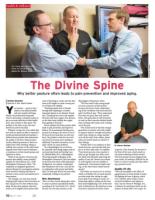
Drs. David and Joel Kirs d
check out the posture of
patient Dr. Mitchell Shek.
The Divine Spine
Why better posture often leads to pain prevention and improved aging.
Ruthan Brodsky
Special to the Jewish News
y
our posture — good or bad —
impacts your physical health
and your mental well being.
Health care professionals frequently
observe and analyze a patient's posture to
get an accurate reflection of their health
and a clear window to their spine. The
problem is the older we get, the more
flawed our posture becomes.
Whatever our age, few of us realize that
how well our spines are able to respond to
Earth's gravitational pull and maintain a
halfway decent posture often determines
the quality of our lives. Proper posture
involves balancing muscles so there's no
added stress when standing, sitting or
walking. Poor posture, on the other hand,
happens when there's muscle imbalance
or weakness in certain muscle groups and
tightness in others.
"Much of our practice is based on the
premise that stability creates mobility:'
explains Dr. David Kirsch, D.C., of the
Birmingham Chiropractic Clinic. "We
emphasize an integrated approach to
physical therapy by assessing how patients
move and then working with them to
perform a more correct and natural move-
ment pattern.
"For example, our work may include
helping people improve their movement so
they can get out of a chair without strug-
gling. We also show patients what they
need to do to lengthen their posture after
52
May 9 • 2013
years of slouching at a desk, and why they
need to lift weights to create a strong cen-
ter of balance for stability.
"Teaching patients how to breathe
through their diaphragm is another
important feature in our therapy:' Kirsch
says. "Breathing the correct way supplies
the body with more oxygen. Poor posture,
on the other hand, inhibits the oxygen
from getting to the brain:'
Kirsch explains that better posture often
leads to pain prevention and improved
balance. He recommends checking your
posture by looking in the mirror to see if
the back of your head lines up with your
back. The problem is that for every inch
your head is forward, you're putting an
additional 10 pounds of pressure on your
spine, which can cause problems.
"As a dermatologist, I'm on my feet a
lot, especially when doing surgery, and my
neck and lower back start hurting:' says
Dr. Mitchell Shek, M.D., of Birmingham.
"Receiving periodic evaluations at the
Birmingham Chiropractic Clinic has helped
me become more aware of the importance
of alignment. As a patient, I understand
that chiropractic care is not a cure-all, but
in combination with exercise [and better
diet], I've been pain-free for six years while
consistently working on my posture:'
New Awarenesss
There are three trends taking place when
it comes to posture and physical health,
according to Dr. Joel Kirsch, D.C., David
Kirsch's son who also practices at the
Birmingham Chiropractic Clinic.
"The first trend is that young people
are more conscious of their posture
because they have a better understand-
ing of the correlation with neck and back
pain:' Joel Kirsch says. "They understand
that when it's good, they look and feel
better. This generation is self-motivated
to work on their muscular-skeletal health,
often working with trainers and working
out at the gym.
"The second trend is that this younger
generation is using its own body weight
to improve balance, strength and posture
rather than relying on a large machine
to do all the work. Foam rollers, plastic
tubes and stretch bands are all part of
their therapy.
"Finally, there is an emphasis on func-
tional exercises, exercises that help peo-
ple to do their daily tasks:' he explains.
"Functional exercises train muscles to
help you get through your daily activi-
ties safely and efficiently improving the
quality of your life. Muscles are trained
to work together and core stability is
emphasized. Conventional weight train-
ing, on the other hand, isolates muscle
groups:'
Our bodies are meant to be in motion,
which is probably why our back muscles
are often weak after sitting for eight
hours daily. From sitting so much, our
hamstrings tighten, pulling on the lower
back and straightening it out. If the lower
back is flattened out, the head has to lean
forward to maintain the body's center
Dr. Steven Weiniger
of gravity. This shortens the muscles in
the front of the neck, which results in
increased weakening of back muscles.
The back muscles become fatigued and
pain results, all making it difficult for the
brain to conserve energy and often affect-
ing a person's mood.
Quality Of Life
"We're all susceptible to the effects of
aging because our body spends its entire
life fighting the force of gravity, which
over a lifetime often results in bone
and joint breakdown and degenera-
tion," says Dr. Steven P. Weiniger, D.C.,
of Atlanta. He and Renee North are the
authors of Stand Taller-Live Longer: An