

■
world >> news analysis
Attack Into Syria
Is Message To Iran
1
Obama uses Israel to show Assad supporters that U.S.
is serious when it says "all options are on the table."
Ron Ben-Yisha
Ynet News
Israel Taking A
Necessary Risk
E
very Western intelligence agency
estimated it would happen soon,
and now, according to all indica-
tions, it has: Bashar Assad tried to reward
Nasrallah and his men — who are fighting
and dying for him — by transferring mod-
ern, surface-to-surface missiles that would
alter the balance of power between the
Lebanese Shiite group and Israel.
The Jewish state, it was reported, inter-
vened and thwarted, just as the prime min-
ister, defense minister and Israel Defense
Forces chief had promised it would. It is
safe to assume that the arms convoy was
about to leave the storage facility at the
Syrian army base toward the Bekaa Valley
in Lebanon when it was hit.
The attacked storage facility is apparently
located in an isolated base used for training
Hezbollah terrorists in the use of "deter-
rence-breaking" weapons and also serves as
a transit station for Nasrallah's organization
on the way to Lebanon.
Israeli aircraft flew over Lebanon in the
days preceding the attack and even carried
out simulated attacks. These flyovers were
most likely meant to signal to Hezbollah
and Syria: We are aware of your intentions
and we will not sit idly by — as Defense
Minister Moshe Ya'alon warned. It seems, at
least according to the American media, that
the warning signals were ignored, forcing
an attack on the arms convoy.
The attack itself, one can assume, was
not carried out from within Lebanese terri-
tory, but from a long distance. Perhaps even
from over the sea. It is known that Israel
has lethal long-range weapons systems —
such as the Popeye air-to-surface missile
manufactured by Rafael — which allows
for very accurate hits from a range of more
than 100 kilometers (62 miles), maybe even
much more.
'Game Changing' Weapons
Among the strategic and modern weapons
systems Israel said it would not allow to
be transferred to Lebanon are the Scud D
ballistic missiles — based on the original
Russian Scud — which Syria developed
with Iran's funding. These missiles have
the potential to carry chemical warheads
containing the advanced chemical warfare
-
40 May 9 • 2013
Dan Margalit
Israel Hayom
T
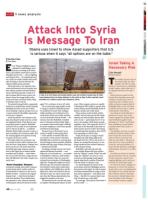
A view of an Iron Dome anti-missile battery near the northern Israeli town of Haifa.
Israel deployed two Iron Dome batteries in the north on May 5 after reported Israeli
airstrikes on a military center near Damascus, Syria.
agent VX to a distance of up to 423 miles.
The accurate long-range missiles Assad
is trying to transfer to Hezbollah present
two problems for Israel: They endanger
military facilities and civilians from the
north almost all the way to Eilat; and they
can be activated far from the border — for
instance, from the Hezbollah-controlled
area in Lebanon's northern Bekaa Valley —
in a manner which would make it difficult
for Israeli warplanes to reach them quickly
and thwart the launching.
The good news is that Israel's Arrow
system is capable of intercepting them
—if the number of missiles fired does
not exceed a certain amount. Therefore,
Hezbollah has an interest in receiving from
Syria the largest amount possible of ballistic
missiles and long-range rockets of all types
—mainly Scud missiles.
According to foreign sources, the Assad
regime had already succeeded — even
before the civil war broke out — to transfer
to Hezbollah in Lebanon a small number
of Scud D missiles. Israel was aware but
refrained from acting due to Washington's
objection. It happened roughly two-and-a-
half years ago: The American administra-
tion feared an Israeli attack would under-
mine stability in the Middle East, and the
fighter jets, which were already in the air,
returned to base. It is safe to assume that
since then the Obama administration has
changed its position on the issue.
The advanced Scud is not the only weap-
on capable of breaking the balance of deter-
rence. Other weapons systems are capable
of limiting the IDF's ability to operate deep
inside Lebanon should Hezbollah decide to
launch a missile-and-rocket attack.
These systems mostly include mobile,
"stealth:' and accurate anti-aircraft missile
batteries and radar facilities that are diffi-
cult to locate — particularly the SA-17 sur-
face-to-air missiles, which Russia recently
supplied to Syria. The request for the SA-17
was made in the aftermath of the strike on
Syria's nuclear reactor in 2007. Now Russia
is transferring these missiles to deter NATO
from operating as it did in Libya.
Assad, for his part, is trying to reward
Nasrallah and make things difficult for
the Israeli Air Force. This is why an SA-17
battery was attacked last January as it was
being transferred from western Damascus
to the Lebanese border.
Hezbollah is also after the anti-ship
cruise missiles Russia sold Syria, particu-
larly the "Yakhont" missile. With a 186-mile
range, the "Yakhont" can serve as a very
accurate and devastating missile against
targets along Israel's coastline if launched
from the Syrian or Lebanese coast.
It is interesting that the reports of the
recent attack came from Washington and not
from sources in the region. It is safe to assume
the Obama administration is trying to show
Syria and its supporters — Iran, Russia and
China — that the U.S. is serious when it says
that "all options are on the table
The message: "We stand by Israel when it
protects itself."
❑
he wisdom and necessity of
the Israeli strike are indis-
putable. The West is using
Israel as a mercenary to undermine
Assad's regime, and to that end, it
is willing to back the IAF's opera-
tions.
Israel, however, needs to look
beyond this immediate move and
consider several factors: Even if
Assad opts not to retaliate over a
strike on Iranian weapons held in
Hezbollah bases on his soil, there
is still the risk of a direct, violent
confrontation with Tehran.
According to Israeli Channel 2
television, a source close to the
Iranian regime has already threat-
ened retribution against Israel,
advising it to "take it" and refrain
from retaliating to avoid further
escalation that could result in a
regional war.
Nevertheless, Iran has to under-
stand that Israel has made it clear
over the past few years exactly
where it draws its red line and
what its casus belli is. The govern-
ment has to set a bar, minimal as
it may be, and not go below it. It
may raise the threat of a prolonged
confrontation, but there is no other
choice.
Israel has no interest in interfer-
ing in the Syrian civil war, nor does
it wish to become a party to the
ongoing fighting, as the rebels are
no better for Israel than Assad.
So when Iran sends a delegate to
Damascus to review the situation,
Assad, who is now overwhelmed by
the burden of war, should tell him
that if Tehran wishes to facilitate
his survival, it should release him
from his duties as the Lebanese
terror group's weapons supplier.
❑