
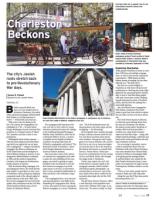

Carriage rides are a popular way to see
Charleston's historic homes and
neighborhoods.
Doors made of Santo Domingo
mahogany protect Torah scrolls at Kahal
Kadosh Beth Elohim, a historic Reform
congregation in Charleston that was
founded by Orthodox Sephardis in 1749.
The city's Jewish
roots stretch back
to pre-Revolutionary
War days.
Susan R. Pollack
Special to the Jewish News
Charleston, S.C.
B
ehind a graceful black iron
fence on a tree-shaded street in
downtown Charleston, the stately
white-columned synagogue, Kahal Kadosh
Beth Elohim, is a living testament to
history — both Jewish and American.
With roots in the city dating to the
late-17th century, the congregation was
established in 1749 — 40 years before
George Washington became America's first
president. In a colonial version of "Mazel
Tov," members sent him a letter of con-
gratulations.
Washington's hand-written response —
"May the same temporal and eternal bless-
ings which you implore for me rest upon
your Congregation" — hangs in the historic
synagogue, the oldest in continuous use
in the United States and the birthplace in
1824 of Reform Judaism in America. It was
designated a National Historic Landmark
in 1980, and the nearby Coming Street
Cemetery is the largest pre-Revolutionary
Jewish cemetery in America.
With its domed ceiling, mahogany Ark
and sloping pine floors, the Greek Revival-
style temple is a good place to start a tour
of Charleston, whose prosperous Sephardi
community made it the cultural capital of
Jewish America in the early 1800s. Like
the city, the synagogue has survived earth-
quakes, fires, hurricanes and the Civil War,
which started just blocks away, at Fort
Sumter in Charleston Harbor.
Z.
Kahal Kadosh Beth Elohim is the oldest synagogue in continuous use in America.
It's also the cradle of Reform Judaism in the U.S.
The synagogue itself experienced its
own civil war in 1824, when 47 young
reformers petitioned trustees for changes
in the traditional Spanish/Portuguese
Shabbat ritual. Rebuffed in their bid for
a shortened Hebrew service, a sermon
in English and an English translation
of prayers, the group split from the
Orthodox congregation and formed "The
Reformed Society of Israelites:' a short-
lived though influential movement in
American Reform Judaism.
Nine years later, many of the reform-
ers rejoined the congregation and, after
a major fire and rebuilding of the syna-
gogue, succeeded in getting an organ
installed in the rear balcony. It was the
first American synagogue to provide
organ music at services, an innovation
that, in turn, prompted traditionalists to
leave and form a new Orthodox congre-
gation.
"The congregation has a very intricate
and amazing history," says Rabbi Arnie
Sleutelberg of Congregation Shir Tikvah
in Troy, who spent two hours touring the
Reform synagogue on a recent Charleston
visit. "All of the feuding between the
denominations, the power-plays and the
in-fighting — it's fascinating:'
On free guided tours, Sundays through
Fridays, volunteer docents detail the his-
tory and share anecdotes about promi-
nent members. Among the early congre-
gants were Francis Salvador, who was the
first Jew to serve in an American legisla-
ture and the first to die in the American
Revolution (he's known as a Jewish Paul
Revere); Penina Moise, a blind poet
known for writing hymns for the worship
service; and Moses Lindo, who brought
the indigo trade to Charleston.
Visitors may explore the city's rich
Jewish history in greater depth in the
synagogue museum, which includes
information panels, photographs, cer-
emonial objects and even a copy of the
Isaac Harby Prayer Book, written by the
journalist-playwright who led the 1824
reformers.
The gift shop, Chosen Treasures, offers
a wide selection, from beautiful meno-
rahs to blue "Shalom Y'all" mugs. As its
motto says, "No need to schlep, we ship:'
Exploring Charleston
Today, greater Charleston is home to more
than 5,500 Jews and multiple congrega-
tions, as well as many Jewish community
organizations. (With dozens of other
historic houses of worship, it's also often
referred to as "The Holy City")
But there are secular delights in
Charleston as well, from well-preserved
architecture to a thriving arts scene, high-
lighted by the upcoming Spoleto Festival,
May 24-June 9. Add fine dining spiked
with tasty Lowcountry cuisine, challeng-
ing golf and generous doses of Southern
charm, and you have the makings for a
memorable getaway.
Just a few blocks from Congregation
Beth Elohim, Charleston Place Hotel
makes a good base from which to explore
the city, either on foot or by horse-drawn
cart.
Part of the Orient-Express Collection,
it is directly across Meeting Street from
the must-see Charleston City Market,
the nation's second oldest. Hundreds of
vendors offer local food specialties —
Carolina rice, crispy benne (sesame)
wafers and fried okra chips — along with
Gullah-inspired paintings, cookbooks and
hand-woven sweet-grass baskets, the ulti-
mate Charleston souvenir.
For an evening to remember, reserve
a table at Charleston Place's four-star
Charleston Grill, where Metro Detroiters
may notice familiar faces: Mickey Bakst,
formerly of Tribute in Farmington Hills,
is the genial general manager/maitre
d', and Rick Rubel, who worked for the
Matt Prentiss Restaurant Group, is som-
melier of an impressive 45-page wine list.
Contemporary Southern cuisine is on the
menu.
"This is a town where people visit for
romance Bakst says with a big smile.
Along the way, they'll find some pretty
fascinating history, too.
❑
Susan R. Pollack of Huntington Woods is a
freelance travel writer. For information about
Charleston, go to www.explorecharleston.com.
May 2 • 2013
17