

home >> at home
Living History
11111E11111111111'
111111111111111E
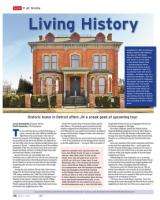
Completed in 1872 for Emanuel
Schloss and his wife, Rebecca,
the home at 234 Winder
Street in Detroit's Brush Park
now serves as an inn. Built
in the Second Empire style
— distinguished by French
architectural details popular
during Napoleon's reign such
as mansard roofs with dormer
windows — the home rests on a
limestone foundation a few feet
above the ground to emphasize
the elegant entryway with gray
limestone trim. The home's
projected window bays with
decorative stone hoods and
keystones add to the grand
impact. A renovation architect
was hired by the city of Detroit
to reconstruct houses in Brush
Park according to their original
plans.
Historic home in Detroit offers JN a sneak peek of upcoming tour.
Lynne Konstantin I Design Writer
Brett Mountain I Photographer
T
he area of Detroit known as Brush Park began as
a farm. Owned in the early 1800s by Adelaide and
Elijah Brush (the second mayor of the town of
Detroit and treasurer of the Michigan Territory), the farm
was parceled out into lots by the Brushes' son, Edmund, in
the mid-1800s when the new rail lines brought Eastern entre-
preneurs to Detroit — making Edmund one of the wealthiest
landholders of the time. He named many of the streets after
friends and family members, including Winder Street after
his friend John Winder, a local attorney.
Because the locale was conveniently close to the
Downtown area as well as the river, the lots were snatched up
by wealthy businessmen who built grand homes (among the
first in Detroit) in various Victorian styles for their families,
transforming the area into one of many elite Detroit neigh-
borhoods.
Among the early residents of Brush Park, whose homes
designed in the French Second Empire style led to its late-
19th-century nickname, the "Little Paris of the Midwest:'
were lumber baron David Whitney and his daughter, Grace
Whitney Evans; Joseph L. Hudson; bank founder William
Livingstone; and dry-goods manufacturer Ransom Gillis.
World-acclaimed Jewish architect Albert Kahn built a home
for himself in the neighborhood in 1906.
Brush Park was also home to Emanuel Schloss and his
wife, Rebecca. The Jewish dry-goods merchant and hab-
erdasher emigrated from Kleinstinach, Germany, in the
mid-1800s and ran a successful store Downtown on Jefferson
Avenue with his brother, Seligman Schloss, and a third part-
ner, Siegmund Simon.
Emanuel Schloss also was active in the Jewish community
— even so his professional success had gained him welcome
in the elite neighborhood — serving in 1860 as president of
Open for overnight visits, special events and
more, 234 Winder Street Inn also is a frequent
stop for Linda Yellin, owner of Feet on the
Street Tours. She will guide tours to the inn
at 9:30 a.m.-2:30 p.m. Friday, April 19, and
Wednesday, May 1. The narrated and escorted
tours, called Detroit Elegance ($69), include
bus transportation from the Starbucks at Maple
Road and Telegraph in Bloomfield Township
to 234 Winder Street Inn, where lunch will be
served, as well as a visit to the opulent Charles
T. Fisher Mansion. For information about the tour,
go to www.FeetOnTheStreetTours.com , or call
(248) 353-8687. For more about the inn, go to
www.234winderstinn.com , or call (313) 831-4091.
Temple Beth El (then known as Congregation Bet El), the
first Jewish synagogue in Michigan.
His brother, Seligman, opened the Hannah Schloss
Memorial Building (designed pro bono by Albert Kahn) in
1903 in memory of his wife (founder of the Jewish Ladies
Sewing Circle and a founding member of the Detroit Jewish
Charities) as a settlement house for Detroit's Jewish immi-
grants.
Such active members of the Jewish community and Detroit
society must have entertained often — and in great style.
In 1870, Emanuel Schloss began construction of a house at
92 Winder Street (his brother lived on the same street) that
is still one of the most elegant examples of Second Empire
architecture in Detroit.
Withstanding the Great Depression, use as a rooming
house, racial tensions and more, the Emanuel Schloss House
survived and has been restored to its original grandeur and
registered as a State of Michigan historical landmark.
Now known as the 234 Winder Street Inn (in 1920, all
Detroit street addresses were revised), the house's detailed
historically accurate renovation was overseen by Mona Ross,
director of the inn since it opened in 2004 and an active par-
ticipant in the revitalization of Detroit
"The house has so much history ' says Ross. "And I love
hearing all the stories that people tell about the house and the
neighborhood when they visit. There are so many stories:'
;
Do you have a home you'd like to share with the community? Contact Lynne Konstantin at lkonstantin@thejewishnews.com .
34
April 11 • 2013
❑