
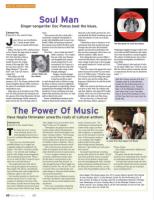

Soul Man
Singer-songwriter Doc Pomus beat the blues.
Michael Fox
Special to the Jewish News
was 6.
"He's a person who has to deal with a
world that's completely inhospitable to
ames Brown was Soul Brother
people with disabilities and in many ways
No. 1. Surely Jerome Felder
hostile Miller said during an interview
deserves an equally affectionate
last summer, hours before the film's world
moniker.
premiere at the San Francisco Jewish Film
Felder, who died in 1991, is better known Festival.
as Doc Pomus, the stage name he adopted
"All of this — does it make him bitter?"
when he began singing in
Miller continues. "No, it makes
New York City blues clubs as
him one of the most humane
a teenager. He's known pri-
and thoughtful and compas-
marily, however, for writing
sionate people that I've ever
dozens of hit songs like "Save
encountered. Doc Pomus is a
the Last Dance for Me," "This
mentsh of the first order. He's
Magic Moment:' "Up on the
a mentsh who comes to that
Roof" and "Can't Get Used to
through challenges."
\ .1
Jerome Felder, aka
Losing You."
Imagine a Jewish teenager
Doc Pomus
Peter Miller and Will
on crutches in the 1940s driven
Hechter's marvelous docu-
to haul up and down stairs
mentary, A.KA. Doc Pomus, produced with to catch elevated trains to Harlem to sing
Pomus' daughter, Sharyn Felder, summons
the blues at African-American nightclubs.
the spirit of a remarkable talent and an
When he gravitated to songwriting, Pomus
extraordinary man.
maintained his friendships with black art-
Felder grew up in Brooklyn in the 1920s
ists like Joe Turner and Jimmy Scott and
and '30s with prevalent anti-Semitism and
added white performers like Dion, Dr. John
the squeeze of the Great Depression. He had and Lou Reed to his circle.
another disadvantage: Felder contracted
Pomus' colorblindness hearkens to the
polio and lost the use of his legs when he
heyday in black-Jewish relations. Miller
J
observed, in his terrific previous doc, Jews
and Baseball, that Hank Greenberg was one
of the first players to reach out to Jackie
Robinson.
"I think that as Jews in America, we do
understand what other people have gone
through who have been discriminated
against, who have been mistreated, who
have not been welcomed, who've been con-
sidered outsiders:' Miller asserts.
Even taking that into account, Miller is
convinced that Pomus, who expended enor-
mous energy in later years to procure gigs
and unpaid royalties for Turner and Scott,
was special.
"Does Doc come to his passion for social
justice because he's Jewish? I'm sure that's
part of it:' Miller muses. "I think he comes
to it because of all of the things that made
him who he was, and I'm certain that a
large part of that had to do with his Jewish
background."
Miller was raised in the Boston area and
now lives in New York City with his wife
and their children, who attend NYC public
schools, which was one of the factors that
led Miller to his other new film, Sosua.
The one-hour doc, co-directed with
Renee Silverman, follows a group of
YOU KNOW HIS SONGS
NOW HEAR HIS STORY
The film poster for AKA Doc Pomus
Washington Heights teenagers, half of who
are Jewish and half Dominican and Latino,
who write and perform a musical together.
The subject: the little-known story of how
the Dominican Republic saved 800 Jews
from Hitler.
"I think history is alive and part of who
we are today:' Miller says. "I look at a story
like Doc Pomus' and see someone who has
so many lessons for the way we should live
today."
❑
AKA Doc Pomus screens at 5 p.m.
Tuesday, April 9, at the Berman
Center for the Performing Arts in
West Bloomfield; 2 p.m. Tuesday,
May 7, at the Michigan Theater in
Ann Arbor; and 7 p.m. Thursday,
May 9, at the Flint Institute of Arts
in Flint. See the Arts cover story for
ticket info.
The Power Of Music
Hava Nagila filmmaker unearths roots of cultural anthem.
Michael Fox
Special to the Jewish News
T
he cliche that every creative
work ultimately proves to be
autobiographical turned out to
be true for acclaimed filmmaker Roberta
Grossman.
"I grew up in an extremely Jewish-
identified family in Los Angeles but
completely religiously assimilated:' she
explains. "But when I would go to family
events — bar mitzvahs and weddings —
and the `Hava Nagila moment happened,
I felt something really powerful. When I
set out to make the film, I wanted to know
what was so powerful about it."
The simple perfection of the title of
her rousing and poignant documentary,
Hava Nagila (The Movie), notwithstand-
ing, Grossman notes with a laugh that she
could have called it, Who Knew?
She traced the melody to a shtetl in the
Ukraine and the lyrics to a cantor and
composer in Palestine at the turn of the
last century. Decades later and many miles
away, Harry Belafonte and Connie Francis
scored crossover hits with the song. Today,
62
March 28 • 2013
JN
"Hava Nagila" turns up everywhere from
Thai TV shows to U.S. ballparks.
"[Moviegoers] are going to learn about
Eastern Europe without learning about
the Holocaust, which doesn't happen very
often:' Grossman effuses. "They're going
to learn about the Chasidic movement.
They're going to learn about the creation
of a Hebrew culture in Palestine. They're
going to learn about the klezmer revival."
And a whole lot more, leavened with
smiles of recognition at the then-new sub-
urban lifestyles of postwar American Jews.
"It was a complete revelation to me:'
Grossman confided last summer when
the film had its world premiere at the
San Francisco Jewish Film Festival, "to
visit, through the lens of `Hava Nagila: my
childhood, and the '50s, '60s and '70s, and
to see how `Hava' was reflecting the very
rapid changes in American Jewish identity
and American Jewish life."
At the same time, as Belafonte recounts
in the film, the Hebrew song unexpectedly
connected with non-Jewish audiences here
and abroad.
"There was a tremendous outpouring
of love and support for the new state of
Israel;' Grossman notes. "The
world had just witnessed the lib-
eration of the camps, and there
was a sense that there was a great
deal of rightness, or appropriate-
ness, for the formation of a Jewish
state. At that moment, maybe in
a way, [singing "Hava
A scene from Hava Naqila (The Movie)
helped people feel less guilty
about having stood by during the
Holocaust. I don't think you could repeat
Warsaw Ghetto.
that moment."
Hava Nagila represented a lighthearted
Grossman's beautiful and wrenching
change of pace.
previous film, Blessed Is the Match: The Life
Her goal is that the film transforms
and Death of Hannah Senesh, recounted
American Jews' relationship with a familiar
the story of the idealistic young Zionist
yet underappreciated chunk of our story.
poet who died fighting the Nazis. The film-
"I do hope that [when] people who have
maker anticipates revisiting the history of
seen the film attend their next bar mitzvah
the Holocaust with her next doc, an exca-
or wedding and they get up, it's going to
vation of the Oneg Shabbat archives of the
mean something more."
❑
Hava Nagila (The Movie) opens the JCC's Lenore Marwil Jewish Film Festival
at noon Sunday, April 7, at the Berman Center for the Performing Arts. It
also screens at 2:30 p.m. Sunday, April 14, at Celebration Cinema in Portage,
near Kalamazoo; at 8 p.m. Sunday, May 5, at the Michigan Theater in Ann
Arbor; and at 7 p.m. Sunday, May 5, at the Flint Institute of Arts in Flint. See
the Arts cover story for ticket info.