

Passover
Feeding The Hungry
Remember those in need at Pesach.
Lori Dube
Special to the Jewish News
W
hen Larry Oleinick, the
founder of Heart 2 Hart
Detroit (H2HD), handed out
his first package of food to a homeless man
in Detroit's Hart Plaza this past summer, it
didn't just feel right; it also felt familiar.
Back in the 1970s and 1980s at Passover,
the living room in the Oleinick's Oak Park
home became an assembly line for creat-
ing care packages — with donated matzah,
fruit and macaroons — for Jewish people
living in Detroit.
The annual matzah delivery project was
started by Oleinick's father, Milton, work-
ing with the late Rabbi Solomon Gruskin of
the Congregation B'nai Zion shul in Oak
Park. Those Passover pilgrimages were
Downtown not far from where Oleinick
ventures now, three times a week, during
the summer heat and the winter freeze to
feed, clothe and connect with the city's less
fortunate.
"My dad taught us the importance of
tzedekah, of giving back, of helping out any-
one in need; says Oleinick. "And my mom,
Cru, had a heart of gold and would lend an
ear to anyone who wanted to talk. What I
am doing through Heart 2 Hart Detroit is
an extension and a way of honoring what I
learned from my folks"
These days, Oleinick, with help from
friends and relatives Ken Levy, Jeffrey
Markowitz, Mark Jacobs, Harriet Kirsch,
Allan Oleinick and Bill Briggs, is reaching
out to a broader community than Jewish
people in need. They are acting upon the
fundamentally Jewish principle of tikkun
olam — repairing the world — to help
address Detroit's homeless issue.
"We now hand out a dozen to 18
lunches three times a week on the streets
in Downtown Detroit. I know what we
are doing doesn't solve the problem:' says
Oleinick. "But if we hand food to one per-
son that hasn't eaten that day, or give a coat
to someone who is living under the express-
way overpass in the freezing cold, I know
we are doing something worthwhile.
"Everyone deserves to be treated with
dignity, and we do that with each package
we hand out and each individual we look in
the eye and ask if they need shoes or socks
or underwear"
Oleinick also knows that building part-
nerships with individuals, businesses and
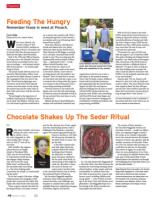
Larry Oleinick and Ken Levy with the
cooler that they pull around Hart Plaza
filled with sandwiches in the summer.
organizations is the best way to have a
real impact on the homeless situation.
That is why his family, cousins, childhood
friends and local suburban businesses
and organizations like the Detroit Pistons,
Tappers, the Shirt Box and Superior
Materials Holdings have all come on board
with the H2HD mission and have sup-
ported its work. H2HD is also networking
with B'nai B'rith Great Lakes Region and
the Isaac Agree Downtown Synagogue for
contributions of clothing and toiletries and
programming possibilities.
With its 501(c)(3) status in the works,
H2HD, along with its board of directors, is
looking to expand the mission to include
more daily deliveries of lunches and cloth-
ing. Since it began in June, H2HD has dis-
tributed more than 1,000 lunches and given
away more than 250 each of coats, new
socks and new underwear.
"I'm proud to be a part of H2HD and
offer any support I can to help them fulfill
their goals of feeding and clothing Detroit's
homeless:' says Mark Jacobs of Farmington
Hills, chairperson of the H2HD board of
directors and also a childhood friend of
Oleinick's. "I've gone to Africa to help pro-
vide clean drinking water to people, but
when I made the delivery Downtown with
H2HD, I saw the profound needs that exist
in our own backyard."
Oleinick adds, "For me, Passover will
always be a time to be with my family and
to give to others. This year's deliveries won't
have matzah in them, but they still repre-
sent the Illor Vador tradition started by my
father that I am proud to continue all year
long through Heart 2 Hart Detroit:'
❑
For more information on how to contribute or
get involved with Heart 2 Hart Detroit you can
visit the website at www.h2hd.org.
Chocolate Shakes Up The Seder Ritual
JTA
R
abbi Adam Schaffer, who's been
leading chocolate seders since
he edited a choco-
late seder Haggadah in 1996,
acknowledges that "people
often do feel ill" from all the
chocolate.
Still, Schaffer, the religious
school director at Temple
Aliyah in Woodland Hills,
Calif., says he was motivated
to "experiment outside the box
and engage college students
who were not in the usual
Hillel track," and found that
the chocolate seder took things
to a "fun level, helping make
connections for people, re-contextualiz-
ing the seder:'
In the last couple of decades, college
campus groups and synagogue youth
groups have concocted the seders that
replace the ritual foods with chocolate.
There is green-colored chocolate for
the karpas/lettuce; chocolate-covered
48
March 21 • 2013
nuts for the charoset mix of nuts, apples
and wine representing mortar used in
building for the Pharaoh; a chocolate
egg for the roasted egg symbolizing the
Passover sacrifice; a very dark
90-100 percent chocolate for
the bitter herbs or maror. You
get the idea.
A chocolate-soaked seder
may help sugar-hyped par-
ticipants absorb the ritual's
teachings about freedom.
An alternative to wallow-
ing in the gooey substitutes
for the usual ritual foods, as
entertaining as that might be,
could use chocolate to name
the issues of slavery, eco-
nomic justice and fair trade
in the chocolate business and to elevate
the profound themes of Passover.
My chocolate Haggadah amplifies
awareness about ethical quandaries
around chocolate, and challenges par-
ticipants to consider labor justice and
spotlight Passover's underlying messages
of freedom, dignity and fairness.
In A Socially Responsible Haggadah for
a Chocolate Seder, chocolate becomes the
medium for uncovering teachings about
ethical kashrut, worker equity and food
sustainability to celebrate those who
toil, often in great poverty, to grow and
harvest cacao, including children and
young adults — some of them in bond-
age in the Ivory Coast and Ghana's cacao
plantations. The Haggadah hopes for a
harvesting of the fruits of productive,
meaningful and safe labors.
The custom of three matzahs —
the chocolate Haggadah version uses
chocolate-covered — recalls our tikkun
olam, our ongoing struggle to perfect
the world, as we consider responsibil-
ity for the contrast between the limited
resources of most cacao growers and the
wealthy consumers of chocolate. When
we cover our matzah with chocolate, we
recall that not only are we descended
from slaves in Egypt, we recall child
slaves on cocoa plantations of our time.
As we prepare to celebrate Passover this
year, may we feel assured that we have
helped advance the messianic era through
our tantalizing array of chocolate choices, not
just chocolate matzah.
❑
Rabbi Deborah Prinz is the author of A Socially
Responsible Haggadah for a Chocolate Seder,
which may be found at her blog, www.jews
onthechocolatetraiLorg. Her latest book is On
the Chocolate Trail: A Delicious Adventure
Connecting Jews, Religions, History, Travel,
Rituals and Recipes to the Magic of Cacao
[Jewish Lights].