

>> news analysis
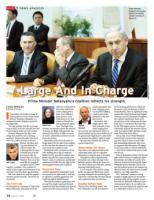
Prime Minister
Benjamin Netanyahu
leading the weekly
cabinet meeting on
March 10.
Prime Minister Netanyahu's coalition reflects his strength.
Haviv Rettig Gur
Times
of Israel
I
f you believe the media coverage of
Israeli politics in recent weeks, Prime
Minister Benjamin Netanyahu is a
weakened premier clinging to power by
his fingernails.
The only problem with this recurring
trope is that it isn't even remotely true and
doesn't hold up under any real scrutiny.
Granted, Netanyahu has done a few
things that could be read as showing
weakness. He gave Hatnuah's Tzipi Livni,
who won a paltry six seats in the new
Knesset, the plum post
of justice minister. He
offered centrist Yair
Lapid arguably the most
powerful post in Israeli
governance after the
premiership: the Finance
Ministry. Even more dra-
matically, he struggled
Yair Lapid
for eight weeks to cobble
together a coalition. Now, coalition in
hand, he faces anger and resentment in his
own party over his cabinet appointments.
But look a little closer, and this negative
narrative quickly unravels. The devil is in
the details:
I
The Livni Link
On the generous concession to Tzipi Livni,
think settlements. Netanyahu knows he
34 March 21 • 2013
will have to dismantle at
least some settlements
in the coming govern-
ment. Even without a
peace process, some
settlements are in clear
violation of Israeli law
and government regula-
Tzipi Livni
tions. The High Court
of Justice has already ordered the removal
of Amona, an illegal settlement that was
removed once before, in 2006, to scenes
of violent confrontation between security
forces and settlers.
Netanyahu needs Livni's six seats as a
hedge against the far-right in his coalition
in the event that the removal of a settle-
ment turns into a political crisis.
Netanyahu's early concessions to Livni
were anything but a sign of weakness.
Rather, his first successful coalition move
greatly expanded his maneuvering room
when it comes to settlements, significantly
weakening the hold of the far-right on the
incoming government and its policies.
Drawn-Out Talks
Another argument for Netanyahu's weak-
ness points to the eight weeks it took him
to negotiate a coalition agreement with
Lapid and rightist Naftali Bennett.
Why did the coalition negotiations take
so long? Put simply, Lapid and Bennett
understood that they needed more than to
merely sit in the next government. They
needed guarantees that
their campaign prom-
ises would be fulfilled,
would be part of the
guidelines of the new
government.
Netanyahu, who
largely agrees with
Naftali
their proposals on key
Bennett
issues ranging from
the economy and educational reform to
Haredi national service, nevertheless stood
his ground and fought hard to water down
any promises he might be asked to make
— because why surrender the political
maneuvering room?
Undercutting The Hawks
Then there is the rightward shift of the
Likud itself, often cited as a sign that
Netanyahu is losing his grip on the party.
Through his cabinet appointments,
Netanyahu sent a blunt message to the
hawkish upstarts, offering his more cen-
trist allies cabinet posts that their primary
showing could hardly justify.
It is no surprise, then, that the young
hawks are angry and blustering, openly
accusing Netanyahu of transforming the
Likud into a dictatorship. But their bluster
only emphasizes their powerlessness.
Keeping Options Open
There are two clarifying caveats. The
first: Netanyahu can still be weakened
by the looming split between Likud and
his partner party, the Russian-oriented
Yisrael Beytenu. But it is significant in this
context that Yisrael Beytenu head Avigdor
Liberman stuck by Netanyahu throughout
the coalition negotiations: Better to be
second place on the ruling party list than
head of an 11-seat faction tied with Shas
for the fifth-largest party in the Knesset.
(Liberman's political fate remains unclear
as he faces legal troubles that have tempo-
rarily driven him from office.).
The second caveat: While Netanyahu
worked hard to preserve his maneuver-
ing room when it comes to peace talks
and dismantling settlements, this is not
an argument that Netanyahu will engage
in new peace talks or remove settlements
— only that he maneuvered hard to make
sure he can.
None of Netanyahu's actions over the past
eight weeks is those of a weakened, depen-
dent premier, but rather of a nearly invin-
cible one, at least for the foreseeable future.
Netanyahu leads a shrunken Likud, to be
sure, but political power is not measured in
objective terms, but rather in one's strength
relative to any viable opposition.
This "weakened" premier is strong
enough to largely ignore his own party's
primaries while piecing together a coali-
tion that can dismantle settlements (but
won't pressure him to do so), deliver eco-
nomic and social reforms he supports, and
is as dependent on him as he is on it.
❑