

metro
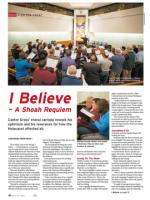
Cantor aniel Gross rehearses / Believe
with a choir'at Adat Shalom Synagogue
in Farmington Hills.
I Believe
degree requirements at the H.L. Miller
Cantorial School at the Jewish Theological
Seminary in New York.
"I realized that there is a defmite lack of
liturgy for the Shoah, and I thought I could
address that through music:' Gross explains.
"Once I had the idea, everything started
coming together. I composed the piece in six
weeks, and it can be sung by volunteer choirs
as well as professional choirs.
"The contexts and the textures of the
movements are varied in part because there
is no instrumental music. There are times
when the choirs sound as if they are mimick-
ing sound effects:'
A Shoah Requiem
Cantor Gross' choral cantata reveals his
optimism and his reverence for how the
Holocaust affected all.
CONTINUED FROM PAGE 1
Those beliefs come across through I
Believe — A Shoah Requiem, a musical lit-
urgy he composed for cantor, soloists and
choruses dedicated to the observance of Yom
HaShoah (Holocaust Remembrance Day).
Gross, in his zeal to call attention to the
circumstances of the Holocaust and its after-
math, has organized the premiere presenta-
tion of his cantata to include participants of
diverse faiths and ethnicities and an audi-
ence of the same representation.
The event, funded by Adat Shalom
families and offered at no price to the public,
begins at 4 p.m. Sunday, April 7, at Orchestra
Hall. Although all the tickets essentially have
been reserved, some seats are being held for
survivors and their families.
"My goal in writing this was to show musi-
cally and compositionally how the Shoah
affected everybody: young and old, Jewish
and not Jewish, black and white, all races and
religions," Gross explains.
"I'm showing that by having the actual
performers be multicultural, multigenera-
tional and multireligious. The people on
stage singing the music are just as diverse as
the clergy involved in the presentation and
the audience:'
Gross had three reasons for excluding
instrumental music.
"I wanted this to be a completely human
experience' explains the cantor, who per-
formed with and directed an a cappella rock
group at the University of Pennsylvania. "I
love stretching the voice and using the voice
to make sound effects.
"I also wanted the piece to be a cappella
so excerpts could be used in synagogues
for holidays that don't allow instruments.
In addition, Yom HaShoah, which this
year begins on the evening of April 7, falls
within a period [the omer, the days between
Madrigal Chorale member Chris Martin
of Rochester Hills and other choir
members at rehearsal
Passover and Shavuot] when many Jews
don't listen to instrumental music:'
Liturgy For The Shoah
I Believe consists of 13 movements, giving it
symbolic meaning as it links to Maimonides'
description of 13 principles of faith, also
referred to as Ani Maamin.
The 13 parts highlight a variety of sources,
from traditional religious texts to modern
writing. They reach from Psalms excerpts
to the words of Primo Levi. There is the
Mourner's Kaddish and an unsigned inscrip-
tion found along a Cologne cave where Jews
had been hiding.
Gross originally developed the piece,
revised since 2009, to comply with master's
Assembling It All
Getting the premiere together began with
booking the venue.
"Orchestra Hall was the key element, and
it was available' the cantor says. "It was key
because of its acoustic perfection. Since this
is a cappella, it needs the natural reverb to
highlight the overtones of the singing voice.
"Orchestra Hall also was key because it
is a neutral venue. It isn't a specific syna-
gogue, and it isn't a church. It is totally non-
religious, and anyone can feel comfortable
walking into that setting:'
To get community support, Gross con-
tacted key representatives of Jewish and
non-Jewish organizations to be part of the
presentation as he also reached out to poten-
tial singers.
"I knew I always wanted the Adat Shalom
choirs to be part of it because of my connec-
tion to the synagogue," explains Gross, who
also relies on the talents of his wife, soprano
Lauren Skuce Gross.
"A couple of years ago, I got an inquiry
from the Madrigal Chorale of Southfield ask-
ing to use synagogue space for rehearsals,
I Believe on page 12
10 March 14 • 2013