

spirituality
Young Beth Ahm members learn about Tu b'Shevat, superhero style.
Shelli Liebman Dorfman
I Contributing Writer
new youth program may have
serious goals like caring for the
Earth and celebrating nature,
but its name — Zum Gali Gali Earth
Rangers — means fun.
The group of elementary and middle
school kids meet weekly after school
at Congregation Beth Ahm in West
Bloomfield to learn about the holiday of
Tu b'Shevat, which marks the start of the
New Year for trees in Israel.
Taking place this year on Shabbat,
beginning Friday evening, Jan. 25, Tu
b'Shevat is also termed Jewish Arbor Day
or Jewish Earth Day, and is the time of
the earliest bloom on the trees in Israel
and the beginning of a new fruit-bearing
cycle. It falls on the 15th day of the
Hebrew month of Shevat.
Earth Rangers members, who belong to
Beth Ahm, take part in a hands-on, inter-
active program of recycling projects and
healthy food promotion — and tasting.
They also have been rehearsing traditional
and popular music with a message of Tu
b'Shevat to perform at the synagogue's
upcoming Tu b'Shevat seder.
Many synagogues and groups, including
Michigan Coalition on the Environment
and Jewish Life, hold a Tu b'Shevat
seder, a concept created by 16th-century
Kabbalists.
Some use Haggadot with a focus on
ecology or Israel or family activities.
Four cups of wine are served to represent
aspects of the fruit tree and of ourselves.
The seder is marked by eating fruits,
specifically those named in the Torah as
being found in Israel, including grapes,
figs, pomegranates, olives and dates.
A
Saving Trees
At Beth Ahm, the seder is sponsored
by the synagogue's Tikkun Olam-Social
Action Team (TOSAT), whose tagline
says they are "dedicated to improving the
world:'
"Our co-sponsorship means that our
caterer can use glass plates and dinner-
ware and TOSAT can do its part to save
the trees by not using paper goods at the
seder," said Nancy Kalef, TOSAT chair-
person.
Earth Ranger Ayla Schwartz, 12, of
Beverly Hills offers a few holiday sug-
gestions: "Plant a tree, take a hike in the
woods to sketch and think, hold a conver-
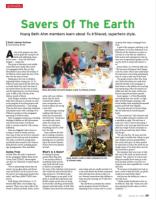
Elissa Berg helps the Earth Rangers create Tu b'Shevat artwork.
sation with your children
about what the Earth
would be like without
trees, incorporate a new
Jewish tradition like trying
a new fruit:'
Ayla encourages creating
traditions like those her
family has incorporated
into their lives. "Sometimes
we would read a book
called The Giving Tree
about a tree that gives
everything it has to a little
boy:' she said.
Some celebrate the holi-
day by making a donation
to an environmental cause,
planting trees or contribut-
ing to the Jewish National
Fund to have trees planted
in Israel.
What's In A Name?
In naming the group,
creator Elissa Berg said,
Sarah Aguilar creates a table centerpiece for the
"I was trying to think of
Tu b'Shevat seder.
something catchy and the
song `Zum Gali Gali' came
to mind as an example of
the music of the chalutzim [early pioneers and ecology and are usually invested in it,
who worked the land of Israel] that is
so the name blends the Jewish component
often present at a Tu b'Shevat seder.
with what they hear about in other ven-
"Earth Rangers, in my mind, is kid
ues. Personal connections help children to
speak; it sounds like superheroes and
make personal meaning out of what they
are doing:'
should conjure up the sense of caring
for the Earth:' said Berg, Jewish family
She said there is potential for continu-
educator and lead teacher at Beth Ahm.
ing the program beyond Tu b'Shevat,
"Children learn about the environment
expanding it into a nature club or a musi-
cal group that sings at synagogue func-
tions.
A goal of the program, said Berg, is for
participants "to see the celebration of Tu
b'Shevat and the references to nature in
our texts as a way that our tradition is
both ancient and contemporary, that we
were once an agricultural people, and the
way the Earth is treated still matters to
us:'
Itamar Moltz, 10, of Beverly Hills said,
"The best part of being an Earth Ranger
is the fun crafts." But he also understands
the importance of recycling and planting
trees as a way to take care of the Earth.
The group's projects reflect this, Berg
said. Seder decorations are made from
materials already in the synagogue or
their homes so the children are recycling
and repurposing. Other decorations are
edible and, after the seder, will become
food for squirrels and other animals.
Sarah Aguilar, 7, of West Bloomfield
said making their own snacks is a high-
light of Earth Rangers meetings, with
recent healthy treats including homemade
granola and fresh fruit lollipops.
The group also gets to discuss things
like the importance of protecting the
Earth.
"Look around you:' Ayla Schwartz said.
"It's the middle of January and there isn't
a snowflake in sight. This isn't how it
used to be. This is what it's becoming. I
remember a few years ago when the snow
piled up so high we had a mountain on
our cul-de-sac until early April. Where
did that go?
"We can stop this. We must stop this.
Don't make it end like this. When you give
your children and your grandchildren
this world, don't give it to them spoiled.
It's important to protect the Earth for one
simple reason. If we don't, there won't be
any Earth left to protect:'
She maintains that some ways to help
take care of the Earth are pretty uncom-
plicated. "You could try to recycle some-
thing you usually throw away, go to the
park and pick up litter, even just try to
compost your extra vegetables for a week:'
Ayla said.
"If everyone on the planet just took an
hour a week to help the Earth, our planet
would be in much better shape:'
And she sees the holiday as a time to
start this focus.
"I think people should take action on
Tu b'Shevat," Ayla said. "Teach your chil-
dren important Jewish values as well as
traditions:'
❑
January 24 • 2013
29