

On Sacred Ground from page 24
Commentary
built a miniature model of the gas cham-
bers and crematoria at Birkenau, which
had been destroyed by the fleeing Nazis as
they tried to cover up their crimes. This
mock-up showed the long, underground
undressing area, where up to 2,000 people
at a time disrobed for supposed "showers"
— then the long, underground chamber,
just as cramped, where men, women and
children were gassed to death.
MLK's Legacy: An Enduring
Reminder Of The Just Way
Horrors Of Birkenau
Soon, we were actually at Birkenau, the
large, desolate killing fields where so many
Jews perished. I stood on the railway sid-
ing where Jews were selected by the infa-
mous Nazi "doctor" Joseph Mengele. Some
would serve as slaves or be subjects of his
horrendous medical "experiments" The
others — the old, the weak, the women
and the children — were doomed to be
murdered within minutes.
In 1944, more than 400,000 Hungarian
Jews were slain during a 10-week period. I
saw the barbed wire and the guard towers.
The smell of burning human flesh and the
cries of fear and desperation I could only
imagine.
I have read books on the Holocaust,
seen films and spoken with survivors and
their families. Despite all my prior knowl-
edge of anti-Semitism and the Holocaust,
now, for the first time, I could sense a
tiny bit of the personal reality of being
there — how it might have felt facing the
ultimate anti-Semitism on that railway
siding at Birkenau. The impact of standing
there left me emotionally and physically
overwhelmed with the Holocaust's reality,
within my eyes and under my feet.
But also, I was also overcome with hope.
Moments later at Birkenau, I witnessed
New York/JTA
F
Israeli youth on an emotional visit to
Birkenau
another glimpse of reality — a large con-
tigent of Israeli youth proudly holding
aloft the blue-and-white flag of the Jewish
people.
Anti-Semitism through the ages
has shown its evil face in small, everyday
banalities as well as cataclysmic slaughter.
But the Jewish people, as evidenced by these
proud youth of Israel, have survived for
millennia.
Standing alongside the train tracks
at Birkenau, all I could think of was the
Passover admonition that Jews must feel
as if they — personally and physically
— were rescued by God from slavery in
Egypt.
Now, I finally understood.
❑
David Sachs is senior copy editor
or those of us who closely
follow America's progress in
the battles against racism
and anti-Semitism, the observance
of the Rev. Martin Luther King Jr.'s
birthday this year has par-
ticular relevance.
First, the King holiday,
which this year is observed
on Jan. 21, reminds us of
two significant anniversaries
surrounding the civil rights
leader. It is the 50th anniver-
sary of his historic "I Have
A Dream" speech at the Mall
on Washington and the 20th
anniversary of all 50 states
in the union observing the
holiday.
Second, while leading the monu-
mental struggle for civil rights in this
country, King never equivocated in
denouncing anti-Semitism.
"The segregationist and racists
make no fine distinction between
the Negro and the Jews," he stated
bluntly.
And in a letter to Jewish leaders
just months before his 1968 assas-
sination, King said, "I will continue to
oppose it [anti-Semitism] because it
is immoral and self-destructive."
A Resonant Path
at the Detroit Jewish News.
Let It Snow!
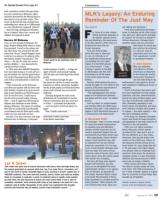
This winter has been one of Israel's stormiest with heavy rains and high winds, but
the season generated an unusual white hue Jan. 9 as snow fell on Jerusalem, not
just in the north of Israel. Snowfall began in early morning in Israel's capital city of
760,000 residents. The snow had shut schools, courts, trains and roads by midday.
Snow in Jerusalem is typically a cause to celebrate since it usually melts quickly,
but this time, the pile measured 6 inches, the most since 1992. It was a time of
snowballs, snowmen, snow-covered palm trees or just taking in the quiet of a city
suddenly void of traffic. Meanwhile, all the winter rain replenished the drought-
marred Lake Kinneret (Sea of Galilee), Israel's main freshwater source.
The message – that it is never enough
for Jews and Jewish organizations
to condemn only anti-Semitism –
remains terribly important for the
country. Important leaders from all
communities must follow King's lead.
More specifically, King's condem-
nation of anti-Semitism was, and
is, important for his own African
American community. For too long,
levels of anti-Semitic attitudes have
been too high. And some African
American cultural figures utter senti-
ments about Jews and Jewish power
that remain very troubling.
Not only did King react against
blatant anti-Semitism, but also
early on, he anticipated the more
sophisticated versions. In an appear-
ance at Harvard, as reported by
the scholar Seymour Martin Lipset
in his book The Socialism of Fools,
King responded to a hostile question
about Zionism: "When people criti-
cize Zionists they mean Jews; you
are talking anti-Semitism."
Third, King understood the impor-
tance of standing up for other minori-
ties, both as a value and to strength-
en support for his work on behalf of
African Americans. Perhaps King's
greatest legacy was his conviction
that justice for black peo-
ple could not be achieved
in a vacuum, that all
Americans must live free
from oppression in order
to guarantee freedom.
A Just Course
Why was obtaining
civil rights for African
Americans so important
to the American Jewish
community? Because it
was the right thing to do,
and because it was good for all and
built coalitions in fighting all forms of
prejudice.
Fourth, King knew that power poli-
tics were important to bring change.
Speeches, marches, demonstrations
and sit-ins were all about power poli-
tics. But he profoundly understood
that, ultimately, appealing to the
moral values, the goodness and long-
term interests of those who needed
to change – the white majority – was
the key to changing society.
In the long run, however, changing
hearts and minds through education
and appealing to the best instincts of
America is the real solution.
Fifth, the civil rights revolution
led by King also further opened
up America for Jews and is one of
the key elements as to why today,
American Jews are the freest com-
munity in the 2,000-year history of
the diaspora and why things are so
much better for Jews today than 60
or 70 years ago. Civil rights legisla-
tion allowed Jews to challenge their
exclusion. Even more, the revolution
changed society in a way that being
different and expressing one's differ-
ences was no longer a liability.
These values were King's values.
Too often in society today, we stray
from them. This 50th anniversary of
his "I Have a Dream" speech is a good
time to recommit to those things that
brought us all together.
❑
Kenneth Jacobson is deputy national
director of the Anti-Defamation League.
❑
January 17 • 2013
25