
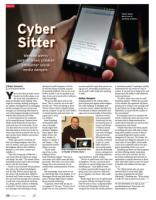

metro
Family Signal
alerts you of
potential problems.
Cyber
Sitter
donlySignal: Drugs aler
Your child Alice. Pleasee see
information
gfial.COM
for more
We
e alerts
parentlithen children
encounter social
media dangers.
I
Robin Schwartz
Contributing Writer
y
ou've seen them at malls, movie
theaters and coffee shops, or on
the street with smartphones in
hand and thumbs busily tapping. They
might be tweeting, chatting, posting sta-
tus updates, sharing photos or exchanging
private messages, but you can bet most
teenagers are connecting with friends or
even total strangers through social media
websites like Facebook and Twitter.
A recent national survey conducted
by the nonprofit group Common Sense
Media found 90 percent of teens have
used some form of social media, 75 per-
cent have their own accounts and more
than half check in at least once a day. So,
where does that leave parents who are try-
ing to protect their children and monitor
what's going on?
"When I got used to Facebook, the
kids were doing Instagram, then they
were on Twitter:' says Laura Gorosh of
Birmingham. She has three children:
Hannah, 14, and twins, Andrew and
Isabella, 11.
"They have thousands of followers. I
can't check what all of them are saying
and doing;' she adds. "The minute I learn
something and get used to the technology
they're onto the next thing:'
Gorosh is one of dozens of local parents
who rely on the website FamilySignal.
corn for help. When a parent signs up,
the service will monitor their children's
Facebook and Twitter accounts 24 hours a
day and send text message alerts instantly,
in real time, if any discussion involving
sex, drugs, alcohol, violence or bullying
is detected. The site does not monitor
text messages, but technology is being
20 January 17 • 2013
developed to add Instagram to the list
accounts and don't want their parents see-
ing any of it. Personally, my parents can
of networks being constantly scanned
for potential problems. The service costs
see my stuff. I don't really have anything
$4.99 a month; it can be canceled at any
to hide:'
time. It also can be used with or without a
Online Dangers
child's knowledge.
"We sat our kids down and we told
Eisenberg believes the website offers a
them, 'This is a tool for you to be safe;"
level of protection against online dangers
like cyber-bullying. In Michigan and
Gorosh says. "We're not spying on them.
They're minors, they're using the phone
across the country, student suicides have
and the computer we pay for, and I believe been blamed on attacks and hateful mes-
we should monitor and teach them. It's
sages sent via social media. In December,
a great tool to teach
schools in several
our children:'
local communities
Brian Eisenberg
closed early for win-
of Bloomfield Hills,
ter break because of
who co-founded
rumors and threats
Family Signal with
of violence spread
developer Matthew
over the Internet.
Last week, Michigan
Fanto, agrees. He's a
father of four chil-
Attorney General
dren: Jordan, 13,
Bill Schuette visited
Kaylie, 11, Ashtyn, 3,
a number of schools
and Taitym, 1. They
as part of a cyber
launched the website
safety initiative to
about a year ago.
warn young people
Brian Eisenberg of Bloomfield Hills,
"There's noth-
about the potentially
co-founder of Famil y Signal
ing to buy, no disc,
serious consequences
nothing to down-
of posting malicious,
load;' Eisenberg explains. "You put in
mean-spirited or violent content.
your name, your child's name and their
"We live in small towns, and I have a lot
passwords. After that, even if your child
of daughters. I'm very concerned about
changes his or her password, we can
what goes on and the things that are said;'
monitor their communications 24 hours
Eisenberg says. "I just think it's better
a day:'
to embrace social media because it's not
Not surprisingly, many teens are not
going away. If you and your child don't
too fond of this idea. Leah Frankel, 15, of
go at it together, who knows what could
Huntington Woods says she's heard her
happen?"
peers at Berkley High School complain
Family Signal grew out of sophisticated
about parental monitoring.
encryption software developed by Aegis
"In general, I know kids my age are
Data Security in Troy, a company headed
very against it," she says. "I know a lot of
by Fanto and Eisenberg. It doesn't just
people who are very protective of their
recognize key words; the website performs
A
a "sentiment analysis;' meaning it actually
understands the way words are used in
context. It can pick up on slang terms, and
parents have the ability to add additional
words and phrases.
"It's able to learn every time it's used:'
Eisenberg explains. "Within five seconds
to five minutes, the registered cell phone
parents put in will get a text message with
an alert [about sex, drugs, bullying, etc.],
followed by an email with the content of
the conversation:'
But teenagers may try to outsmart the
system. Frankel says teens she knows who
are aware they're being monitored are
careful about what they say and how they
communicate with friends.
"I think when they know their parents
are looking into their stuff, they're either
using other people's accounts or they're
not saying things their parents would
disapprove of:' she says. "On Twitter, I've
seen people post things for attention or to
cause chaos or start fights. Social media
can be from completely safe to very dan-
gerous depending on how you use it:'
Eisenberg says there are other programs
out there offering similar monitoring
services, but not in real time. He says
the instant notification gives parents an
opportunity to quickly intervene or deter-
mine what other action to take. It's aimed
at families with children between ages
10-15.
"Do I think parents who are more
informed have a much better fight-
ing chance of getting the job done?
Absolutely!" Eisenberg says. "We're trying
to help. We want to protect your kids:'
❑
For more information or to sign up, go to
www.familysignal.com . There's also a live
demonstration on the website.