
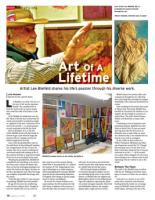

Left: Artist Lee Bleifeld, 85, is
compelled to express himself
through his art.
Below: Detailed, intimate pose in paper
Artist Lee Bleifeld shares his life's passion through his diverse work.
Lite! Michaeli
Special to the Jewish News
L
ee Bleifeld is an artist. You see it in
his eyes. In the way he expresses
himself. You certainly know it
from the works of art in various media
that crowd the walls of his home in Oak
Park.
At 85, Bleifeld is looking back over his
life. Much of his life story comes from his
words, punctuated by an infectious laugh
or a glimmer in his eyes. And much of it is
seen in his artwork — as varied, passion-
ate and emotional as the life he's lived.
Born in Brooklyn, N.Y., in the late
1920s, Bleifeld moved with this family to
Detroit at age 4, just when he began his
journey with art, copying cartoons his
father brought home for him.
Later, when his grandmother came to
live with them, he found himself watching
her, compassionate for this 70-year-old
woman who was so used to working and
now found herself with nothing to do. In
the summer, he'd take a camp stool outside
for her to sit on as he played in the yard.
Watching his grandmother, Bleifeld felt
compelled to do something, so he went to
his room, took a canvas and paints, laid
them on the bed and began painting in his
mind. He could see her figure, the lines on
her face, the shadows and, when the image
was complete, he painted that image onto
the canvas.
"Until this day, I believe it was my great-
est painting:' Bleifeld says with emotion.
By age 18, his room was overflowing
with art from ceiling to floor. Though he
knew he wanted only to be an artist, he
14 January 3 • 2013
Bleifeld's garage serves as his studio and gallery.
felt a need to serve his country during
World War II. He entered the U.S. Army in
the summer of 1943. Beginning his train-
ing in Mississippi as a combat engineer,
then being dispatched to Europe, Bleifeld
spent his service dismantling landmines
in England, then taking on special assign-
ments in France and Belgium.
He served two winters without a sea-
sonal uniform. He still overheats his Oak
Park home, in defense of the memory of
that old chill. After serving for two and a
half years, he arrived on one of the first
vessels to enter New York harbor and says
he couldn't help but feel like a hero.
Still, the harsh situations Bleifeld
encountered during his military service
are embodied in his work. So are Jewish
themes, as Bleifeld takes his religion and
philosophizes about it in his biblical paint-
ings and sculptures, capturing the charac-
ters in their strongest moments. His David
and Bathsheba's embrace, for example,
appears dark, rough and even violent.
Bleifeld shares his morals, ethics and
compassion through his art, reflecting
and connecting them through the images
embedded in his mind and manifested on
canvas.
After studying art for nearly three years
at Wayne State University, Bleifeld then
enrolled at Chouinard Art Institute in Los
Angeles. He also taught at a private art
school there. The artist claims Picasso,
Pollack and Mondrian as major influ-
ences.
Graduating as one of institute's most
promising students, Bleifeld knew that
often an artist's first 10 years are spent
starving and cold. His first job as an
illustrator was to paint tulips on canis-
ters. Bored by this, a few months later he
moved on to work as a designer.
By the 1990s, he had worked at J.
Walter Thompson, McManus and other
top ad agencies around the U.S. Though
his main goal was to be the best in his
field, somewhere along the line it became
irrelevant to be No. 1 — all he needed
was a goal, which changed over the years,
from wanting to be a famous artist to just
expressing what he wanted to say to the
world.
Between The Faces
The walls of the Bleifeld home overflow
with his art. Walking around this warm
house, it seems as if there are no walls at
all.
Each piece is a mirror to one of the
many faces, memories and emotions
bursting from the inside out. An image
erupts in Bleifeld's mind and then the
ritual begins, starting at the top of the