
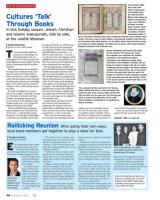

The Kennicott Bible:
arts & entertainment
One of the great
Hebrew manuscripts
Cultures 'Talk'
Through Books
In this holiday season, Jewish, Christian
and Islamic manuscripts, side by side,
at the Jewish Museum.
Sandee Brawarsky
I Special to the Jewish News
T
o see the Rambam's handwrit-
ing up close is astonishing. Two
of his handwritten works are
behind glass in New York City, part of the
Jewish Museum's current exhibit "Crossing
Borders: Manuscripts from the Bodleian
Libraries."
His autograph draft of his comprehen-
sive legal code, or Mishneh Torah, dates
back to around 1180. Its black Hebrew
letters are written in a cursive Sephardic
script, with many letters joined, as though
the philosopher, rabbi, doctor and leading
figure in the medieval Jewish world were
writing in a hurry, without lifting the pen
very often.
He writes in straight lines and some-
times in the margins, occasionally crossing
out. The sheets were found in the Cairo
Genizah. An autograph manuscript of
his Commentary on the Mishnah, written
in Judeo-Arabic from 1167, includes his
drawing of the plan of the Temple.
The more than 60 works showcased —
many on display in the United States for
the first time — span the third century
through the 17th, and they include Bibles,
commentaries on the Bible, prayer books
for daily and festival use, a Hebrew psal-
ter with French and Latin annotations,
and collections of fables. Three volumes
of Euclid's Elements of Geometry — in
Hebrew, Arabic and Latin — are set in a
row, all open to the same diagrams. All the
exhibited works are commentaries, too, on
their times and hint of the hands that cre-
ated, commissioned and used them.
The museum presents a brilliant solu-
tion to the difficulty inherent in displaying
valuable manuscripts and books under
glass: As is usual in exhibits of rare books,
the individual volumes are propped open,
with an often spectacular two-page spread
visible. But the viewer is left wondering
what might be on the following or previ-
ous pages, or the opening title page. Here,
adjacent iPads are part of the exhibition.
For several of the books on display, addi-
tional pages may be viewed by touching
the screen, and images can be enlarged for
more detailed views.
Claudia Nahson, the Morris and Eva
Feld Curator at the Jewish Museum,
explains that the museum used touch
screens before in exhibitions, but never
iPads, and never has used the technology
as extensively as it does in this show.
"Here, it was an interesting option —
but not only for the technology and what
of the Middle Ages,
the 1476 Kennicott
Bible (scribe: Moses ibn
Sabara; commissioner:
Isaac, son of Solomon
de Braga, Corunna,
Spain) contains lavish
illuminations combin-
ing Islamic, Christian
and popular motifs. It
has an inscription identifying the artist (Joseph ibn Hayyim), rare in Hebrew manu-
scripts. The book is open to Sefer Mikhlol, a grammatical treatise by the 12th-cen-
tury Provencal rabbi David Kihmhi. It is set within Islamic-style horseshoe arches,
surrounded by animal vignettes. The Bible owes its name to the English Hebraist
Benjamin Kennicott (1718-1783).83), who
Hebrew Pentateuch with Motif of the Virgin
and the Unicorn: This manuscript, meant
for synagogue use, comprises the Aramaic
translation of the Pentateuch, Rashi's
commentary and additional readings. Most
remarkable is the medallion at bottom, with an
image of a unicorn resting in the lap of a virgin.
It decorates the first page of the book of Genesis,
together with Adam and Eve, who are portrayed
as sinners bringing death upon the world. The
images are Christian in their symbolism, alluding
to the Incarnation and the New Creation: Christ
is the unicorn and the second Adam; Mary is the
virgin and the new Eve.
This exquisite miniature portrait of Sir Thomas
Bodley (1545-1613) bears a Latin inscription indi-
cating the date of its creation, 1598, and the fact
that the sitter was 54 years old. This was the year
when he retired from diplomatic service under
Queen Elizabeth I and decided to re-establish the
library at Oxford.
it allows you to do. It's another form of
the book. We start with scrolls, rotulus
(a scroll that unfurls vertically), codices.
It's all part of a history, how we transition
from one to another; she says, pleased to
see all of the forms together in one space.
In fact, the very first sentence of the first
panel in the first room nods to the new
Cultures 'Talk' on page 53
Rollicking Reunion
After going their own ways,
local band members get together to play a show for fans.
I
Suzanne Chessler
Contributing Writer
E
ric Gutman knows how to make
at least one dream come true.
A full-time ticket broker and
part-time stage performer, Gutman had
a dream about appearing again with his
band from high school
and beyond and spent
waking hours putting a
show together.
The quartet, which
began with the name
Affliction and became
Small Craft Sighting
to get away from any
A part-time
heavy metal connec-
actor, Eric
tions, will appear
Gutman can be Thursday evening, Dec.
seen on many
27, at the Berkley Front
local stages.
in Berkley.
48
December 20 • 2012
"This will be a rock 'n' roll show with
the original music we recorded for eight
albums on independent labels," says
Gutman, 35, who has been on tour with
Jersey Boys and periodically joins a cast of
Forbidden Broadway.
"It will be our 20-year reunion, mark-
ing the time we started, and I hope our
friends who saw us in local clubs and at
college shows will be in the audience for
this event:'
Gutman, a student at Harrison High
School in Farmington Hills when he
joined up with the other quartet mem-
bers, sings and plays rhythm guitar. Joe
Kirkland, the bass player, continues with
another local band, Lisboa, although his
primary work is as a philosophy profes-
sor.
Drummer Courtney Cahill and guitar-
ist Chris Nagarah don't keep up profes-
sionally with their music. While Cahill
works in logistics, Nagarah is an electrical
engineer.
Gutman, the only Jewish member, had
a singing role model in the family. His late
grandfather, David Gutman, was cantor at
Temple Beit Kodesh in Livonia.
Religion is important to Eric Gutman,
and his wife, Sarah, who have chosen day-
care at Temple Emanu-El in Oak Park for
their two daughters: Riley, 4, and Sydney,
2.
"I joined with the quartet in 1992 and
stayed with them until I decided to move
to New York in 2000:' says Gutman, who
lives in Huntington Woods and recently
appeared in the play Ordinary Days at the
Tipping Point Theatre in Northville. "We
all wrote the music, but Joe was the one
who came up with the lyrics.
"We had wonderful times together, and
we've been doing a lot of rehearsing to get
ready for our reunion. The other three
Small Craft Sighting, circa 1998:
Joe Kirkland, Courtney Cahill, Chris
Nagarah and Eric Gutman
spent more time together because they
continued as a trio after I left the band.
"I still think of them as great friends,
and I look forward to seeing other high
school friends at our reunion show. We can
have an early toast to the new year"
❑
Small Craft Sighting will perform at
9:30 p.m. Thursday, Dec. 27, at the
Berkley Front, 3087 12 Mile Road,
in Berkley. Doors open at 8 p.m. $5
cover. (248) 547-3331.