

metro
OLIVER PEOPLES
2,5&04,2144wida;?*
0077❑❑
Face To Face
Holocaust survivors share stories with
U-M students at annual luncheon.
1 .
4
Comprehensive Exams • Eyewear • Vision Correction
Try them on...
Bergman Porretta
Eye Center w
EXCEPTIONAL EYECARE WITH A CLEAR FOCUS
Ophthalmologists
Ronald H. Bergman, M.D.
Anthony C. Porretta, M.D.
Gary D. Bergman, M.D.
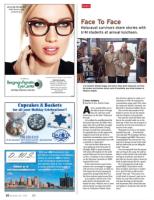
U-M students Michelle Kappy and Alyson Shore greet Holocaust survivors
Ebi Centeri and Hermina Hirsch, both of Southfield, and Alfred Zydower of
29990 Northwestern Highway
Farmington Hills, Ml 48334
248.538.6463
Madison Heights.
www.bergmanporretta.com
1797590
I
Cupcakes & Baskets
A
for all your Holiday Celebrations!!
Cup cakeCake
s
On the Boardwalk • 6879 Orchard Lake Rd. • West Bloomfield
www.dakotabread.com
aot:5?TROIT
II
fe#1
, 5
7
.1TC.fF.F
W IV W.DETROITWAITSTAFE COM
Contact us at:
info@detroitwaitstaff.com
"With over 200 Restaurants, Bars
and Diners in Downtown and Midtown
Detroit, as well as 100's of others
in the surrounding neighborhoods
and suburbs, there is now 1 websit
to locate potential workers and job
openings in the Detroit Area!"
-
yerixl•
• '.—
32
November 22 • 2012
Mi
Haley Goldberg
Special to the Jewish News
worn, manila folder sat on
the table in front of George
Vine, 85, with two words
handwritten on the label: "Holocaust
Records:'
As he talked, he carefully placed his
documents back into the folder with a
paper clip, only to pull them out again
within a matter of minutes. During
the span of a half-hour conversation,
he repeatedly drew out the paperwork,
original records from his arrival to
Auschwitz concentration camp in 1942,
where atop was a handwritten note with
a reminder to "speak slow."
Vine and 49 other Holocaust sur-
vivors gathered at the University of
Michigan Hillel to speak intimately
with about 200 students for the sixth
annual Holocaust Survivor Luncheon
on Nov. 4. Students on the Conference
on the Holocaust Committee at Hillel
organized the event.
In the same format as past events,
students were encouraged to engage
with survivors over lunch. At Table 22,
Vine began the event by sharing his
experiences during World War II to
the three students seated around him.
In accordance with his note, Vine
spoke slowly and eloquently as he
shared his story. When he was 12 years
old, his family was taken from their
home in Ciechanow, Poland, where
they lived in a ghetto, by cattle car to
Auschwitz in 1942. He remained in
concentration camps until 1945, when
his camp near Munich, Germany, was
liberated by American military forces.
Vine was the only member of his
family to survive; he lost his parents
and four brothers in the genocide.
Vine said the words his father told
him in the crowded cattle car on the
third day of their four-day transport to
Auschwitz served as his motivation to
survive in the camps.
"He leaned over to me so my mother
shouldn't hear, and ... he lowered his
voice and said, 'We are going to die here.
We are going to get killed. I leave you a
commandment: You must survive. You
must do it. Because no one in the world
will ever believe that you are telling the
truth,;' Vine said.
Vine was separated from his parents
after arriving in the camp. He said his
father's words echoed in his mind after
arriving in Auschwitz, and about 10
days later he devised a plan to leave his
bunk at night and get shot by a guard.
As I was going out trying to get
myself killed, I heard those words
from my father, and I knew I couldn't
do it. And I'm here to tell the story
myself;' Vine said. "The reason I try
to talk slowly is because I want you to
believe me, and what could be more
real than showing you documents,
real documents, that I found after the
war hidden in Auschwitz, that told the
story."