

>> on thel
-r.
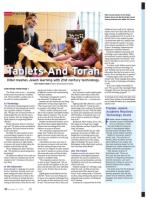
Hillel second-graders Aviel Siegel,
Nathan Moral and Mia Mechnikov touch
Torah parchment with Rabbi Zvi Pincus.
Hillel meshes Jewsh learning with 21st-century technology.
Keri Guten Cohen I Story Development Editor
CONTINUED FROM PAGE 1
"The Torah is who we are — everything
Jewish comes from that text:' Freedman
said. "How beautiful to combine who we
are with 21st-century education:'
1:1 Technology
"We take pride in being progressive and at
the forefront of what educational research
says is good for students:' Freedman
said. "We did a year of research before we
decided tablet PCs were the best way to
go for students. They are stronger [than
Apple products] in supporting Hebrew
software:'
Marilyn Mossman, director of technol-
ogy, said, "We took our time and looked at
all options. We let the decision be driven
by the curriculum:'
The tablet PCs allow students to have
a personal laptop computer as well as a
touchscreen tablet that uses a stylus.
Teachers had their hands on the devices
last winter and had six to eight months
to become well versed in them before the
students received theirs this fall.
"We are helping each other:' Mossman
said. "The teachers are also learning from
the students:'
The tablets are made by Lenovo and cost
about $1,400 each. Freedman says all 105
students in the 7-8 division of the school
have them.
In The Classroom
Jessica Stempek is a language arts teacher
for the 7-8 division. Not only are her stu-
dents reading texts online, but they are
Skyping with classrooms in India as they
study the evolution of writing; they have
interviewed specialists about ancient cave
writing in that country. They also are read-
12
November 15 • 2012
ing the same books as other classrooms
in different countries and communicating
with those students.
"Technology is bringing the world to
our classrooms:' Freedman said.
Stempek says the students also are doing
collaborative writing using Google Docs.
"They can go home, and I can help them
by computer with editing:' she said.
"There's a wealth of Jewish texts avail-
able on the computer:' said Rabbi Jonathan
Berger, rabbi-in-residence. "You can call
up on screen all sorts of texts, like the
Dead Sea Scrolls at the Israel Museum:'
Students use Microsoft OneNote, synch-
ing software that includes digital binders,
planners and note-taking devices that
teachers can access at all hours.
"It's a tremendous organizational tool:'
Berger said. "Students who have lost
papers now know exactly where they are.
The excuse now would have to be the dog
ate my stylus."
And students now have more time in
the classroom to interact with each other
and their teachers because some class-
rooms now are "flipped:' In math, students
can watch 15 minutes of a lecture at home,
take notes and review, and then do their
homework in the classroom where the
teachers is available to help.
"The computers maximize the time
we have in class:' Stempek said. "We can
access and edit work together on the com-
puter, and then they have more individual
time to write. It's faster than in the class-
room:'
Eighth-grader Jacob Edelson loves his
tablet PC. "It lets us do more things and
it's easier to be prepared; nothing gets lost
and it's easier to show teachers your work:'
he said. "You have more time to learn and
it's more fun:'
Joey Greenstein, another eighth-grader,
likes that he doesn't take as much time
fixing mistakes in math because he just
deletes and starts over — no messy eras-
ing.
Eighth-grader Miles Menuck is a poster
boy for the tablet PC. "I have the worst
handwriting in the world and I'm horrible
at organization; he said. "With the tablet,
I'm much more organized and connected.
With OneNote, it's seamlessly easy. I can
even set alerts to remind me of things I
have to do:'
Jill Menuck, Miles' mother, also is a fan.
She's happy he no longer has to juggle
heavy textbooks, and says it's good for stu-
dents' self-esteem.
"The students feel like they are really
progressive and modern at Hillel, even
though they are learning ancient texts
in the most modern way:' she said. "The
school has always been on the cutting
edge of technology. We went to look at
Birmingham Groves High School, and they
don't even have Smart Boards:'
Into The Future
Freedman recently sent parents a letter
outlining the technological expansions
planned for the school, accelerated by a
grant from a private foundation, and mak-
ing Hillel the most tech-savvy elementary
school in the area.
Students in grades K-2 will begin using
iPads this week. An iPad cart has been
purchased and will be shared by class-
rooms. In the coming weeks, 5-6 division
teachers, along with specialty teachers and
leadership team members, will being tab-
let PC training.
In January, it is expected that the Early
Childhood Center staff and K-4 division
teachers will receive their tablet PCs and
begin training. An additional iPad cart
will be purchased for ECC 4s and K-2. In
the fall of 2013, every student in grades
5-6 should have tablet PCs. Robotics also
will be introduced in grades 5-8 as part
of the school's commitment to its STEM
(Science, Technology, Engineering and
Mathematics) education initiative.
Freedman emphasizes that along with
technology comes responsibility. Tablets
are monitored to ensure students use tech-
nology appropriately and ethically. "Tech
literacy and safety are part of our curricu-
lum:' he said.
"In today's world, children need to learn
knowledge and discern knowledge he
said. "Students need to know that not all
information they find is accurate or trust-
worthy. We are teaching them to question:'
Freedman again comes around to the
school's Sefer Torah campaign that meshes
the two worlds of technology and Judaism
so well.
"It all comes together beautifully:' he
said. "The success of the meaningful Torah
Campaign will ensure the long-term stabil-
ity of the technology program:'
❑
To participate in the writing of the Sefer Torah,
contact Cheryl Schanes at cschanes@hillelday.
org, call (248) 539-1488 or go to www.hillelday.
orgIsefer torah.
Frankel Jewish
Academy Receives
Technology Grant
F
rankel Jewish Academy has
received a grant of $500,000
from an anonymous funder
that will enable the school to
launch its long-planned digital
learning project: Bridging Teens
Through Jewish Digital Learning.
Rabbi Eric Grossman, head of
school, said, "The selection of
Frankel Jewish Academy and the
green-lighting of our project will
have long-reaching impact for FJA
students and Jewish students in the
Detroit community and beyond."
Patti Shayne, director of
technology, said, "Since our
first year, we have been at the
forefront of integrating technology
into the classroom. Last year's
distribution of iPads to every FJA
student reflected this ongoing
commitment."
The grant gives FJA the financial
wherewithal to develop digital
learning programs that tap into
Jewish source materials, Hebrew
language, and Jewish culture and
identity.