

arts & entertainment >> book fair
Beyhan Cagri
Track: "Turkish
cooking is very
Dishing
Diversity
spontaneous."
Cookbook author shares personal stories
and delicious recipes at Book Fair tasting.
Suzanne Chessler
Contributing Writer
B
eyhan Cagri Trock, who grew
up with a Jewish mother and
Muslim father, learned early
about the problems religious differences
can cause in families, but she also learned
about accepting diversity and finding love.
Trock brings that story — and the
authentic traditions she experienced — to
what has become both a personal his-
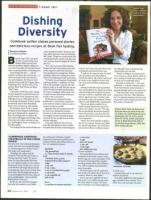
tory and cookbook, The Ottomon Turk
and the Pretty Jewish Girl (Cupper James
Publishing; $35). The title refers to her
parents, Berta "Beti" Revah and Hayri
"Zeki" Cagri.
A discussion of the book and a tasting
of some Sephardic and Turkish foods fre-
quently found on her dining room table
will begin at 6 p.m. Wednesday, Nov. 14,
at the Jewish Community Center's Annual
Jewish Book Fair in West Bloomfield,
where Trock will meet up with relatives.
Her husband, Bruce Trock, an epide-
miologist at Johns Hopkins in Baltimore,
grew up in Detroit and is a graduate of
Henry Ford High School as well as the
University of Michigan and Michigan State
University; his brother and sister-in-law,
Gary and Kathleen Trock, currently live in
West Bloomfield.
"I'm finding that the Jewish-Muslim mix
ALBONDIGAS AGRISTADA
(MEATBALLS IN EGG-LEMON
SAUCE)
Everyone loves this traditional Sephardic
recipe. Succulent, juicy meatballs bathed
in a lemony-egg sauce. Oh boy. Doesn't
that make your mouth water?
Albondiga, the Ladino word for
meatball, is derived from the Arabic al
bundaq, meaning "round." My mom's
sister Ida Dana learned this dish from
her very talented mother-in-law, Sultana.
Nicknamed Suzan, Sultana was a marvel
in the kitchen and taught Ida practically
everything she knows about cooking. How
lovely then, that Ida taught the recipe to
her granddaughter Brielle Dana, Sultana's
great-granddaughter. And now Brielle
kindly shares it with you!
By the way, Ida named her daughter
Suzy after her mother-in-law. Unlike
44
November 8 r 2012
114
makes people interested," Trock says dur-
ing a phone interview from her Bethesda,
Md., home. "People are curious about how
something like that would work; they also
want to know about the Sephardic Jewish
part of it.
"Jews who were part of the Ottoman
Empire and have since left for places like
Israel, Argentina and Cuba remember
their grandparents coming from Turkey,
speaking Ladino and cooking these foods.
They're remembering an older generation.
"If I had to choose between being Jewish
and being Muslim, I would have to deny
half of my parentage. I can't do that. My
parents raised us to seek God any way we
could. We did Chanukah and Ramadan.
We went to synagogue and mosque, and
I found the same ideas about reverence,
sacrifice and social justice!"
Trocks parents, disowned by their
families for 12 years before a rapproche-
ment with her mother's relatives, came to
America to start a new life.
Separated from her architectural work
for three years during the economic
downturn, Trock came to the book as a
meaningful activity to provide heritage
resources for her two grown sons from a
previous marriage.
"It became important for me to put
down the information so that I wouldn't
feel guilty that all of this would disappear
the Ashkenazim of Europe, Spanish
(Sephardic) Jews have no problem nam-
ing their children after living relatives. In
fact, it's considered an honor.
Meatballs:
1 lb. ground beef
1-2 Tbsp. bread crumbs or matzah
meal
1 medium onion, grated
5 sprigs fresh parsley, chopped
1 egg
1 /2 tsp. salt
1 /2 tsp. cumin
1 /4 tsp. or sprinkle black pepper
1 /2 cup water
1 /4 cup vegetable oil
dash of salt
Sauce:
1 /2 cup flour or matzah-cake flour
forever:' says Trock, who also refers to the
Catholicism experienced by her sons.
"It took me two years to write the book,
take the pictures and self-publish in
Canada last March. My mother's sister and
her sister-in-law taught me Jewish cook-
ing. I learned the Turkish cooking from
my dad."
Among her favorite recipes, presented
here and detailed in the chapters providing
cultural background and general prepara-
tion tips, is one for a Sephardic dish, meat-
balls in egg-lemon sauce. Another, leeks
and carrots in olive oil, represents Turkish
influence and fulfills kosher requirements.
"Jews in my family cooked a lot of
Turkish recipes that became part of our
culture and cuisine," she says. "The ones
that are specifically Jewish have Spanish
names because they came from the 15th
century, when the Jews left Spain because
of the Inquisition.
"What I love about Turkish cooking is
that it's very textural. You get your hands
into natural ingredients. You smell them,
and you throw them in without measur-
ing, although I have included specific
measurements for the book.
"Turkish cooking is very spontaneous.
In our house, we always danced while we
were cooking. We had music playing, and
my aunt and I would belly-dance."
Returned to architecture — this time
residential — with the economic upturn,
Trock finds that her circle of friends is
growing through readers who contact her.
"They share their stories and family
experiences:' she says. "They talk about
how I've ignited memories, and they send
me pictures of their families and the food
they make on Facebook."
Beyhan Cagri Trock will discuss her
book and serve up some of the eth-
nic dishes she recommends at 6 p.m.
Wednesday, Nov.14, at the Jewish
Book Fair at the Jewish Community
Center in West Bloomfield. $15 for
the tasting. Reservations: (248) 661-
1900; www.jccdet.org .
1 /2 cup water
2 eggs
juice of 1 lemon
1 /2 tsp. salt
% tsp. sugar
plus additional water
To make meatballs:
Place ground beef in a medium-sized
mixing bowl with bread crumbs, onion,
parsley, egg, salt, cumin and pepper. With
wet hands, blend ingredients together,
punching mixture down and working it
very well to tenderize meat and blend
spices thoroughly.
Wet hands again, and roll small meat-
balls inside your palms (about the size of
a walnut). Place in a large skillet.
Add 1/2 cup water, vegetable oil and a
dash of salt. Cover skillet, leaving room
for a little steam to escape. Cook meat-
balls 15 minutes over medium-high heat.
Albondigas Agristada
To make sauce:
Combine flour and 1/2 cup water in a
medium-sized bowl.
In another small bowl, whisk together
eggs, and add to flour mixture. Stir in
lemon juice, salt and sugar. Set aside.