

metro >> on the cover
Honoring Veterans
JWV Commander David George was a Marine on the spot in the "Forgotten War."
Bill Carroll
I
Contributing Writer
CONTINUED FROM THE COVER
George earned a pack of medals,
including two Bronze Stars, before the
war ended. Now, George, 81, who lives in
Auburn Hills, is the new commander of
the Michigan Jewish War Veterans posts.
As Veterans Day approaches (Nov. 11),
he'll have a prominent, but less dangerous
role in the annual observance, "march-
ing in a parade or giving some speeches,"
he said. "I'll also attend Veterans Day
Shabbats at synagogues in the commu-
nity:'
'Police Action'
George grew up in Detroit and started
learning engineering at Cass Tech High
School before being drafted at age 20.
He chose the Marine Corps. After basic
training and radio school in San Diego,
he shipped out to Korea to fight in what
has since become known as the "forgot-
ten war" or a "police action," as President
Harry Truman called it.
Ruled by Japan since 1910, Korea was
divided up by the allies after Japan was
defeated in World War II; Communist
Russia got the northern half, and the U.S.
took the southern half, with the 38th
Parallel as the dividing point.
When North Korea invaded the south
in 1950 — the first armed combat of the
Cold War — the U.S. and other United
Nations forces interceded.
But U.S. troops comprised almost 90
percent of the 340,000 total troops, result-
ing in the deaths of more than 33,000
Americans. Thousands more were wound-
ed, and the status of a few thousand MIAs
still is uncertain even today. An armistice
was reached in 1953.
"It was a strange war in many respects:'
recalls George. "When I first got there, an
officer ordered me to man a machine gun
nest along the 38th Parallel, but he said,
`Don't shoot anybody.' I thought that was
weird, so I just sat there, listening to the
sounds of women and children as they
scurried around waving white handker-
chiefs. It turned out that the families of
the opposing Korean armies were allowed
to walk in the line of fire, and visit rela-
tives and bring food and gifts to each
other.
"Also, each side would hold its fire to
allow the other side to go out and collect
the wounded and bodies of the dead."
12
November 8 • 2012
Jaw.
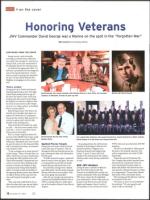
David George, left, meets monthly with Mitchell Rycus of Ann Arbor and Leonard
Marine Cpl. David George
Zeidman of Westland, friends he grew up with.
David George and his lady friend,
The Jewish War Veterans color guard served at a recent funeral for a fallen veteran.
Delores Davis
David George is in the front row, second from left.
Spotted Precise Targets
He graduated from the old Electronic
Institute of Technology in Detroit and
joined Ford Motor Company at its
Dearborn Research and Engineering
Center. "I spent 23 years with Ford,
mostly in the dynamometer lab, testing
vehicles under actual driving conditions,"
he said.
George got more action when he joined
a four-man team of "spotters" who ran
through the hills and selected precise tar-
gets, radioing the ships with information
for their guns.
"If shells missed the target, I would tell
them to raise or lower the guns. We were
so consumed by our job that we hardly
noticed the gun and mortar fire at us."
For protection, George wore a helmet
and a flak jacket, "and the lucky mezuzah
that my wife sent to me over there. Only
one of our group was wounded."
After the war, George was promoted to
corporal and finished his Marine duty in
1960 by training officers in radio exper-
tise at the Quantico Marine Corps Base in
Virginia.
600 JWV Members
George became a member of Maurice
Rose Post #510 of the Jewish War
Veterans in Southfield and recently was
named commander of the nine Michigan
JWV posts, chosen by the individual
post commanders. Seven of the posts are
located in the Detroit area, plus Grand
Rapids and Saginaw; there's a total of
600 members, a far cry from the end of
WWII when each post had about 400-500
members.
The JWV was founded in 1896 around
the time of the Spanish American War,
and the organization now totals 37,000
nationwide.
Toward the end of the Korean War,
Gen. Douglas MacArthur launched some
intrusions into Communist China ter-
ritory, disobeying Truman's orders to
desist. MacArthur even favored an inva-
sion and also criticized Truman in a letter
to a congressman. Truman then relieved
MacArthur of his commander duties.
Were George and the Marines ready for
an escalation of the war?
"Of course we were; we were Marines!"
he exclaimed. "We were gung ho and
ready to take on anything."
❑