

metro
Fighting Oppression
Civil rights expert talks about
struggles of Guantanamo prisoners.
Achieve
academics
Detroit Country Day School
provides its students with a
well-rounded liberal arts education
that is nationally recognized
for a tradition of excellence in
academics, athletics and the arts.
LOWER SCHOOL
Pre - K3 - 2nd grade
3003 West Maple Rd
248.430.2740
JUNIOR SCHOOL:
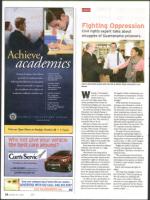
Jules Lobel greets people after his talk at Wayne State University's Law
School.
3rd 5th grade
3600 Bradway Blvd
248.430.1074
W
inning a "tremendous
victory" in court doesn't
always lead to suc-
cess, said civil rights expert Jules
Lobel, president of the Center for
Constitutional Rights and a law profes-
sor at the Pittsburgh School of Law.
He spoke last month at Wayne State
University Law School's Damon J.
Keith Center for Civil Rights. Lobel is
co-author of the award-winning book,
MIDDLE SCHOOL
6th - 8th grade
22400 Hillview Ln
248.430.3655
UPPER SCHOOL
9th - 12th grade
22305 West 13 Mile Rd
248.430.3587
DETROIT C01. - NTR Y DAY SCHOOL
www.dcds.edu
Visit our Open House on Sunday, October 28 • 1 3 p.m .
-
.
1764400
the best care
Ready to gi.ve your vehicle the service it d
Pornalized care driwn by tedmanoi
248.545.0500
Call
for an appointment, or
for more promotional information, visit us at
Keep your company top of mind with our readers.
ADVERTISE WITH US! CALL 248.351.5107
Visit theJEWISHNEWS.com
26
October 18 e 2012
3N
Less Safe, Less Free: Why America is
Losing the War on Terror.
His topic at Wayne Law was the
Guantanamo Bay detention center
in Cuba, where nearly 170 prison-
ers are still held, even though many
of them have been found to have no
connection to terrorists and have
been "cleared for release or transfer,"
Lobel said. "Eighty-seven people who
shouldn't be there are still there."
Some have been referred to military
tribunals. The rest exist in a "legal
black hole he said.
The prisoners are being held in
indefinite "preventive detention" with-
out due process under American law,
considered a right in criminal cases,
and without adherence to the bulk of
the Geneva Convention, considered
a right for prisoners in international
war. In some cases, the detainees don't
know the charges against them and
have no avenue or means to show their
innocence if they did know, he said.
"In 2004, we won a tremendous vic-
tory (in Rasul v. Bush)," Lobel said.
"The court said that the habeus statute
(giving prisoners the right to face
their accusers in court to determine
the legality of their confinement) cov-
ers detainees at Guantanamo. We had
won a tremendous victory — or so we
thought!"
While hundreds of Guantanamo
prisoners were released as a result of
the 2004 litigation, and conditions in
the detention center improved some-
what, hundreds more remain, due to
decisions by the U.S. Court of Appeals
in the District of Columbia consider-
ing the holding of uncharged prisoners
allowable under expanded executive
powers due to the "war on terror." The
U.S. Supreme Court has refused to
review the issues, Lobel said.
He spoke of lessons he's learned
through the ongoing legal battles by
the Center for Constitutional Rights to
bring justice to innocent people arrest-
ed since Sept. 11, 2001, never charged,
and held indefinitely at Guantanamo.
"Rights are useful," Lobel said.
"They're very important. But they're
not sufficient. They have to be tied to a
political action.
"The second lesson I learned from
this is that the divide between winning
and losing is not as great as we think it
is. Reality is more complex. Reality is
more nuanced."
But he will continue the fight, he
added.
"The long-term struggle is what is
key," Lobel said. "We're not giving up.
We will continue to challenge this.
The story is not written. I think our
real task is to resist oppression. When
faced with oppression the key thing is
to resist. We will not accept oppression
without a fight."