

alts entertainment
el
I
t was some egg — actually a small
work of art in the shape of an egg
designed by the House of Faberge —
that came up for auction in 2007 and sold
for $18.6 million.
Known as the clock egg and long among
the holdings of Jewish banking icons the
Rothschild family, the enamel and gold
designer piece was bought by a Russian col-
lector.
The Faberge artistry — whether in the
form of bejeweled eggs or in the forms of
decorous picture frames, parasol handles and
other adornments — will be on view Oct.
14-Jan. 21 through an exhibit traveling to the
Detroit Institute of Arts.
"Faberge: The Rise and Fall, Collection of
the Virginia Museum of Fine Arts" show-
cases more than 200 precious objects made
by the Russian-based firm associated with
its country's aristocracy in the late 19th and
early 20th centuries.
Toby Faber, author of Faberge's Eggs, is
familiar with some of the pieces that will be
on view in Detroit and recommends them
and their stories. He spoke with the IN about
Jewish connections to Faberge pieces in a
recent phone conversation from England.
"I knew something about Faberge when I
started writing the book, but I didn't expect
how beautiful I would find the objects when
I saw them in the flesh:' says Faber, who
recently talked about the artwork and his
book during a meeting of Spiro Ark, a Jewish
cultural organization in London.
"The objects really are much more impres-
sive when you see them properly exhibited as
I'm sure they will be in Detroit.
"Photographs never do the pieces justice,
partly because they're a lot smaller than
you'd expect them to be. They're more jewel-
like, and you can appreciate the craftsman-
ship that much more in person when [you
also can notice] the way the light catches off
them:
Among the many displayed treasures will
be a menagerie of animals carved from semi-
precious stones and one-of-a-kind miniature
egg pendants.
The display is complemented by text,
large-scale photo murals and hands-on
activities to show how such luxury objects
would have been handcrafted in a workshop,
viewed in a storefront and used to adorn the
interior of an imperial palace.
The DIA will feature public programs —
lectures, artist demonstrations, rare silent
films and live music — to give a sense of the
times in which the Faberge pieces were made
(see sidebar on this page).
Ultimately, the exhibit explores the inter-
national fame and eventual demise
of the designer brand spanning 40
years in Russia.
At the height of its success, the
House of Faberge employed more
than 1,500 craftsmen and was sell-
ing today's equivalent of $175 mil-
lion worth of goods annually, having
a privileged relationship with the
Romanov imperial family
"The Faberge family members
were Huguenots from the Protestant
tradition in France, persecuted by
Louis xrv,' Faber explains. "There's
nothing particularly Jewish about
Faberge, but there's a link of people
being similarly persecuted for their
religious beliefs. I'm sure some of the
Faberge workmen were Jewish."
One well-documented contributor to the
House of Faberge was workmaster Julius
Rappoport, a Jewish craftsman who trained
in Berlin and opened his own workshop in
St. Petersburg in 1883. He became Faberge's
most important supplier of silver objects in
St. Petersburg. Best known for his natural-
istic animal figures, he also executed special
commissions for the imperial family and the
imperial cabinet.
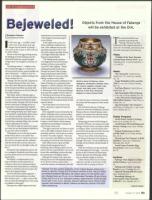
One of the objects to be shown at the
DIA is a brantina, or spherical vessel, by
Rappoport.
Faber originally became interested in the
subject of Faberge artistry because he liked
the idea of objects connected to stories. His
recent London speech was given at a Wartski
location, a Jewish family-owned antiques
establishment specializing in Faberge and
other Russian works of art.
"The eggs in particular, and there are quite
a few in the exhibit coming to Detroit, were
essentially made for czars to give to czarinas
for Easter:' the author explains. "There also
were connections with different events that
were going on in the lives of the Romanovs"
Faber tells the story of Jack and Belle
Linsky, Jewish immigrants from St.
Petersburg, where Faberge artistry was cen-
tered. In the U.S., they built their own art col-
lection after establishing a fortune through
the manufacture of Swingline staplers.
Although the Linskys tried to give their
Faberge pieces to the Metropolitan Museum
of Art, the two noted art donors were
scorned by museum administrators who did
Trav is Fu lle r ton, © Virg in ia Museum of Fine Arts
Suzanne Chessler
Contributing Writer
Objects from the House of Faberge
will be exhibited at the DIA.
he events listed below are
planned to go along with
"Faberge: The Rise and Fall,
Collection of the Virginia Museum of
Fine Arts." For details, and ticket prices
for some events, go to www.dia.org .
Films:
Twilight of the Tsars: Russian
Cinema from 1910 to 1919: 7 p.m.
Thursdays, Oct. 11 and 18, and Nov. 1,
8, 15 and 29.
Bratina: House of Faberge, Julius
Rappoport, workmaster, undated, silver,
gilt, enamel, sapphire, emerald, ruby,
garnet, blue topaz, pearl. Virginia
Museum of Fine Arts, Richmond.
Bequest of Lillian Thomas Pratt.
not value the pieces at that time. Eventually,
the couple sold that segment of their artistic
holdings.
One of the first collectors of Faberge
pieces was American oil billionaire Armand
Hammer (the son of Jewish Russian immi-
grants), who amassed his collection during
his business ventures with Soviet Russia in
the 1920s.
Faberge eggs, because of their linkage to
the history of Russia, may bring some mixed
feelings to Jewish visitors viewing the exhibit,
according to Faber. Amid the beauty of the
pieces looms the background of the devastat-
ing treatment of Jews in czarist Russia.
"You can trace all the events that led up
to the Russian Revolution in the designs of
the eggs': Faber says. "It wasn't deliberate by
Faberge, but [is evident] with the benefit of
hindsight.
"After the revolution, you get specifically
into what happened to the eggs — how they
got lost in the revolution and found again,
and how they got sold off through middle-
men to collectors, largely in America.
"Lillian Thomas Pratt was one of those
collectors, and she is at the heart of the
collection that is coming to Detroit."
"Faberge: The Rise and Fall, Collection of the Virginia Museum of Fine Arts"
will be on view Oct. 14-Jan. 21 at the Detroit Institute of Arts. This is a timed
and ticketed exhibition: $15 adults, $8 children ages 6-17, free for DIA mem-
bers. Museum hours are 10 a.m.-4 p.m. Wednesdays-Thursdays, 10 a.m.-10 p.m.
Fridays and 10 a.m.-5 p.m. Saturdays-Sundays. Beginning Nov. 13, the DIA also
will be open 9 a.m.-4 p.m. Tuesdays. Museum admission alone is free for DIA
members and residents of Wayne, Oakland and Macomb counties. (313) 833-
7900; www.dia.org .
Music:
Trio Voronezh: 7 and 8:30 p.m.
Friday, Oct. 12; 1 and 3 p.m. Sunday,
Oct. 14.
Sergei Prokofiev's Peter and the
Wolf: 11 a.m. and 1:30 p.m. Sunday,
Nov. 18.
CutTime Players: 7 and 8:30 p.m.
Friday, Nov. 30.
Igor Stravinsky's Rite of Spring:
11 a.m. and 1:30 p.m. Sunday, Dec. 16.
A Jazz Nutcracker featuring the
Mike Jellick Quintet: 7 and 8:30 p.m.
Friday, Dec. 21.
Igor Stravinsky's The Firebird: 7
and 8:30 p.m. Friday, Jan. 11 and 1 and
3 p.m. Sunday, Jan. 13.
Family Programs
Artist Demo: Geode Cracking:
noon 4 p.m. Sunday, Oct. 21.
Artist Demo: Silversmithing and
Pewter Casting: noon-4 p.m. Sunday,
Nov. 11.
Puppet Performance of Peter
and the Wolf: 2 p.m. Friday-Sunday,
Nov. 23-25.
MicroScope Toy Theater's A Real
Elephant: 2 and 4 p.m. Wednesday-
Thursday, Dec. 26-27.
Artist Demo: Pysanky (Egg
Decoration): noon-4 p.m. Sunday,
Jan. 20.
-
Lectures
Faberge: From Imperial Culture
to Pop Culture: 2 p.m. Sunday, Oct.
14.
Faberge and Cartier: An Epic
Rivalry: 6 p.m. Thursday, Nov. 15.
Imperial Dining with the Czars:
2 p.m. Saturday, Dec. 8.
Reworking Faberge: In
Conversation with Alexander
Caldwell: 2 p.m. Saturday, Jan. 12.
- Suzanne Chessler
October 11 • 2012
53