

arts & entertainment
Moonlight And Magnolias
A great night of theater for JET audiences.
Ronelle Grier
Contributing Writer
ewish Ensemble Theatre's season
opener, Moonlight and Magnolias,
takes us behind the scenes of the
classic film Gone with the Wind, where
the characters who created the epic block-
buster are as fascinating as those depicted on
screen.
The 2005 Off-Broadway hit play, written
by Ron Hutchinson and directed by JET
Managing Director Christopher
Bremer, is an intriguing and
often hilarious look at how
Margaret Mitchell's 1,037-page
Civil War saga became one of the most
successful movies ever made, winning 10
Academy Awards when it premiered in 1939.
The play, which is based on true events,
takes place over the course of five days
during which three Hollywood legends —
producer David 0. Selznick (Wayne David
Parker), screenwriter Ben Hecht (Joel
Mitchell) and director Victor Fleming (Glen
Allen Pruett) — revised the Sidney Howard
GWTW screenplay in a locked room after
Selznick fired original director George Cukor
and suspended filming three weeks into
production.
When the play opens, Fleming, in the
midst of directing The Wizard of Oz, and
Hecht, who was writing the Marx Brothers'
At the Circus, are called in to salvage the
troubled film. Selznick explains the rules:
No one leaves the room until the screenplay
is finished, and the only food allowed is
bananas and peanuts. When Selznick and
Fleming learn that Hecht has never read
Mitchell's novel, they agree to act out each
scene while Hecht pounds away at his
typewriter.
This is where the real fun begins.
Parker and Pruett are hilarious as they
take turns playing the roles of Scarlett,
Rhett, Ashley, Melanie, and Prissy the
maid, et al. Hecht is contemptuous of the
whole project and makes no attempt to
hide his disdain, insisting that "no Civil
War movie ever made a dime."
The action crosses over into
very funny slapstick when the
men re-enact the scene where
Scarlett O'Hara slaps the recal-
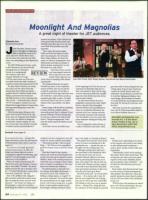
Glen Allen Pruett, Mary Wright Bremer, Joel Mitchell and Wayne David Parker
citrant Prissy for dawdling while Melanie
is giving birth.
The acting and direction are superb.
Mitchell does justice to the complicated
By the beginning of Act Two, the men are
goes from order to chaos during the five-day
persona of Hecht, who was not only the
exhausted and disheveled right down to
writing ordeal. Props by Diane Ulseth and
acclaimed screenwriter of such films as
their sweat-stained T-shirts, and the stage
costumes by Christa Koerner add to the
Scarface and The Front Page (and, later, Some is strewn with peanut shells and crumpled
authenticity. The production is rounded out
Like it Hot) but a noted director, producer,
pages torn from Hecht's typewriter by the
by Scott Ross' lighting and Matthew Lira's
journalist, playwright, novelist, civil rights
perfectionistic Selznick.
sound design, which includes the familiar
activist and Zionist, who tries to convince
The interaction between the men is
roar of the MGM lion and background music
Selznick of his responsibility to his fellow
delightfully counteracted by Mary Wright
from both The Wizard of Oz and Gone with
Jews.
Bremer, who plays Miss Poppenghul,
the Wind.
Parker brings to life the driven, bordering-
Selznick's efficient and long-suffering sec-
Allow time to peruse the comprehensive
on-manic Selznick, complete with his
retary. In a wonderful performance, she
Gone with the Wind memorabilia exhibit by
renowned ego and Type A+ behavior. Pruett
responds to her boss' constant and often
local collector Kathleen Marcaccio.
portrays Fleming as the hard-driving direc-
unreasonable commands with a pleasant
tor who has no patience for what he calls
"Yes, Mr. Selznick," even as her prim-and-
Moonlight and Magnolias runs
Hecht's "Chicago newspaperman" ethics
proper demeanor disintegrates along with
through Oct. 7 at the Aaron
when the writer protests the films portrayal
the others.
DeRoy Theatre in the JCC in
of slavery.
The set, designed by Adam Crinson, is
West Bloomfield. (248) 788-
As the days wear on, the battles ensue.
a replica of Selznick's studio office, which
2900; www.jettheatre.org .
REVIEW
❑
Feminist from page 61
to circumcise her sons — though after
some reservations, given the growing tide
of liberal Jewish critics who've come out
against it.
But she has increasingly gravitated
toward women's issues. In 2009, she
kicked up a storm when she wrote a
scathing piece against breastfeeding, argu-
ing that it was preventing women's full
immersion in the workforce.
When she began brainstorming The
End of Men piece, she founded a women's
site on Slate called "DoubleX." But Rosin
doesn't describe the site as feminist exact-
ly — "it's more like the news written from
a women's perspective," she said.
Part of the problem with calling her-
self a feminist is that she's acutely aware
that the gospel her essay, and now book, -
espouses — the women are taking over
the economy — may not be entirely a
good thing. If it results in men leaving the
64
September 27 * 2012
workforce and not coming back, then the
results for society could be catastrophic.
"The book is not like, 'This is a good
thing' — No! This is not an unqualified
good for women at any social level: Rosin
said.
What she's found is that, already,
women who work are not having the men
in their lives pick up the domestic respon-
sibilities. Many of the working women are
exhausted and, according to many studies,
about as happy (or unhappy) as they were
before they entered the workforce.
This phenomenon is especially true
in working- and middle-class homes —
described as those with residents not
holding a college degree, or roughly 70
percent of Americans. The result has been
the unprecedented rise in single-mother
homes, with women seeing men, to quote
Rosin, "as just another mouth to feed."
Increasingly, working women are choos-
ing to stay single, or choosing to divorce.
The gender and economic issues Rosin
raises, of course, are playing out in the
presidential race — mostly, she says, in
the fight over the working-class vote.
"Although working-class white men
have gravitated to the Republican Party
over the last 30 years, you can see
President Obama's efforts to win them
back by portraying Mitt Romney as an
alien rich creature who will not look out
for their jobs. Obama is trying to appeal
to the side of men that knows they need
some government assistance in this econ-
omy and can't always go it alone."
Her book, Rosin says, "is not just about
women — it's a clarion call to men. It's
time for us to expand the role of things
men can do" and to get men comfortable
with taking on roles once seen as gender-
driven — joining PTAs, doing the laun-
dry, taking (or at least asking) for parental
leave.
Perhaps more importantly, lower down
in the economy, men need to start taking
on jobs still perceived as feminine —
such as nurse, teacher, social worker and
homemaker.
"Theoretically, [men] can be anything
these days," Rosin writes in the book. "But
moving into new roles, and a new phase,
requires certain traits: flexibility, hustle
and an expansive sense of identity" — all
of which are traits that have proven elu-
sive to men.
Rosin makes clear that she doesn't want
to come across as a biased champion for
either gender. She values the critical and
analytic perspective more than the polem-
ical one. She sees a hint of her Jewishness
in that, too:
"With the Jews, the questions are always
open; we're always questioning," she says,
"I love that questioning tradition." ❑