

metro
Volunteer Extraordinaire
Mark Hauser earns Federation's highest award for his community involvement.
Israel was something that changed my
life. We met relatives who had survived
the Holocaust and made their way to Israel
with the help of our family and the Hebrew
Immigrant Aid Society. We had a wonderful
guide who took us everywhere in his rusty
1949 DeSoto. It was very hot, the food was
pretty bad, the roads were dusty and yet we
had the most remarkable time of our lives
because we felt the rebirth of our people in
our Homeland. As we walked the streets of
Tel Aviv, my mother kept saying in wonder
after looking at Yemenites, people from
India and even a few from Ethiopia ..."all of
these people are Jews!"
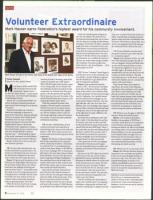
Mark Hauser at home in his library with some of the photos he's taken of his family.
Vivian Henoch
Special to the Jewish News
M
ark Hauser of Bloomfield Hills
will receive the Detroit Jewish
community's highest honor —
the Fred M. Butzel Award — at the annual
meeting Sept. 24 of the Jewish Federation
of Metropolitan Detroit.
Hauser, 69, is a community builder, vol-
unteer, fundraiser, financial steward and
legal counsel, listed among the best lawyers
in America.
From his first family trip to Israel in
1960 to his leadership in missions to
Israel, from Federation's Young Leadership
Cabinet to president of the United Jewish
Foundation and vice chair of United
Jewish Communities, from the Oak Park
Neighborhood Project to the Jewish
Community Center Applebaum Campus,
from Jewish Family Service to Jewish Senior
Life, from Temple Beth El to Yeshivas
Darchai Torah — there's hardly an aspect
of the Jewish community in which Hauser
hasn't had impact and a positive influence.
Hauser sat down for a one-on-one inter-
view shared in part here.
VII: You have often described your com-
munity involvement as sacred work in "the
Jewish survival business." In your view, how
has that business changed over the years?
And in what ways has it stayed the same?
Hauser: We grew up in the shadow of the
Holocaust, the bright lights reflecting from
the new State of Israel, three wars to keep
Israel alive, the challenge of freeing Jews
from the Soviet Union — all seminal events
that made it easy for young American Jews
of my generation to identify with the needs
for Jewish unity and creative survival. In
contrast, many young Jewish Americans
today are growing up past "all of that."
While the threat to Israel from its neigh-
bors remains as real today as ever, the
8
September 13 • 2012
economy in Israel is booming, most of the
country is beautiful and, while Israel is
filled with Birthright Israel travelers, many
of our young people do not identify with
the challenges facing Israel and the Jewish
community. As American Jews have pros-
pered, so has the pursuit of the good life
that at times has obscured the reality of the
needs of less fortunate Jews at home, in the
remaining Diaspora and in Israel.
What has remained the same is the
strength of Detroit's Jewish community.
We have lost some of our major donors,
but important new donors have stepped
up. And we continue to have a cadre of
upcoming leadership to take us forward in
our mission. We also have had wonderful
professional leadership.
VII: You have a family history of com-
munity involvement and a deep love of
Israel starting with a trip you took with your
family in 1960. Tell us about your first con-
nections with Israel and the organized Jewish
community.
Hauser: The Hauser and Baum families
had strong connections to the organized
Jewish community in Detroit. I remember,
as a child of 10 or 11, accompanying my
mother, Pearl Baum Hauser, as she did her
face-to-face Campaign "Kit" at various peo-
ple's homes. My Aunt Diane Hauser's father,
Israel Davidson, was one of the great local
Zionist supporters of Israel. I remember
him returning from a trip to Israel in the
middle 1950s where he told us that he met
[David] Ben-Gurion and was shown statues
that actually hid missile launchers.
Diane and Jerry Hauser returned from
one of the first UJA national missions to
Israel in the late '50s with great enthusiasm
and many slides of the young nation. That
led up to my parents, Myron and Pearl
Hauser, taking my sister and me to Europe
and Israel in the summer of 1960 following
my graduation from Mumford High School.
VH: The term "volunteer" doesn't begin to
describe your service to the community. Can
you identify a specific challenge or opportu-
nity that inspired you to get started on the
path of community leadership?
Hauser: Upon graduation from law
school in 1967, I was fortunate to be hired
by the firm of Friedman Meyers and Keys.
Many of the partners were stalwarts of the
Jewish community. The firm did some legal
work for Federation. So, I quickly learned
that the Allied Jewish Campaign was run
by the Jewish Welfare Federation. One day,
right after the 1967 War, firm client Tom
Borman, who was Campaign chair, stepped
into my office, introduced himself and said,
"Young man, you are at the right time and
in the right place to make a difference for
the Jewish people."
He invited me to participate, and I said
that I would. A few days later, his son Paul
D. Borman came into my office and told
me about Federation's Junior Division [later
named YAD and now NEXTGen]. Then, a
few weeks later, my dear and lifelong friend
Bill Barris, another firm associate, said, "I
don't know how involved you want to be,
but they would like you to join the Junior
Division Board." So, that was my start.
I did a great deal of work on Campaign,
learned about Federation and the agen-
cies, and eventually became an officer and
member of the Junior Division Executive
Committee.
Step two was in 1976, when Larry Jackier
convinced my wife, Jan, and me to join a
national UJA Young Leadership Cabinet
Holocaust to Rebirth Mission to Austria and
Israel. Jan had not been to Israel. We both
loved the trip, and I met these "Cabinet
Guys" from all over the U.S. who had a level
of commitment I had only seen in Larry
Jackier and Stanley Frankel. The next year,
my old friend Richard Krugel and I were
asked to join the Cabinet.
I had five exciting years during which I
spoke as the "outside expert" on campaign
solicitation to large groups in Boston and
Louisville, small groups in Saginaw and Bay
City, went on and/or led several missions to
Israel, visited Poland, including my grand-
parent's shtetl, and took on leadership roles
in Detroit. The Cabinet, in those days, was a
real force in organized Jewish life and gave
me many tools I have relied on for years.
VH: In your estimation, how has Israel
changed or evolved in terms of its needs for
our community support?
Hauser: In the summer of 2011, my wife
and I were fortunate enough to be able to
take our daughters Sandra and Molly, their
spouses and five grandchildren to Israel.
We enjoyed the nightlife in Tel Aviv, did
Saturday night in Jerusalem in the new
Mamilla Mall, and met and dined with old
friends and family members. The kids
loved playing soccer on the beach at night
with Israeli children and saw a prosperous
country with much history.
They learned about the rockets hit-
ting Sderot, the needs of the Ethiopian
immigrants, the complaints in the middle
class about social inequality, but really
did not see what I saw in 1960. On one
hand, that is great because Israel is thriving
and I think my grandchildren "get it." On
the other hand, Israel's long-term survival
is as precarious as ever it has been. Our
Federation's commitment to Israel must
remain strong and without qualification.
VH: What are your thoughts on NEXTGen
and your dreams for Detroit's future?
Hauser: I am so pleased that Marty
Maddin is the president of NEXTGen. I
remember clearly that the 1971 Federation
Junior Division nominating committee
meeting was held in my office in Southfield
one evening where we nominated his father,
Michael Maddin, to be the next president.
In the Maddin family, the apple does not
fall far from the tree. My hope is that we
can continue to raise future generations
who understand the importance of chari-
table giving and Jewish survival.
VH: What do you do in your leisure time?
Hauser: My wife says that four things are
important to me: my family, my business,
Jewish survival and Michigan football. As
usual, she is right. Over the years, I have
enjoyed photography, primarily of our
children, grandchildren and of our friends.
I also like to read. Our home, as were the
homes of my parents and grandparents, is
filled with books. __I
Federation's annual meeting will be held Sept.
24 at 7:30 p.m. in Handleman Hall at the
Jewish Community Center in West Bloomfield.
Vivian Henoch is Web content developer for
Federation. The full interview can be viewed at
myjewishdetroit.org.