

arts & entertainment'
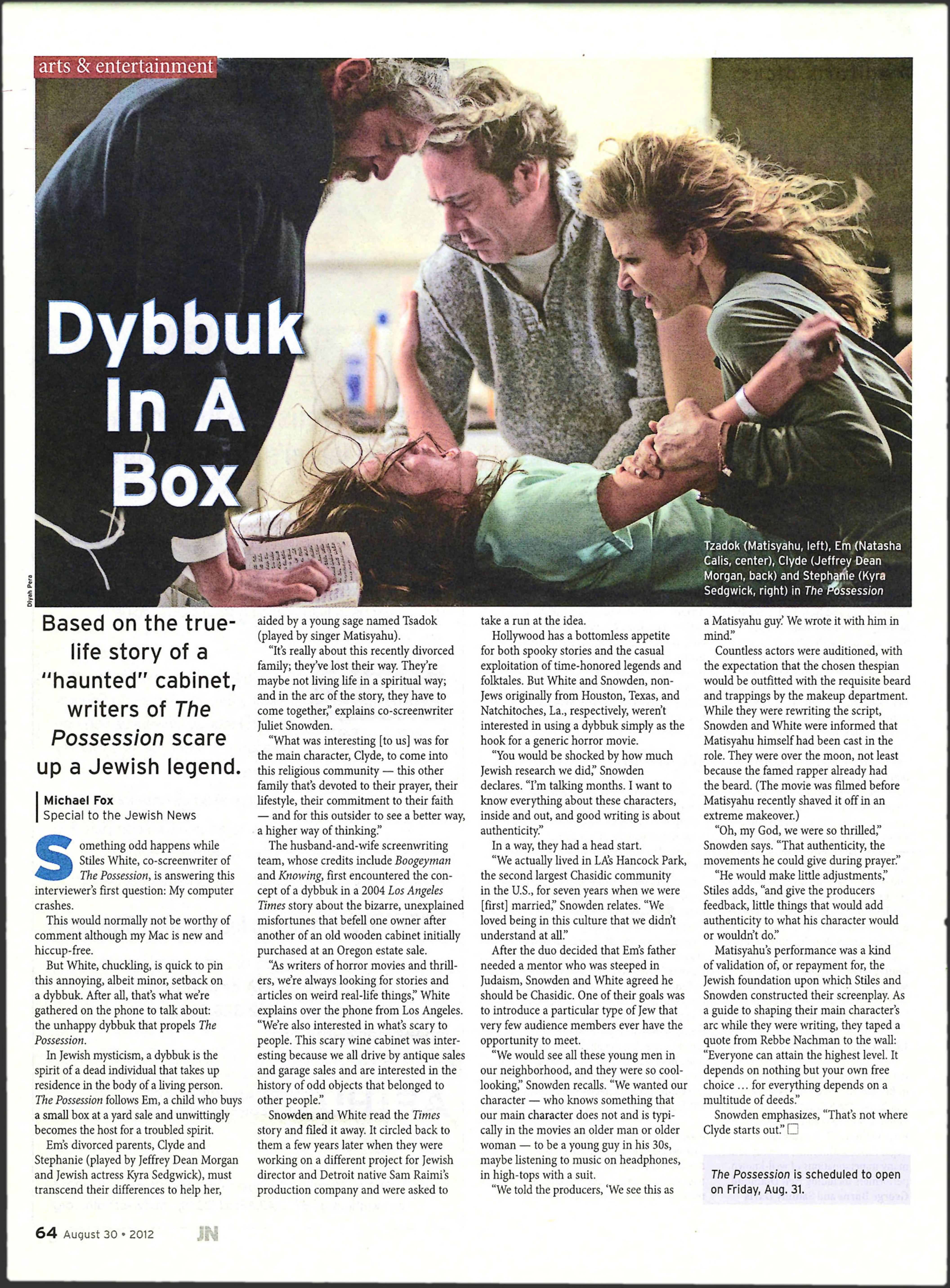
Tzadok (Matisyahu, left), Em (Natasha
Calls, center), Clyde (Jeffrey Dean
Morgan, back) and Stephanie (Kyra
Sedgwick, right) in The possession
Based on the true-
life story of a
"haunted" cabinet,
writers of The
Possession scare
up a Jewish legend.
Michael Fox
Special to the Jewish News
S
omething odd happens while
Stiles White, co-screenwriter of
The Possession, is answering this
interviewer's first question: My computer
crashes.
This would normally not be worthy of
comment although my Mac is new and
hiccup-free.
But White, chuckling, is quick to pin
this annoying, albeit minor, setback on
a dybbuk. After all, that's what we're
gathered on the phone to talk about:
the unhappy dybbuk that propels The
Possession.
In Jewish mysticism, a dybbuk is the
spirit of a dead individual that takes up
residence in the body of a living person.
The Possession follows Em, a child who buys
a small box at a yard sale and unwittingly
becomes the host for a troubled spirit.
Em's divorced parents, Clyde and
Stephanie (played by Jeffrey Dean Morgan
and Jewish actress Kyra Sedgwick), must
transcend their differences to help her,
64
August 30 • 2012
aided by a young sage named Tsadok
(played by singer Matisyahu).
"It's really about this recently divorced
family; they've lost their way. They're
maybe not living life in a spiritual way;
and in the arc of the story, they have to
come together;' explains co-screenwriter
Juliet Snowden.
"What was interesting [to us] was for
the main character, Clyde, to come into
this religious community — this other
family that's devoted to their prayer, their
lifestyle, their commitment to their faith
— and for this outsider to see a better way,
a higher way of thinking"
The husband-and-wife screenwriting
team, whose credits include Boogeyman
and Knowing, first encountered the con-
cept of a dybbuk in a 2004 Los Angeles
Times story about the bizarre, unexplained
misfortunes that befell one owner after
another of an old wooden cabinet initially
purchased at an Oregon estate sale.
'As writers of horror movies and thrill-
ers, we're always looking for stories and
articles on weird real-life things:' White
explains over the phone from Los Angeles.
"We're also interested in what's scary to
people. This scary wine cabinet was inter-
esting because we all drive by antique sales
and garage sales and are interested in the
history of odd objects that belonged to
other people!'
Snowden and White read the Times
story and filed it away. It circled back to
them a few years later when they were
working on a different project for Jewish
director and Detroit native Sam Raimi's
production company and were asked to
take a run at the idea.
Hollywood has a bottomless appetite
for both spooky stories and the casual
exploitation of time-honored legends and
folktales. But White and Snowden, non-
Jews originally from Houston, Texas, and
Natchitoches, La., respectively, weren't
interested in using a dybbuk simply as the
hook for a generic horror movie.
"You would be shocked by how much
Jewish research we did," Snowden
declares. "I'm talking months. I want to
know everything about these characters,
inside and out, and good writing is about
authenticity."
In a way, they had a head start.
"We actually lived in LAs Hancock Park,
the second largest Chasidic community
in the U.S., for seven years when we were
[first] married:' Snowden relates. "We
loved being in this culture that we didn't
understand at all."
After the duo decided that Em's father
needed a mentor who was steeped in
Judaism, Snowden and White agreed he
should be Chasidic. One of their goals was
to introduce a particular type of Jew that
very few audience members ever have the
opportunity to meet.
"We would see all these young men in
our neighborhood, and they were so cool-
looking," Snowden recalls. "We wanted our
character — who knows something that
our main character does not and is typi-
cally in the movies an older man or older
woman — to be a young guy in his 30s,
maybe listening to music on headphones,
in high-tops with a suit.
"We told the producers, 'We see this as
a Matisyahu guy.' We wrote it with him in
mind:'
Countless actors were auditioned, with
the expectation that the chosen thespian
would be outfitted with the requisite beard
and trappings by the makeup department.
While they were rewriting the script,
Snowden and White were informed that
Matisyahu himself had been cast in the
role. They were over the moon, not least
because the famed rapper already had
the beard. (The movie was filmed before
Matisyahu recently shaved it off in an
extreme makeover.)
"Oh, my God, we were so thrilled,"
Snowden says. "That authenticity, the
movements he could give during prayer!'
"He would make little adjustments:'
Stiles adds, "and give the producers
feedback, little things that would add
authenticity to what his character would
or wouldn't do."
Matisyahu's performance was a kind
of validation of, or repayment for, the
Jewish foundation upon which Stiles and
Snowden constructed their screenplay. As
a guide to shaping their main character's
arc while they were writing, they taped a
quote from Rebbe Nachman to the wall:
"Everyone can attain the highest level. It
depends on nothing but your own free
choice ... for everything depends on a
multitude of deeds."
Snowden emphasizes, "That's not where
Clyde starts out."
❑
The Possession is scheduled to open
on Friday, Aug. 31.