
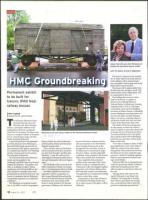

Above: Henrietta and Alvin Weisberg are
funding the permanent boxcar exhibit.
Left: The boxcar arrived in September.
Permanent exhibit
to be built for
historic WWII Nazi
railway boxcar.
Mike Ingberg
Special to the Jewish News
T
he Holocaust Memorial Center
broke ground Aug. 29 on the
Henrietta and Alvin Weisberg
Gallery, a permanent addition to the
building that will house an authentic
World War II-era boxcar. The Nazis used
boxcars to transport millions of European
Jews to concentration camps and their
deaths during the Holocaust.
A generous gift from local philanthro-
pists Henrietta and Alvin Weisberg of
Bloomfield Hills funds construction of
this permanent HMC gallery, expected to
be completed late this fall. The Weisbergs'
gift also is being used toward a perma-
nent education endowment.
"All of us at the Holocaust Memorial
Center are very grateful to the
Weisbergs," said HMC Executive Director
Stephen M. Goldman. "This gallery will
allow us to display an object of great
significance and will help fulfill our pri-
mary mission to remember those who
perished and survived the Holocaust. The
boxcar is'a reminder that the Holocaust
was genocide organized as an industrial
enterprise."
The Weisbergs are longtime benefac-
tors to the HMC as well as Congregation
12
August 30 • 2012
Rendering of the new boxcar exhibit at the Holocaust Memorial Center
Shaarey Zedek, the Jewish Federation
of Metropolitan Detroit and Beaumont
Hospital, among others.
"Every survivor who sees the boxcar
will be reminded of the fear and atroci-
ties they lived through," said Henrietta
Weisberg. "I want the world to know
what happened during the Holocaust so
that such inhumanity will never happen
again:'
The Weisbergs will be honored at the
HMC's Anniversary Dinner on Sunday,
Nov. 11, at Congregation Shaarey Zedek.
The HMC acquired the boxcar last
September with the cooperation of
the German National Railroad and the
Technical (Railroad) Museum in Berlin.
Restoration and conservation of the
boxcar is being funded by the German
government, Goldman said. Believed to
be one of the last in existence and the
only one exported to the United States
from Germany, boxcars such as this
transported Jews and other victims of
the Holocaust to concentration camps.
Forced to endure crowded, deplorable
conditions, many perished in the boxcars
before they reached their destinations.
Once completed, this permanent
exhibit will be composed of the boxcar
placed on rails in a cobblestone plaza,
reminiscent of the Umschlagplatz (gather-
ing point) in the Warsaw Ghetto where
Jews and other victims of the Holocaust
were gathered to be transported to killing
centers or slave labor camps.
Among those in these type of boxcars
were Henrietta Weisberg and her fam-
ily, in whose memory this gallery will be
dedicated.
The boxcar is expected to be installed
Oct. 8. Glass walls on the north and east
of the addition will be removed and a
new roof added. And the glass wall to the
lobby will be moved outward.
The boxcar will be approachable from
all sides and close enough to touch. This
silent sentinel, itself a killing place, will
be a memorial for all to see.
The building that serves as a back-
drop for the boxcar is a replica of
Hannoverscher Bahnoff (Hanover
Railroad Station) in Hamburg, Germany,
originally built in 1872 as a passenger
terminial for trains between Hamburg
and much of Eastern Europe. It ultimately
became Hamburg's main deportation site
for Jews and Roma and Sinti (Gypsies).
Often it served as a switching station to
add boxcars loaded with Jews and other
victims of the Nazis from other cities.
The exhibit will be the starting point
for the journey on which the visitor is
about to embark to learn about Jewish life
in Europe, the rise of Nazism and libera-
tion and resettlement just as the ghetto
plaza and the station were embarkation
points for Jews and other victims of the
Nazis to their fates.
"To be able to display an object of such
great significance at our center helps us
fulfill our mission of not only remem-
bering those who perished and survived
the Holocaust, but also using this tragic
period as a model for teaching righteous
behavior and responsible decision-mak-
ing," said Goldman.
While the HMC has a simulated boxcar
within the permanent exhibit, Goldman
added that having this genuine item
affects people in a way that no other arti-
fact can.
"Hearing about what went on dur-
ing the Holocaust is one thing," said
Goldman, "but being able to actually
show visitors, particularly the younger
ones, actual physical objects from this
period is an extremely powerful toe' ❑