

rr
k r
M
il
l!
-
Moving To America
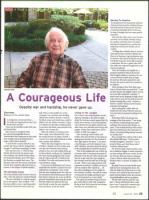
Samuel Katz
A Courageous Life
Despite war and hardship, he never gave up.
Sue Pearl
Special to the Jewish News
I
'm living here on borrowed time ...
I'm really not supposed to be alive, but
thank God I am here'
These are the heartfelt words of 84-year-
old Samuel Katz.
Katz was just a young boy when
he endured unimaginable horrors.
Unbelievably, these experiences only made
him stronger and more determined to
make a better life for himself.
"I came to this country with $5 in my
pocket, but I knew that if I worked hard
enough, I could have everything," he said.
Katz was born Oct. 5, 1928, in Iwie,
Poland. He lived with his parents and
three siblings. The family enjoyed their
old-fashioned lifestyle until 1939 when
the Russians occupied their town. The
Russians took over the schools and insist-
ed that their people be allowed to live as
tenants in the homes of Jewish families.
The Germans Come
The living situation only became worse in
1941, when the Germans invaded Poland.
"We were told that we could no longer
live in our homes," Katz recalled. "The
German soldiers came in and demanded
that all the Jewish men meet in the city
hall. There, in the middle of a crowd
of people, was a German man deciding
which Jews would be chosen to work in
the labor camps and which Jews would be
killed. I saw my mother and sister crying,
so I asked if I could take my father's place.
I was sent to the labor camp instead of my
father. I was 13 years old.
"After six months of working in the
labor camp, I was informed that I was
too young and was no longer needed. I
was put on a train with hundreds of other
men, women and children.
"When the train stopped in the town
of Wilno, I looked out the window and
saw that the Germans were putting
people in box cars and sealing them up
so that nobody could get out. Suddenly,
the train started going fast and I knew
that if I did not get off, I would surely
be killed. The train was headed for the
concentration camps.
"I was near the bathroom and I ran in
and broke the window. I jumped out and
rolled down a mountain. I was so fast
that the men standing above the train on
the mountain with machine guns did not
have time to shoot at me. I got up off the
ground, immediately removing my jacket
with the yellow star [that all the Jews
were forced to wear for easy identifica-
tion] and threw it into the trash:'
Living In The Jungles
For 10 days, Katz walked barefoot on the
highway, sleeping in the fields at night,
afraid the Germans would capture him. He
finally met someone in one of the ghettos
who told him that his father, brother and
older sister were still alive and living in the
jungles. (Sadly, Katz would never see his
mother or little sister again.)
After reuniting with his father and
brother, Katz joined them in becoming an
underground partisan for the Russians in
their fight against Germany. "I was given
a machine gun, and I did whatever I was
told:' said Katz, who knew that if he did not
do his job properly, he would be executed.
"One of my assignments was to blow up
a German train. I was given 40 pounds of
dynamite to do the job. I blew up the train
and ran to get away, but I got caught by
the Germans and they shot me in the leg:'
he said. "There I was, lying in blood with
a grenade in my hand. I pulled out the pin
and was ready to blow myself up ... I'd
have done anything not to be caught by
the Germans. Luckily, I was able to escape,
running into the jungle, putting the pin
back in the grenade as I ran to hide."
Katz spent six months living in the jun-
gle, barely able to walk while waiting for
his leg to heal. By the time he had recuper-
ated, the war was finally over.
Traveling back to his hometown (still part
of Russia); Katz found his childhood house
had been burned to the ground. He knew
it would be impossible to live in the area
for long. It brought back too many painful
memories.
Katz and his older sister were the lone
survivors in his family. Besides losing
his mother and little sister, his father
had died of typhoid fever, and he had
helplessly watched his brother die in
combat.
Deciding they wanted to live in America,
Katz and his sister traveled to Poland and
then on to Germany to get permission to go
to America. Katz stayed in Munich one year
to help the American Army still occupying
a camp there. He met a captain who took
him under his wing and brought him to the
American embassy.
There he found he was eligible for a
program headed by Eleanor Roosevelt
that brought orphans to America. He was
contacted three months later to begin
his journey. (His sister joined him later
because she was too old to be considered
an orphan).
After arriving in New York, Katz took a
train to Detroit where an uncle lived. "I may
not have known any English when I arrived,
but I was full of ambition," said Katz. "I
tried to pick up the language in high school.
I also went to work for my uncle at his fruit
market, making $40 a week. I worked as
hard as I could to advance in the business
and learn the language:'
After working for a while, Katz was
drafted into the Army. When he returned
two years later, he resumed working for his
uncle.
By the late 1950s, Katz became the
manager of the fruit market. "I was doing
so well that I started dating fancy girls,"
said Katz, who met his wife, Sharon, at a
party. "I was actually fixed up with another
girl, but I looked across the room and saw
Sharon. We started dating and got married
six months later"
Katz currently lives with his wife in their
Bloomfield Hills home. "We have three
beautiful daughters:' said Katz. "I am so
proud of them, and I don't know what I
would do without them:'
For 30 years, Katz owned a produce mar-
ket in Madison Heights. It wasn't unusual to
see him working 100 hours a week. For the
last 18 years, Katz has owned a shopping
center in Warren where his present store,
Produce Palace, is located. It employs 140
people.
Recently, because of some health issues,
Katz has been working fewer hours. His
wife now helps him at the store on a regu-
lar basis. As a result, he has more time to
spend with his family, which also includes
six granddaughters and one grandson.
"All my hard work has paid off' said
Katz. "I always did the best that I could.
Since I was 13 years old, I wanted to live ...
I knew that I would never give up!"
❑
IN
August 23 • 2012
29