

. _
liCui ll ail No, rth ...24 Om ; lips
L=EETFI ;rat ,11111leionigflippnit '
iju — ql$REMLsil l - l aslairl i r m ilioNda rt ‘
NI
17,
so . g:Pfr. : 14
4,E 1EaLl
' 1 ; 1E
E.Ilk
a L:
liti , . dgl t
i iceli,
ea
'rciLilii /
■ L 1.;.iii t ear 3 Oil
C' :1 iv-1EL L'- L 7_111 BEIE,Gt 3,1mA
;
0 , 4 , i ;., ,
:
.11
. up, t0. 1:_i I
r irf m It6 ; 11
17-1 ,11_ 1 ro t , s'E
r - ti,,,-E,N1 ,'1/4-ip
It ' 1,2r4 1-'
-
ri
i
.E.,
4 7,117 '
,.,.
tA '
7_.E1
Arz,
11;*.
riiispw
Lt"VillikP.6'M.IM4-/
- : -Iv , • 7 b.1", ■ 4- T
■
IF, 1 id
1
-EiF71
r
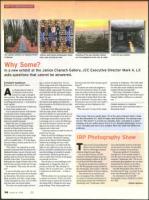
The Jewish cemetery on Okopowa Street Visitors amid family photographs stolen
in Warsaw
from Jews arriving by train
Standing at the gas chamber, looking
out from Majdanek at the city of Lublin
Inside the gas chamber
Why Some?
In a new exhibit at the Janice Charach Gallery, JCC Executive Director Mark A. Lit
asks questions that cannot be answered.
Elizabeth Applebaum
Special to the Jewish News
A
s a theater director, Mark A.
Lit learned to look at every,
moment on stage as though it
were a picture. The colors, the shapes, the
sounds, the mood and the placement of
everything and everyone — it all needs to
work together.
As an artist, he knows how to find beau-
ty where none seems to exist.
And as executive director of the Jewish
Community Center of Metropolitan
Detroit, he has mastered dealing with the
challenges of running a nonprofit organi-
zation in a painful economy.
Earlier this year, Lit, along with JCC
Vice President Carol Weintraub Fogel,
traveled to Poland and Israel on a trip,
sponsored by the Jewish Community
Centers Association of America, which
included visits to many Nazi death camps.
Along the way, he took photos that
will be on exhibit Sept. 1-27 at the Janice
Charach Gallery, located inside the JCC in
West Bloomfield.
"Why Some?" was inspired by an early
moment on the trip when Lit stood in the
Majdanek bunkers, one set of harsh wood-
en bunks next to another and another and
another, and was struck by the incompre-
hensible truth of fate. "It was that ghostly
feeling that the Angel of Death came to this
bed and this one, but not that one he says.
He wondered: "Why some, but not oth-
ers?"
It was an idea that came to life not only
with the name of Lit's show but in the pho-
tos themselves. The pictures are mostly
black and white, but often a single image
or idea will appear in color: one red-white-
and-blue shoe, one brown bunker.
The colors are usually bright and invit-
56
August 16 • 2012
ing, a contrast Lit appreciates. To see a
sharp-orange earth and vivid-green leaves
surrounding bare trees in a forest_just
behind a death camp reveals "the richness
of outside life and the [prisoners'] impos-
sible desolation at the idea of ever getting
there Lit says.
Lit's first camera was a Brownie, but on
this trip he went digital and edited the
photos mostly on his iPad on the bus trips
around Poland.
Each one of Lit's skills came into play
when he took a photo. With his back-
ground in theater, he could quickly size up
what would work visually; as an artist, he
could design and produce a picture that
is stunning, even in a place like Birkenau;
and with his business acumen, he could
approach the project with necessary
restraint and a clear head.
"I used my camera as a kind of screen to
protect me he says.
Where he did find challenges was keep-
ing track of time. Absorbed in taking a
picture of the Warsaw Ghetto Memorial,
cluttered by buildings but bone-white
under a clear moon, Lit waited until the
light was just right and no one was in the
picture, and then considered how to elimi-
nate the buildings (eventually he simply
erased them). Finally he got the shot —
only to realize that everyone in the group
was already on the bus.
That decision to erase buildings in the
background, or change the colors of a
picture, at times felt "like cheating;' he
admits. "But to an artist's soul — not that
I really have an artist's soul — it feels so
right."
With his photos, he was aiming, he says,
to express an emotion: "You're out of the
moment trying to capture the moment so
that others feel it," though he never stop-
ping thinking: "How many people were
burned in that oven that I just got a good
shot of?"
The photos are stark and poignant: a
bird on the barbed wire fence of a death
camp; the statue of Janusz Korczak, who
chose to die with the orphans in his care;
the back side of Arbeit Macht Frei at the
gates of Auschwitz ("because this is what
the prisoners saw once they were inside");
and looking out from Majdanek to the
nearby town.
"That was eerie Lit says of the camp's
proximity to civilization. "We could smell
the smoke from the city so can you imag-
ine what [the town's residents] must have
smelled with the burning flesh."
"Why Some" will feature 52 photo-
graphs and, following its time at the Janice
Charach Gallery, will leave on a national
tour. ❑
Elizabeth Applebaum is a marketing
specialist at the Jewish Community Center of
Metropolitan Detroit.
"Why Some" will be on exhibit Sept. 1-27 at the Janice Charach Gallery, inside
the West Bloomfield JCC, 6600 W. Maple, West Bloomfield. The opening recep-
tion for "Why Some?" is at 6:30 p.m. Saturday, Sept. 1, preceded by a patron
reception at 6 p.m. Gallery hours:10 a.m.-5 p.m. Mondays-Wednesdays, 10 a.m.-
7 p.m. Thursdays and noon-4 p.m. Sundays. More info: (248) 432-5579; www.
jccdet.org .
IRP Photography Show
T
hese are not your grandparents'
photos. No out-of-focus travel
shots or 100 images of grand-
children doing the same thing.
For more than 20 years, the IRP
(Institute of Retired Professionals) has
hosted photography exhibits at the JCC
in Oak Park and West Bloomfield.
The photos are taken by members of
the IRP Photography Group, headed by
Ron Hamburger, and include a collection
of memorable photos of diverse subjects.
"Our pictures are as varied as any-
one can imagine, from colorful des-
ert sunsets to historical architecture to
interesting portraits and vivid flowers,"
Hamburger said. "Landscapes, reflec-
tions and beautiful scenery of all kinds
can be seen in our shows. We also find
humor in a number of our pictures."
The group includes 6-10 members,
and ages run "from recently retired to
over 90, and we are always open for new
members:' Hamburger said. "We are not
professional photographers, but we enjoy
seeing what the camera can do with a
keen eye and an open mind behind it."
The IRP Photography Show will be at
the Oak Park JCC Aug. 31 to Sept. 30 and
at the West Bloomfield JCC Nov. 1-30.
For information about the IRP
Photography Group, call the JCC at (248)
967-4030.
- Elizabeth Applebaum