

The most important things
Dr. Richard Keidan puts
his profession and faith
to work in Nepal
By jack Lessenberry
There are well-educated, affluent and well-
connected people in Michigan today who
share a bond with hundreds of primitive
villagers thousands of miles away in remote
rural eastern Nepal.
They all owe their lives to Richard Keidan,
M.D., who spends nine months a year
performing delicate cancer surgery at
Beaumont Hospital in Royal Oak. But every
three months or so, he flies off to one of
the world's most forbidding places. He
climbs mountains and trudges into Nepal's
primitive Khotang region.
There he endures stiff winds, pitches a tent
and spends a month or so at a time with
Nepalese villagers, among some of the
poorest people in the world. You might
expect he would be doing cancer surgery,
a quest to figure out in
what direction to take
his life.
Keidan came back
and built a stunningly
successful career as a
surgical oncologist. He
has published dozens
of articles in medical
journals, and is a
professor of surgery
at both Wayne State
University and Oakland
University's new medical
school.
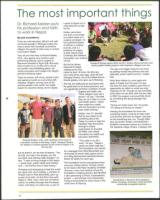
Namgyal Sherpa (green shirt) and Dr. Keidan discuss present and
But he has always
future public health projects with Nepalese villagers over tea.
returned to Nepal,
"You get a far bigger bang for your buck
walking across that
by putting money into primary care and,
nation at least 18 times. His life's big
especially,
public health services," Keidan
turn came three years ago, when he met
says.
Namgyal Sherpa, one of the fabled Mount
Everest guides, who grew up in Khotang.
What drew Keidan to come again and
The tall, fair-skilled doctor journeyed with
his guide back to his home province, and
saw appallingly primitive conditions of both
hygiene and health care.
"Most villagers never see a
doctor," he says. "The best
they can do is hike to a rural
'sub-health station,' where
there might be a medic
with the equivalent of a few
years' basic training."
Keidan, now 57, decided
that he was meant to do
something about this.
Today, he works to help the
Nepalese help themselves
through a unique
organization he founded,
the Miles Levin Nepal
Foundation for Health and
Education (MLNFHE).
again to Nepal over the years, he says,
was that the stark conditions gave him an
opportunity to reflect on what was truly
important in life. Though he had met Miles
Levin when he was alive, after the boy died
in 2007 the surgeon was powerfully struck
by something the dying teenager had
written.
"Dying isn't what scares me," he wrote.
"It's dying and having no impact."
Naming the foundation for Levin was
something Keidan could do to help make
sure the boy did have an impact. Last year,
he did something else, too. Though Miles
also was Jewish, Keidan commissioned a
Buddhist monument known as a chorten in
the Nepalese village of Bane. A plaque with
Richard Keidan, M.D., and members of his team at
Lamidada Airstrip in Khotang, Nepal. Namgyal Sherpa,
Dr. Keidan's constant partner in his work in Nepal, is at
the far left.
but he doesn't, for the best of reasons. "You
do that, you help a few people, yes. But
you leave, and nothing really changes," he
says. "I want to bring change to this region
— good, basic, public health and medical
care — for the first time in their history."
Changing and attempting to heal the world
are values with which Keidan, a member of
Temple Israel in West Bloomfield, grew up
as part of his faith. He first fell in love with
Nepal in 1983, when, fresh out of medical
school, he trekked through that Himalayan
nation with Betsy, his wife-to-be, as part of
4
"This really is my life's
work," he says. "Nepal is
where my heart really lies."
The foundation was named
for a teenager from West Bloomfield who
chronicled his heroic fight against cancer
on a blog that became nationally famous
before his death five years ago.
The foundation has far more projects than
resources, Keidan admits. Perhaps closest
to his heart is the Patan Academy of Health
Sciences, a new rural medical school the
foundation is helping sponsor. But MLNFHE
is also sponsoring a school, a hydroelectric
project — and perhaps most importantly,
trying to bring toilets to every house in the
small town of Dipsung.
-a, •
Detail from a mural in the hospital in
Diktel, Khotang, showing a nurse-midwife
examining a pregnant patient.