
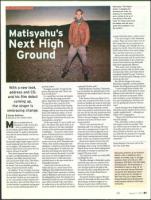

Matisyahu: "The 'Spark
Seeker' is digging and
searching for truth, for
meaning, for inspiration
and is willing to let go of
everything to find that
truth. To create music from
the depths and not worry
about what category is on
the surface."
With a new look,
address and CD,
and his film debut
coming up,
the singer is
embracing change.
George Robinson
Special to the Jewish News
M
ake no mistake about it:
Matisyahu is still a serious Jew.
Even a casual hearing of
his new album, Spark Seeker, which was
released on July 17, makes it abundantly
clear that his Jewish identity is at the cen-
ter of his art.
"It's a very important part of who I am:'
the popular reggae singer-rapper said in a
recent telephone interview from his home
in Los Angeles. "My inspiration comes
from it. It gave form to my music. It's very
much a real part of my life'
There have, however, been some chang-
es made. Last fall Matisyahu, 33 and born
Matthew Paul Miller, shaved his beard
and cut his peyot (side curls). That choice,
he admits, "was a little scary at first, to
be honest." And it was headline-grabbing
news, at least in the Jewish media.
He explains: "It was no longer necessary
to show people that I'm spiritual or Jewish
by my outward appearance. Growing up,
the way that I looked was very important
to me. I was always trying to impress peo-
ple, and when I grew my beard there was a
certain freedom, a separation, getting past
the way I looked, identifying myself as a
spiritual seeker."
He laughs and adds, "I looked in the
mirror afterward and said, `There's my
face; it's still there:"
It is a good face, too, lean and angular.
In one of the key songs on the new
album, "Baal Shem Tov," Matisyahu writes,
"It's your life to live; I can't live it for
you." But if you ask him if that warning
is intended for overzealous fans who are
unhappy with his new look or his earlier
break with Chabad, he replies, "A lot of
these lyrics were written before I made
these changes. It shows how the lyrics are
coming from a new place."
On the other hand, it is not a totally new
place. The album title, Spark Seeker, is an
obvious reference to the idea embedded
in much of the Jewish mystical tradition
of Kabbalah — the need to collect those
sparks of holiness that were scattered in
the original act of Creation.
"The title has a kabbalistic reference
as does a lot of my stuff:' Matisyahu says.
"When I first started reading about the
kabbalists, I would hear about them being
seen in strange places. It would turn out
that they were doing some kind of spiri-
tual work to elevate the sparks. In my life
and career, I've had the opportunity to
find myself where I could make some
spiritual moves, to do some work that is
spiritually important"
At least one of his fans in the rab-
binate concurs. In a recent issue of the
Huffington Post, Rabbi Yonah Bookstein
writes, "Spark Seeker represents a continu-
ation of Matisyahu's personal journey and
his independent streak. The changes he is
showing the world are part of his spiritual
quest and are fueled by the same desire
for authenticity as the call that led him to
avoid the world of materialism and toward
a spiritual Chasidic path."
Rabbi Bookstein concludes, "Matisyahu
has not forsaken his spiritual quest or the
Judaism that has inspired him on his jour-
ney so far."
If the themes of the new album (its 13
tracks were recorded in New York, LA and
Israel) are familiar, the sound is somewhat
less so. As has been the case for each of his
previous recordings, Matisyahu worked
with a new producer and production team,
this time the hot hip-hop majordomo Kool
Kojak (Nicki Minaj, Travis Barker, Ke$ha).
There's a lot more singing, a denser, more
textured sound and a bit more main-
stream pop feel.
"This is a new direction for me
Matisyahu said."I'm working with a pro-
ducer who is younger, more of a peer. He
comes from the same background as me.
Doing the album was more like meeting
with a friend, making beats and writing
hooks. So this was a real fun record for me."
However, he admits, the tour that will
fill most of his summer and early fall,
including a stop on Aug. 5 at the Fillmore
Detroit, draws on his usual working band
and makes no attempt to reproduce the
sound of the new record.
"Live and in the studio are totally differ-
ent things:' he says.
The other change in Matisyahu's profes-
sional life may come as a surprise to his
fans, but for him it is a return to what he
once thought would be his path in life:
He makes his film acting debut later this
summer in the Jewish-themed horror
movie The Possession.
Directed by Danish suspense film spe-
cialist Ole Bornedal, the film stars Jeffrey
Dean Morgan and Kyra Sedgwick as a
divorced couple whose child has been
visited by an ancient curse. Appropriately
enough, Matisyahu plays a rabbi-exorcist.
"I was into acting as a kid:' Matisyahu
reveals. "There was a time when I was 18
that I played the boy in a production of
Equus in Oregon, and I thought that was
going to be my life. I have been busy and
haven't had a chance to do much acting;
this is my first crack at it in 15 years."
Many artists who moved between the
worlds of pop music and the movies have
found commonalities in the creative pro-
cesses of the two forms, but Matisyahu
finds them significantly different.
"With music you're working with a
producer, and you walk out of the studio
six hours later with a track that's almost
completely finished': he says. "There'd an
almost immediate payoff. Making a movie
doesn't go that way."
But with the changes in his music,
Matisyahu recognizes a certain similarity
between the acting process and his day job.
"I never thought about it before, but
now I'm in a place where there's so many
different voices with which I can rap or
take on characters in my music. When
you're acting in a scene, feeling the emo-
tion, you are getting into character, and
now I'm getting into character with my
voice."
Despite leaving Crown Heights behind,
Matisyahu davens regularly in his new Los
Angeles neighborhood — although not
always with a congregation.
"I daven with God these days:' he says
only half-jokingly.
Then, referring to a throat condition
that required vocal rest, he adds, "This
year I had to learn to be silent for a couple
of months, and I had to learn how to
daven silently. It's hard for me to do that
in a shul when I'm around a lot of people.
But you grow, you learn new ways of
expression." ❑
George Robinson is the music critic for the
New York Jewish Week.
Matisyahu performs at the Fillmore
Detroit, with co-headliners Dirty
Heads, on Sunday, Aug. 5. All ages
welcome. Doors at 6:30 p.m. 2115
Woodward. $25-$40. (313) 961-5451;
livenation.com . The Possession is
scheduled to open on Aug. 31. To
see an interview George Robinson
conducted with Matisyahu follow-
ing his recent set for YouTube in
New York City, go to http://www.
thejewishweek.com/videosnewish -
weeks-george-robinson-interviews -
matisyahu.
August 2 2012
51