

Making your own
wine is sure to leave
ou i high spirits.
Louis Finkelman
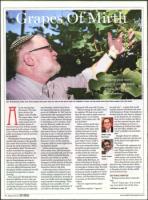
Zev Wrotslaysky looks over some grapes that grow onto his side of the fence from his neighbor's house. He has made wine from these grapes over the years.
1:11
h, the waning days
of summer. The days
grow shorter, the
nights cooler. Finally,
the grapes ripen. Local
winemaking enthu-
siasts prepare for yet
another season of
home brewing. One of those oenolo-
gists (experts in the science of wine)
is Zev (Victor) Wrotslaysky, a certified
public accountant in private practice
in Southfield.
Wrotslaysky's winemaking hobby
started with a memory. His grandfa-
ther made wine at home in Chicago
during the Great Depression. When
his grandfather died, Wrotslaysky's
mother inherited the equipment.
It sat unused, but not forgotten, for
years. When Wrotslaysky moved
into his home in Southfield 25 years
ago, he found grapes growing on
the fence. His next-door neighbor,
a dentist, was retiring from making
wine and offered Wrotslaysky both
the grapes and his equipment as well.
So started an adventure in home
brewing.
Now, each year Wrotslaysky brews
dozens of gallons of wine. One year
he makes a sweet Concord, the favor-
ite of his "customers" (lucky friends
and family who get most of the wine
as gifts). The next year, he makes his
48 August 2012
I RED MAD
own favorites, varietal wines from
the classical European wine grapes
grown in California. In "his" year, he
experiments with copying the finest
commercial wines available, such as
a rich, ruby-red Cabernet Sauvignon,
or developing a new variation, such
as a dry Muscato, unlike the sweet
Muscato you can buy in stores.
Rabbi Chaim Cohen of Oak Park
also makes dozens of gallons of wine
each year to give to friends and fam-
ily. In his professional life, Cohen
directs the David Hermelin ORT
Resource Center ofJVS, teaching
computer skills to underemployed or
unemployed people.
Cohen started many years ago
with a raisin wine. His first sample
came out reasonably well, and he was
hooked. When he told his friends
about his new hobby, he quickly
inherited old winemaking tools that
belonged to Rabbi Shalom Goldstein,
the late principal of the Beth Jacob
School for Girls in Oak Park.
In the years since, Cohen has tin-
kered, modified and replaced some
of this antique equipment as he has
increased his production. Actually, he
says, you hardly need any equipment
to get started in winemaking. "Wine
making is very accessible. It is all
about basic chemistry and biology. If
you follow a few basic rules, some-
am just lazy" — a claim that would
thing good will come out," he says.
surprise anyone who knows his work
"Human beings do not make wine,"
with Partners in Torah. Eventually, he
he explains. We just set up condi-
decided that the next time he cleaned
tions for the yeast to make wine out
up his basement, he would just
of grape juice, or, in Cohen's
clear out the carboys and throw
words: "God makes wine. We
out the contents because, after
just facilitate."
years of sitting on its lees, or
Cohen used to teach wine-
sediment, in bottles that might
making out of his home. In
not have been airtight, the
the course of the class, each
"wine" probably was not drink-
student took part in every
able.
step of basic winemaking
Rabbi Le iby
Samples from two carboys
and went home with a big
Burnham
failed the taste test, and the rest
bottle of fermenting grape
of the liquid went right down
juice called "must," ready to
the drain.
become that year's vintage.
The third had a pleasant, but
The course materials always
thoroughly unfamiliar taste, he
included enough equipment
says. People categorize com-
for the students to make
mercial Concord wine into
another batch the next year
roughly three varieties: some-
— and Cohen's telephone
Rabbi Ch aim
what syrupy, even sweeter than
number for backup advice.
that and way too sweet. None of
Rabbi Leiby Burnham, di- Cohen
those descriptions came close to
rector of Partners in Torah in
Detroit, learned winemaking a couple this bone-dry Concord wine. When
Burnham added a teaspoon of sugar
of years ago in Cohen's class. He went
to the glass, he had a lovely, mildly
at it with unrestrained enthusiasm,
putting up nearly 15 gallons of "must" sweet Concord wine.
in three large glass containers called
GETTING STARTED
carboys, and described the process
Feeling curious about winemak-
in an essay on the Detroit Partners
ing?
website.
"Do it!" Cohen says. "It is reward-
Then he neglected the project
ing. Jews drink wine all the time.
entirely.
continued on page 50
Burnham explains, "I guess I
www.redthreadmagazine.com