

Jewish
du extra
Interfaith Initiative
U-M Muslim/Jewish group helps Alabama
tornado recovery efforts.
Sarah Snider } Special to the Jewish News
S
traight out of Yeshiva University's Stern
College, English Lit degree in hand,
I went to work for Jewish Disaster
Response Corps (JDRC) as a field logistics
coordinator/educator in January 2012.
An organization whose mission is inspired
by the Jewish values of tikkun olam and vol-
unteerism, JDRC accepts all volunteers willing
to work hard, regardless of religious beliefs.
During the 2011-12 school year, JDRC
tive not only for the students, but for me,
Michigan and
too. The rewarding experience of physically
attended Jewish
schools my entire
life, so Muslim
building a house punctuated by open, honest
dialogue in both formal and informal settings
defined their service learning trip.
Armed with hammers and tool belts filled
with nails and dressed in bright yellow hard
hats, the MuJews looked and built like real
construction workers. The group advisers,
Rabbi Seth Winberg of U-M Hillel and Amena
brought volunteers down to Birmingham,
Ala., to rebuild houses destroyed by the April
Qureshi, a graduate student in health man-
agement and policy at U-M, took turns lead-
27, 2011, tornadoes. My role was to stay
ing the customary Habitat for Humanity morn-
ing prayer before each workday, bringing up
with volunteers housed at Knesseth Israel
Congregation, feed them, transport them and
keep them safe and thinking.
Transitioning from living in a dorm to liv-
ing in a synagogue with weeklong volunteer
groups of college students was less difficult
than you might assume; there are amusing
similarities. Walking into a communal bath-
room to find a Muslim student adjusting her
hijab, however, was definitely a new experi-
ence for me.
MuJew: Muslim-Jewish Interfaith Dialogue
at University of Michigan came down to
Birmingham in late February to volunteer with
JDRC and Habitat for Humanity of Greater
Birmingham.
While not the first interfaith group I'd
worked with, MuJew was among the most
enthusiastic. The week they spent in Alabama
was both thought provoking and transforma-
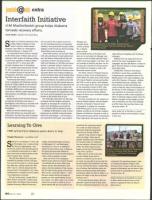
Volunteers from. I_T-M's Mujew: Muslim-jevv-ish
interfaith Dialogue. They are spelling out "Mujew"
with their hands.
prayer services
and interfaith dinners in the Deep South
were not on my bucket list. Although, look-
ing back at that incredibly impactful night, I
couldn't have been happier I was there. Not
only attended by Muslims and Jews, the din-
ner party also consisted of Christian guests
from Habitat for Humanity as well as the
Mennonite Disaster Service.
Jane Aslam, director of Disaster Response
with natural disasters and past partnerships
with JDRC as well as giving a brief explana-
work ethic. However, Sri Narayan, a Habitat
for Humanity Americorps volunteer, Ohio
born, married and lived on the same block her
entire life. She shut herself in a closet with
tion of the prayer service we had just attend-
ed. Elie Lowenfeld, founder of JDRC, often
her grandchild as the tornado ripped out the
trees in her backyard and toppled them onto
mentions the ability of disaster relief work
tion my intent for going on a service project
trip. What was I getting myself into? Why
didn't I go on a normal spring break like
everyone else? I was headed to city I knew
new experience of construction work with
skill and grace as well as their acceptance of
sometimes with her daughter and grand-
The week concluded with the students cel-
ebrating Shabbat together with the Modern
MuJews managed to bring together not just
Jews and Muslims, but those from Michigan
daughter, to encourage the volunteers. By
week's end, the MuJews had erected the
Orthodox community of Knesseth Israel
Congregation. To prepare the volunteers,
and Ohio State, they must have been a spe-
cial group indeed. @
her house, and yet managed to look upon the
disaster as the positive work of God.
She visited the construction site each day,
outer and inner walls of Patterson's house.
A highlight of the MuJew's week of volun-
teering was an interfaith community dinner
held at the local mosque — the last place I
ever expected to find myself. I was raised in
College, George Washington University
in Washington, D.C., and Washington
University in St. Louis in an attempt to
rebuild tornado-stricken areas of Alabama.
Our group partnered with Habitat for
Humanity and the Jewish Disaster Response
Corps to help accomplish our goal.
Upon my arrival to the synagogue,
Knesset Israel, where we would be housed,
I immediately felt at home. Rabbi Eytan
Yammer and his wife welcomed us and
made us feel like members of their commu-
nity. The rabbi led our group in discussions
about service, Israel and Judaism — talks
that were deeply moving and made me
This past spring break, I joined Hillel of
Metro Detroit, along with 12 other young
Jewish adults from Wayne State University,
Oakland University, Oakland Community
own values. I was able to gain a lot of inspi-
ration from my peers to stand up for my
Jewish identity. We also discussed how we
May 31 • 2012
others of alternate religious beliefs. And if the
Rabbi Winberg gave a lesson on keeping
Shabbat according to the Orthodox tradition.
Members of Habitat for Humanity as well as
Sarah Snider, 22, of Oak Park is a recent
ICNA joined the group and the community for
in New York.
graduate of Yeshiva University/Stern College
Friday night dinner and stayed late into the
I gained a large amount of appre-
ciation for things I often take for
nothing about to complete a service project
I was beginning to reconsider.
44
State alumnus and die-hard Buckeye fan,
could not help but attest to the excellence of
the MuJews in their willingness to tackle the
to break down barriers between different
groups; the dinner was a wonderful example
of this potential.
Shugmi Shumunov } jewish@edu staff
This idle time allowed me to play over
hundreds of potential scenarios and ques-
Coming from a family of U-M alumni
(Go Blue!), I cannot deny a possible bias
was Mary Patterson; the students were build-
ing the house for this older woman who was
community forget the devastation
they had only recently suffered.
had a lot of time to think and had no idea
what to expect when I arrived.
get to know the people in whose synagogue
they'd been living.
in expressing the remarkable nature of the
MuJew group in their open-mindedness and
HMD spring trip in Alabama sparks desire to help.
leaving my comfort zone and being placed
in an unfamiliar environment for a week. I
synagogue, and gave the MuJews a chance to
Services at Islamic Circle of North America
(ICNA) Relief USA spoke about ICNA's history
would help the community rebuild.
For a week, we tried to help this
S
Shabbat lunch was prepared by the stu-
dents for the entire congregation of the
Jewish and Muslim ideas about helping others
to motivate the students. Another inspiration
Learning To Give
thing in a van during an 11-hour ride
to Birmingham, Ala., I could not help
but feel a bit apprehensive. I was
night talking and laughing with the MuJew
volunteers.
question my own Jewish identity and my
granted. Building houses with Habitat
for Humanity made me understand
that not everyone is blessed to have
shelter. The entire experience also
taught me that much like building a
house, life is a process.
When we first arrived at the site,
we saw a lifeless house with no
Roman Golshteyn of Southfield, Washington
University students Molly Remch and
Emily Feder, and Shugmi Shumunov
of Southfield
exterior or insulation. By the end of
our week, we were able to put up vinyl sid-
ing and drywall, add insulatation and inject
our own spirit into the house. I realized that
we, as humans, start relatively empty and
without meaning, but forge relationships
and develop values that start to define us as
people and shape us into who we envision
ourselves to be.
community. This upcoming semester, I plan
on finishing my degrees at Wayne State
University. There, I hope to take the lessons I
learned in Birmingham and use them to help
provide relief to communities that are suf-
fering at home. @
Shugmi Shumunov of Southfield is a senior
On the long ride back home, I felt rein-
vigorated. It gave me time to think about
at Wayne State University and is a Peer
the way I envisioned giving back to my own
Metro Detroit.
Network Engagement Intern at Hillel of