

metro >> on the cover
Not Your
Mother's
Mikvah
Putting a modern twist on
an ancient tradition.
Ronelle Grier
Contributing Writer
CONTINUED FROM PAGE 1
Mikvahs are featured in many articles,
websites and books, including The Ritual
Bath by Jewish mystery writer Faye
Kellerman. Even Oprah has gotten into
the act, visiting (but not immersing in) a
mikvah during her televised tour of two
New York Chassidic neighborhoods.
What Is A Mikvah?
A mikvah is a body of water designed
for immersion according to the rules
and customs of Jewish law. According to
the website www.mikvah.org, the pool,
which contains about 200 gallons, must
be filled with living waters from a flow-
ing source that has never been dormant,
such as fresh spring water, rainwater or
even melted snow. The tradition is based
on the belief that water, as the primary
source of all living things, has the power
to purify, restore and replenish.
The original purpose of the mikvah
was to facilitate the observance of the
Jewish laws of family purity, or taharas
hamishpachah, which require periods of
separation and reunion as part of mar-
ried life. The separation, a time when the
couple refrains from physical intimacy,
begins with the onset of the menstrual
flow and continues for seven days after it
ends. The woman visits the mikvah after
sundown on the seventh day, and then
they can resume their sexual relationship.
Dispelling The Myths
Some modern Jewish women have
eschewed the tradition because they
believe it fosters a negative view of
women. One woman remembers her
mother's horror stories about the stern
mikvah attendants who examined her
fingernails and admonished her for being
unclean. Itty Shemtov, religious educa-
tor and wife of Rabbi Kasriel Shemtov of
The Shul in West Bloomfield, says quite
the opposite is true; the mikvah provides
16 May 10 • 2012
a symbolic rebirth that enhances the
spirituality of the woman and the marital
relationship.
"The tradition of mikvah introduces
sanctity to marriage:' she said. "It pro-
motes greater intimacy between husband
and wife."
Shemtov explained a pre-wedding visit
to the mikvah is part of the spiritual and
physical preparation for marital intimacy,
which Judaism considers a holy act.
"The ritual is based on the Jewish con-
cept of water as a source that cleanses,
refreshes and rejuvenates:' she said.
"Each detail relating to the mikvah —
its size, the type of water used — has a
mystical origin."
She said the ritual of mikvah brings
an element of romance to marriage and
provides an opportunity for women to do
some private soul searching about them-
selves and their relationship. A woman's
monthly visit is usually anticipated by
both husband and wife.
"It's considered a special night; some
call it their own private monthly honey-
moon:' Shemtov said.
This view is shared by Rachel M. (not
her real name), who uses the mikvah on
a regular basis, according to the laws of
family purity.
"I like having my own space within the
marriage," she said. "It's a spiritual time,
and it's given us a deeper level of respect
for one another. It also makes the mar-
riage more romantic."
She believes that, like the ritual of mik-
vah, the role of observant women is mis-
understood by much of modern society.
"People do not understand the empow-
erment that women have and how they
give that to their families. We're not walk-
ing three steps behind; we're not turning
the necks and heads of men; we're help-
ing to enrich the souls and minds of our
husbands and children."
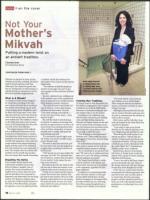
Rabbi Marla Horsten
of Temple Israel with
a "mikvah baq" given
to recent converts who
immerse in the mikvah.
Creating New Traditions
At Temple Israel in West Bloomfield, the
first Reform congregation in the country
to build its own mikvah, Rabbi Marla
Hornsten is constantly looking for new
and creative ways to use the facility.
In addition to the traditional uses,
which include conversions, pre-wedding
visits and High Holiday preparation,
Hornsten has helped women use the mik-
vah for various kinds of healing ceremo-
nies, both physical and emotional, includ-
ing dealing with cancer, divorce, death,
miscarriage or other life crises.
"Part of healing is moving forward:'
Hornsten said. "Some people are carry-
ing baggage or bitterness, and this helps
them let go."
For nontraditional situations, Hornsten
often writes a custom service with per-
sonalized prayers, poems or readings.
"If you can dream it, we can do it," she
said. "We want to be as creative and inno
vative as we can. I like taking something
old and making it new again."
The Temple Israel Mikvah is widely
used by members of the Reform and
Conservative movements; it is available
to the community regardless of syna-
gogue affiliation.
In addition to accompanying brides,
often with their mothers or close girl-
friends, Rabbi Rachel Shere of Adat
Shalom Synagogue in Farmington Hills
has taken women who are recovering
from illness, going through divorce or
trying to start a family to the mikvah.
"The word mikvah comes from the
same Hebrew root as tikvah (hope).
When using the mikvah, for whatever
reason, we immerse ourselves in a pool
of hope she said.
Although primary patrons for the mik-
vah are women, Hornsten said some men
do come to commemorate the holidays as
well as other occasions.
Rick Larson, and his wife, Mary Jane,
each participated in the ritual when they
converted to Judaism.
"I was ready to take on my Jewish
identity, and the mikvah experience was
very enlightening and spiritual:' he said.
Those doing the ritual as part of con-
version are given a "mikvah bag" pro-
vided by Temple Israel's Sisterhood and
community donations. The bag contains
a Kiddush cup, towels embroidered with
the words "Mazel Tov," a Tzedakah box,
Shabbat candles and a cookbook.
Kari Provizer, director of the Family
Life Center at Temple Israel, visited the
mikvah with a group of women studying
Kabbalah with Hornsten.
"It was a two-and-a-half-hour ceremo-
ny, very emotional:' she said. "Many of
the women connected with their Judaism
in ways they never thought they would."
In her role as a social worker, Provizer
recommends the mikvah experience after
any kind of loss, such as death, divorce
or miscarriage. She also encourages
people to use the mikvah for good occa-
sions, too, such as becoming a parent or
grandparent, or celebrating a bar or bat
mitzvah.