

oints of view
Missile Defense from page 41
could acquire four Iron Dome batter-
ies, and Congress provided the funds.
Including this funding, the president
has committed $650 million through
this fiscal year for cooperative U.S.-
Israeli missile defense programs.
Beyond this commitment, just last
week the Pentagon announced that
the administration will work with
Congress to seek additional funding for
more Iron Dome batteries. Rep. Howard
Berman, the ranking Democrat on the
House Foreign Affairs Committee, has
introduced legislation to help Israel
buy additional Iron Dome batteries and
interceptors. These efforts are in keep-
ing with the longstanding and biparti-
san U.S. commitment to our partner-
ship with Israel.
In confronting Iran, President
Obama has made clear that a nuclear-
armed Iran is unacceptable, and that all
options — including military options
— are available to prevent such an
outcome. Missile defense cooperation
with Israel is a powerful factor that
can help dissuade Iran from choosing
the nuclear weapons path. And should
Iran continue its intransigence, missile
defense cooperation will help ensure
that both our nations can pursue what-
ever course of action is appropriate to
meet that threat.
❑
Carl Levin is a Democratic U.S. senator
from Michigan and chair of the Senate
Armed Services Committee.
Dry Bones
42 May 3 2012
Commentary
Anti-Semitism Bites 'Watchdog
F
or more than 50 years, the Columbia Journalism
Review (CJR), under the auspices of the Columbia
University Graduate School of Journalism, has
served as a "watchdog" – along with some other trade maga-
zines – over the media.
As a regular feature, CJR "punishes" media institutions
with "darts" for stories that are unprofessional, violate
ethics or are guilty of a wide variety of other journalistic
offenses.
Well, given CJR's performance in its
January-February edition, it deserves two
darts for just one story.
At issue is a long article, "The Times
and the Jews" by Neil A. Lewis, which
analyzed whether the New York Times is
biased against Israel in the paper's cover-
age of the Palestinian-Israeli conflict.
Lewis, analyzing how the Times handles
Jewish issues, concludes that the Times
is not guilty of any unfairness to Israel.
While a thoughtful article, one cannot
really conclude from his analysis whether
the Times violates journalism's most
sacred principle – objectivity – in its coverage of Israel. But
that subject is best covered in a separate article.
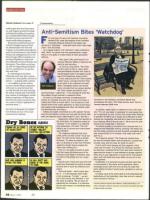
At issue is a full-page caricature, accompanying the
article, of a Chasidic Jew who, with a scowl on his face, is
reading the Times on a park bench. The caricature is remi-
niscent of the most vulgar depictions of Jews by the Nazis,
anti-Jewish Arab propaganda and other anti-Semitic mate-
rial distributed by Jew haters.
Indeed, one reader commented on CJR's website: "By the
way, nice anti-Semitic cartoon you have with the article. Why
don't you make his nose a little longer??? (sic)." Dart No.1.
Apparently, reeling from the reaction to
the illustration, the magazine posted an
"apology" on its website. In a relatively
long explanation, CRJ said: "The first
thing to say is, we are sorry that anyone
was offended."
The magazine explained that since
Lewis points out that a most "vocal seg-
ment" of critics of the Times is heavily
Orthodox, "So what we asked for, and
got, is a drawing of a man from Orthodox
Judaism's Hasidic branch reading the
Times and scowling at it."
First, it is not quite accurate to main-
tain that Lewis attributed much of the
criticism of the Times to Orthodox Jews.
It is part of the article, but not a major
point.
Second, even if that were true, the CJR
could have illustrated the article to make
its point with a much less offensive cari-
cature.
Third and finally – which merits dart
No. 2 – is CJR's apology, which really
is not an apology. To state "... we are
sorry that anyone was offended" is not
the same as stating, "We are sorry for
publishing the caricature. It is offensive
and we were wrong," or something along
those lines.
MUBARAK
Caricature in the Columbia Journalism Review that
accompanied the story "The Times and the Jews" from its
January-February 2012 issue
As another reader said in a comment on the CJR's web-
site: "It is not your place to apologize for what people feel,
but to apologize for your actions that caused these feelings.
It shouldn't be 'We're sorry people were offended' as their
feelings are completely valid and don't need to be excused
by an apology. What it should read is, "We're sorry for pub-
lishing a (sic) image that is offensive."
The whole episode is somewhat ironic because here is a
magazine that dedicates itself to "policing" the media, but
like the media, cannot bring itself to admit wrongdoing and
take responsibility for its mistake. That might even merit
dart No. 3.
The magazine argued: "The image was okayed along
the way by multiple editors and art directors, a group that
includes Jews and non-Jews, for what it's worth..."
It ain't worth much because all that suggests is that
"Jews and non-Jews" at CJR lack the necessary sensitiv-
ity. Moreover, including the fact that Jews were involved in
approving the image is a lame attempt to escape responsi-
bility. Hey, if Jews approved it, it must be OK. That doesn't
wash, and CJR would have been better served not to use
this argument.
Incidentally, it is important to point out that Lewis had
no involvement in the choice of the illustration. When I
exchanged emails with him on his article, he made that
point, adding he knew it would cause a problem as soon as
he saw it.
If, indeed, none of the entire staff at CJR understood the
implications of the illustration, then they all are in need of
some sensitivity training.
❑
A former political reporter, Berl Falbaum, of West Bloomfield, is an
author and public relations executive, and teaches journalism part-time
at Wayne State University.