

metro >> yom hashoah
Enhancing Memory
Portraits of Honor exhibit now online; HMC passports feature Michigan survivors.
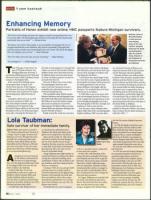
Barbara Cohen of
Brett Moun tain
"We all must acknowledge and praise the righteous people who jeopardized their own
lives to save others. We should appreciate and honor such people for their heroism and
understand what was at stake." — Miriam Ferber
West Bloomfield,
a child survivor
from Poland,
looks at the new
visitors' passport
"Be tolerant. Get to know other people, so you won't fall for stereotyping. We were ste-
reotyped, and that led to anti-Semitism. Also, don't be a bystander. The people who
saved me and my mother were normal people who took a stand. They knew the danger
they were taking to save our lives." — Rene Lichtman.
featuring her photo
and information
with Dr. Charles
Silow, director of
the Program for
"Never lose hope. If you lose hope, you lose everything." — Mala Dorfman
Holocaust Survivors
"Do not forget us!" — Golda Feingold
T
hese "Messages to the Future" are
part of "Portraits of Honor: Our
Michigan Holocaust Survivors," a
permanent exhibit housed at the Holocaust
Memorial Center (HMC) Zekelman Family
Campus in Farmington Hills.
At the annual Yom HaShoah memo-
rial program there on April 22, Dr.
Charles Slow, director of the Program
for Holocaust Survivors and Families of
Jewish Senior Life, announced two impor-
tant developments within Portraits of
Honor.
A passport system now is in use that
gives mock passports to HMC visi-
tors. Each passport includes a photo of
a Michigan survivor featured in the
Portraits of Honor exhibit as well as a brief
description of his or her Holocaust experi-
ences, plus a message for the future. On
and Families.
the back of each passport is a barcode that
visitors can scan at the Portraits of Honor
exhibit to learn more about that survivor.
In addition, those survivors interviewed
for other oral history projects can also be
accessed from this site.
Portraits of Honor also is now online.
The photographs, interviews and
maps of survivors' journeys are now a
comprehensive educational resource at
www.portraitsofhonor.org.
This searchable online exhibit includes
historical references and photographs from
the United States Holocaust Memorial and
Yad Vashem in Israel that further explain
places and circumstances of survivors'
imprisonment. Sir Martin Gilbert, an inter-
national Holocaust historian, developed the
map for Portraits of Honor.
People around the world can now learn
about survivors who settled in Michigan
after liberation, and read about their expe-
riences, their messages of resilience and
their hopes for the future.
"I don't know how much longer I have,
but I now feel a sense of great satisfaction
knowing that my history will be preserved
for future generations:' said survivor
Manya Feldman, who fought with the
Partisans. "It's wonderful that all of these
histories are in one place
In 1999, Slow, a son of survivors, initi-
ated and developed Portraits of Honor as
a way to appreciate the experiences of sur-
vivors through photographs and stories.
The photographs reveal their strength and
resilience as well as pain and loss.
Over the years, many volunteers have
helped collect interviews and photographs.
Stephen Goldman, HMC executive direc-
Lola Taubman:
Sole survivor of her immediate family.
Editor's Note: Inaccuracies occurred in
"The Women of Ravensbruck: Portraits of
Courage" (Apri119, page 10) about local
Holocaust survivors. We regret the errors,
and offer this revised story about Lola
Taubman. Paula Marks-Bolton of West
Bloomfield and Eva Wimmers of Florida
also were in the April 19 story. For more
details about their lives and their families,
go to www.portraitsofhonor.org.
A
mong local survivors featured
in The Women of Ravensbruck:
Portraits of Courage through
June 24 at the Holocaust Memorial Center
in Farmington Hills is 86-year old Ann
Arbor resident Lola Taubman.
In April 1944, then 18, she was
transported by cattle car to a ghetto in
Munkacs with her parents, Miksa and
Zsenka Goldstein, and two brothers
from her Nazi-occupied Czechoslovakian
hometown of Svalava. Until the late 1930s,
life there had been fairly idyllic.
A month later, after living outdoors
16
tvlay 3 2012
at a brick factory with little food in
Munkacs, the family and others in the
ghetto were transported to Auschwitz.
Upon arrival on May 22, 1944, she was
selected for work by Dr. Josef Mengele;
the rest of her family went to the gas
chambers that day, except for one broth-
er who died of starvation at Mauthausen
later that year. She is the sole survivor
from her immediate family.
Young Taubman spent eight months in
Auschwitz-Birkenau, working with others
sorting the confiscated clothing, shoes
and blankets of those who perished in the
gas chambers, and then transporting the
items to a warehouse.
In January 1945, she was among 10,000
prisoners forced on a death march to
avoid their liberation by the approaching
Russians. Only hundreds survived, and
they were taken by rail to other camps.
Ravensbruck and Malchow were among
those where Taubman was sent. The con-
ditions were horrific.
Eventually, she was sent to Leipzig to
Lo
2004 and in the
1940s
work in a munitions factory, along with
an aunt and some cousins.
In May 1945, with liberation of the
camps, the Nazis eventually left the pris-
oners behind and took off to escape the
liberators. The prisoners had to fend for
themselves. Despite suffering hunger,
cold and exhaustion, Taubman and her
remaining family members managed to
meet up with a Czechoslovakian officer
who coordinated a bus ride to Prague for
them and other prisoners.
In Prague, Taubman was reunited with
two uncles who had been interned in
Siberia. She lived with them for a while;
then, over the next four years, while
trying to emigrate to the United States,
tor, welcomes Portraits of Honor as an
important resource both in the museum
and for Holocaust education globally.
Portraits of Honor was made possible
by Shari Ferber Kaufman, Annette Ferber
Adelman and Ron Ferber to honor their
parents, Miriam and Fred Ferber, and also
by Leo and Harry Eisenberg in memory of
their parents, Belle and Isidor Eisenberg.
The project also is supported by Carol
Rosenberg, director of the Jewish Senior
Life Foundation, and Rochelle Upfal, CEO
of Jewish Senior Life, as well as JSL offi-
cers and its board. The exhibit was devel-
oped and produced by Darius Gueramy of
Red Road Media in Midland.
Survivors and their families not yet
included in Portraits of Honor can contact
Silow or Renee Fein for future inclusion at
(248) 661-2999. ❑
she lived in various displaced persons
camps.
In 1949, she finally received her immi-
gration papers. She first settled in New
York, where she lived with an aunt and
uncle, and worked for an import/export
company. Then, a cousin coordinated a
job for her in Detroit as an assistant to
interior designer Ruth Adler Schnee. She
soon found an apartment of her own, and
again enjoyed living in the same city as
her aunt and uncle, fellow survivors from
her hometown.
In 1954, she married Samuel Taubman,
an aeronautical engineer with his own
manufacturing business in Detroit.
They raised their three children, Alyssa,
Richard and Ruth, in the area. In 1981,
they moved to Florida, where she was a
homemaker. Samuel died in 2004. The
following year, Lola Taubman returned to
Michigan to live in Ann Arbor.
The grandmother of six has spoken
extensively about her Holocaust expe-
riences to various groups, including
temples and schools. In June, she will
publish her memoir, My Story. She is an
accomplished baker, just as her mother
had been. ❑