

The JN And You from page 42
Commentary
and its assets were to be auctioned off to the high-
est bidder on April 2 [see page 35]. Members of the
family who owned the Baltimore paper also owned
the Detroit Jewish News from 1984-2000.
At its peak in the 1980s, the Baltimore Jewish
Times was America's leading weekly publica-
tion. Period. It typically numbered more than
172 pages and combined the business savvy of
third-generation publisher Chuck Buerger with
the editorial brilliance and sensitivity of Gary
Rosenblatt. Rosenblatt, who is currently the editor
and publisher of the New York Jewish Week, was a
Pulitzer Prize finalist whose work was referenced
during floor debates in Israel's Knesset. Following
Rosenblatt's departure to New York in 1993 and
Buerger's death in 1996, the Jewish Times was
operated by the Buerger family's fourth generation.
For decades, the Baltimore Jewish community
and the Baltimore Jewish Times made each other
exceptional. But following Rosenblatt's departure
and Buerger's death, mutual trust and respect
between community and publication eroded.
Both took each other for granted. In recent years,
when the Baltimore Jewish Times needed the
community the most, it largely stood on the side-
lines as spectators to an ugly battle between the
company and one of its key vendors. That battle
led to bankruptcy and the possible demise of the
once-iconic Baltimore Jewish Times. Now, commu-
nity leaders say it would be a sad day for Jewish
Baltimore and the fabric of the community if the
Baltimore Jewish Times ceased to exist.
The JN's Destiny
As we move into and through our 70th anniver-
sary year, the destinies of the Detroit Jewish
community and the Jewish News remain
intertwined. To further strengthen the
bond between the two, the Detroit Jewish
News Foundation was recently created. The
focus of this 501(c)(3) nonprofit entity is
to help assure that the entire contents of
the Jewish News — the story of our com-
munity — will be preserved and digitized
so every word that has ever appeared since
1942 can be accessed.
The Foundation board comprises
a sampling of our community's most
outstanding younger leaders. All have a
respect for the community's history, the
role of the Jewish News in shaping that
history and a desire to learn from this
history in making the decisions that will
chart our future. The board is reinforced
by an honorary panel, many who played
pivotal roles in the very history its mem-
bers will study, utilize and bring to life.
This ongoing and mutually beneficial rela-
tionship will be essential as we, together as a
community and independent Jewish press,
navigate an array of demographic, economic
and social challenges that will shape our col-
lective futures. We appreciate your continuing
readership and support, dating back to 1942,
and look forward to continuing to shape and
report the story of our remarkable commu-
nity with you and for you.
May you and your families enjoy a fes-
tive Passover. ❑
We Need Civility In Public Discourse
T
view. That can't help anyone but our
community's enemies.
Looking back over many years of
Jewish community involvement, I
cannot remember a time when the
atmosphere was so toxic. In the
past, it was a given that Israel used
to unite us. But today, Israel all too
often is a lightning rod for name-
calling: Those who support Israel dif-
ferently are castigated as either
warmongers or appeasers,
depending on one's own posi-
tion. Outreach to other faith and
ethnic communities used to be
universally supported through-
out the Jewish community.
Now, even nonpolitical Jewish-
Muslim tikkun olam (repair of
the world) partnerships such as
our interfaith health fairs elicit
vitriolic responses from those
who object to any such bridge
building.
This kind of divisiveness under-
mines the viability of a moderate
consensus capable of generating
effective public policy. This prob-
lem is hardly limited to the Jewish
community; but we should, and we
must, address it within our com-
munity. Incivility
in the Jewish
public square has
become endemic
and as a minority
community shrink-
ing in size and
perhaps political
influence – if not
FOR FORTY
now, then in the
YEARS.
foreseeable future
– we simply can-
not afford it.
Detroit's Jewish
community has
written the book
on community
organizing. Our
network of out-
standing social
agencies,
•
• service
defense organi-
AND WOULD
zations, affinity
NOT ASK
groups, schools,
ANYONE FOR
synagogues and
DIRECTIONS.
cultural institu-
tions is the envy
of and model
for many other
Jewish communi-
ties as well as the
non-Jewish eth-
nic and religious
wo Jews, three opinions,
the saying goes. We Jews
love to argue. A stiff-necked
people isn't shy about confronting
one another over matters great and
small. That's not necessarily a bad
thing – up to a point. But during
my recently ended two-year term
of office as president of the Jewish
Community Relations Council of
Metropolitan Detroit,
discord within our
Jewish community
has reached alarm-
ing levels.
Angry voices loud-
ly take issue with
differing opinions.
It seems that some
hardliners, whether
right or left, Zionist
or anti-Zionist, will
try to use almost
any Jewish community organiza-
tion or institution, any publication
or community event, as a platform
for launching not only ideological
attacks against ideas with which
they disagree, but also personal
attacks against people who don't
agree with their particular point of
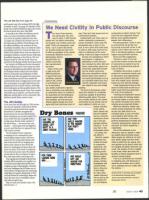
Dry Bones
PASSOVER
re
wow wmvER
w THE DESERT
AND
FOR THEIR
LEADERS WERE
communities in Metro Detroit. That
could not have happened without
Detroit Jews standing together
despite their differences.
Promoting greater civility in such
an environment will be like turn-
ing around an aircraft carrier. It will
require a lot of effort and a lot of
time. It will demand patience, mutual
respect and good-faith behavior.
Some concrete suggestions:
• Declare a vision of civil dis-
course that clearly conveys the kind
of community we aspire to be, the
benefits of achieving that and the
costs of failure;
• Establish and enforce a code of
conduct for community events, pub-
lic discussions and organizational
meetings that prohibits interrup-
tions with raised voices, personal
insults and over-the-top charges;
• Hold community forums on the
issue of civility itself as well as on
major issues that have generated
the most uncivil behavior;
• Develop and implement resourc-
es and models for training leaders
and future leaders in active listen-
ing, conflict resolution and commu-
nicating across polarized divides.
While the collective Jewish com-
munity should undertake this effort,
we also can take action on an
individual basis. In your everyday
conversations with friends, rela-
tives and coworkers, if you hear a
political disagreement escalate into
character assassination, speak up
and point out what's happening –
respectfully.
One of the hallmarks of our
democracy and our people is vigor-
ous debate about pressing issues.
When people are willing to not only
hear others speak, but also really
listen to what they are saying, com-
mon ground can be found, minds can
be changed and better decisions can
result. The wisdom of this is replete
in the Torah, which sets forth the
benefits of robust argument done in
earnest mutual respect.
If we as a community can succeed
in modeling such civil discourse, it
would be yet another way in which
we as a people serve as a light unto
the nations.
❑
Richard Nodel is immediate past president
of the Bloomfield Township-based
Jewish Community Relations Council of
Metropolitan Detroit.
April 5 • 2012
43