
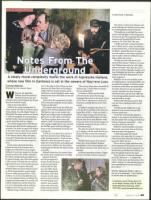

A scene from In Darkness
A steely moral complexity marks the work of Agnieszka Holland,
whose new film In Darkness is set in the sewers of Nazi-era Lvov.
George Robinson
Special to the Jewish News
W
hen you ask Agnieszka
Holland about the historical
tensions between Jews and
Catholics in her native Poland, she doesn't
have far to look for a reply.
Only as far as her mirror.
Holland, the award-winning director
whose superb new film In Darkness opens
Friday, March 16, at the Maple Theater in
Bloomfield Township, was born in Warsaw
in 1948, the daughter of two journalists, a
Catholic mother and a Jewish father. Her
parents raised her with no religion.
Her mother fought in the 1944 Warsaw
Uprising and aided Jewish underground
members. Her father escaped from Poland
to the Soviet Union when Nazis invaded;
his parents were murdered on the streets
of the Warsaw Ghetto. When her father
returned to Poland after the war, he was
arrested by the new Communist govern-
ment.
But his name, distinctly Jewish in
Poland, became both a burden and a
badge worn with pride to the youngest
Holland. At 6, she was taunted on the play-
ground at school. Her mother explained
her father's background and urged her to
be proud of being a Jew. When she applied
to film school in Poland, she was rejected,
apparently because of her Jewish surname.
It comes as no surprise, then, that
Holland's films are almost always focused
on divided personalities, people caught
between conflicting imperatives. Those
conflicts are, for her, invariably the prod-
uct of the turbulent history of Poland, the
complicated relationship of its Jewish and
Catholic inhabitants, and the brutal his-
tory of its relationship with its bullying
neighbors from Russia and Germany.
Holland brings a different perspec-
tive to the subject of the Shoah, one that
has given her three films on the subject
(Angry Harvest; Europa, Europa; and In
Darkness), a moral complexity and a steely
intensity that most other films on the sub-
ject lack.
Asked about the complicated morality
of her characters, Holland merely replies,
"People are like that?'
She explains that Socha, the Polish pro-
tagonist din Darkness played by Robert
Wieckiewicz, was a sewer worker who
helped Jews hiding under the liquidated
ghetto of Lvov. But earlier in his life he
"had been in prison three times, had
robbed a bank." He had committed him-
self to going straight after he got married,
but the film opens with him robbing a
house so the commitment obviously isn't
a strong one.
"It tells you a lot about him, who he is
and what motivates •him," Holland says
of the opening sequence. "Look, it's very
difficult to show pure good. It's easy to
make the victims faceless and saintly, and
everyone loves children, but the result is
sentimental and kitschy. You deprive them
of real life:'
Holland's characters, by contrast, have
the sweaty, dirty complications of reality.
Solomon Perel, the
real-life protagonist of
Europa, Europa becomes
so good at passing for
German that he ends
up in the Hitler Youth
with disturbingly little
discomfort. The Polish
rescuers in both Angry
Harvest and In Darkness
are both initially moti-
vated by cash consider-
ations, and only Socha
finally redeems himself
by discovering altruism.
"The truth is better than a beautiful lie
Holland says. "I don't believe in stories
that are sentimental?'
In Darkness, which was the Polish
selection for this year's Best Foreign
Language Film award at the Oscars (it lost
out to Iran's A Separation as did Israel's
Footnote), is deeply felt but never senti-
mental.
As befits its setting in the sewers of
Lvov, the film is redolent of the basic bio-
logical facts of life — food, sex, death —
with no sugar-coating. The Jewish char-
acters are desperately hungry, and when
they eat, they do so with abandon. Both
Socha and some of his Jewish charges are
frequently consumed with lust, often at
inconvenient times.
The dead are treated without formal-
ity or dignity, with the result that the one
time in the film we hear the mourners'
Kaddish it carries an extra-powerful wal-
lop.
The film derives most of its extraor-
dinary force from Holland's brilliant
manipulation of the claustrophobic sets
and clammy darkness with which they are
depicted.
As Holland proudly proclaims, "Eighty
percent of the film is shot in darkness?'
That choice created some obvious tech-
nical challenges for Holland and her direc-
tor of photography, Jolanta Dylewska.
"Normally, you would light the sewer
scenes with big lights in the background,
but you end up with something that looks
spacious and beautiful like the sewer
scenes in The Third Mae she says.
"I didn't want that. I wanted real dark-
ness. I didn't want to create the darkness
in post-production, in the lab [processing
the film]. I wanted the to experi-
ence the reality. So it became a question of
how to make it dark but still have it pos-
sible to follow the action?'
The film was shot with the by-now-
famous RED camera, "which is very sensi-
tive Holland says, and a lot of the light
within the frame "came from the actors!'
The sewer workers, logically enough, carry
large flashlights that provide a significant
amount of the film's illumination in the
sewer sequences.
Holland's use of such unstable, transi-
tory lighting turns a potential liability into
an expressive strength. In Darkness quick-
ly becomes a film about the literal inabil-
ity of her characters to see one another,
a perfect metaphor for their atomized
emotional states, and the sheer difficulty
of perceiving another person's needs when
survival itself is at stake.
Holland adds that the pervasive dark-
ness also has a significant effect on the
audience.
"It makes people really have to pay
attention to the screen:' she says with
obvious satisfaction.
"In the first week the film played in
Poland, to my surprise the theaters were
full. But people were coming out with their
buckets of popcorn untouched — they
were that riveted by the film?'
Holland is understandably concerned
that people come away from In Darkness
with more than stale popcorn.
"I think that people like Claude
Lanzmann, who argue that it's wrong to
make fiction films about the Holocaust,
are partly right:' she says.
"But we need to share with those who
never experienced this history; we need
to convey the heart of this experience. For
that, fiction is probably more efficient. It
goes through the heart to the mind.
"Even the effect of a kitschy television
series like Holocaust — it changed the
vision of Americans and Germans on this
subject. Perhaps for educational purposes,
even embellishment is better than com-
plete silence:'
❑
Director Agnieszka Holland, right, on
the set of In Darkness: "I don't believe
in stories that are sentimental."
In Darkness opens Friday, March 16,
at the Maple Theater, 4135 W. Maple
Road, Bloomfield Township. (248)
750-1030; www.themapletheater.com .
March 15 • 2012
49