
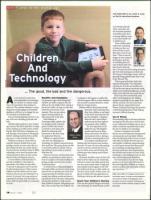

Left: Rabbi Miller's son Jonah, 6, using
an IPad for educational purposes
at the Rontal-Akervall
Clinic, notes that with
the increased popularity
of portable music devic-
es among children comes
an increased health risk
to children's ears.
"Some children don't
Daniel Klein
realize that something
is broken on their ear
buds and they scratch
their inner ears:' he cau-
tions. "There is also the
danger of noise-induced
hearing loss, and that
is something that isn't
even realized until years Daniel Rontal
later. It won't show up
for 15-20 years, but we're seeing more peo-
ple with early hearing loss in their mid-
30s because of listening to music, which is
generally being played louder than it was
in the '80s and '90s.
"Kids in general feel that they're bul-
letproof' Rontal adds. "The white iPod
ear buds just sit in the ear and those are
OK, but the ones that go into the ear canal,
called sound-isolating headphones, can def-
initely cause infection and scratch the ear:'
Kidz Gear (www.GearForKidz.com)
offers wired headphones for children
designed specifically for the Apple iPod,
iPhone and iPad. The Kidz Gear head-
phones feature unique KidzControl
Volume Limiting Technology that provides
a safe listening experience while helping
to protect children's hearing.
rt
... The good, the bad and the dangerous.
A
s our society becomes even
more dependent on technology,
we will have to continue adapt-
ing to the innovations that continue to
amaze us. The constant advances in every-
thing from mobile gadgets to household
appliances will force us to change the way
we currently do everyday tasks.
If you need help figuring out how to use
any of the new technology, just ask your
kids.
Children adapt quickest to new technol-
ogy because they don't really have to adapt
much. Swiping on an iPad screen, control-
ling the Xbox 360 Kinect videogame con-
sole through virtual reality or starting the
family's washing machine from a mobile
app seem to come naturally to them.
Children as young as 4 years old are
using the Internet, mobile devices and
gaming consoles. In some cases, this is a
good thing, but there are certain risk fac-
tors that parents should be aware of. While
technology can be used for positive edu-
cational purposes, there are also serious
physical and psychological concerns.
A recent Nielson study finds that 70
percent of children 12 and under in
households with tablets use the tablet,
77 percent to play games and 57 percent
for educational purposes. Other reasons
children used the tablets were for enter-
tainment, 55 percent, and watching TV or
movies, 43 percent. Forty-one percent of
respondents said they used the tablets to
keep a child occupied while at a restaurant
or event.
14 March 1 . 2012
Benefits And Drawbacks
Local parents report that letting their
children use tablet computers like the
iPad can be very helpful when waiting at
the doctor's office, on long car rides and
before the meal arrives at res-
taurants. There are also advan-
tages to having children do
their homework on the iPad.
Julie Feldman of
Farmington Hills explains that
her daughter Emily (a fourth-
grader at Hillel Day School)
is excited to come home and
finish her advanced math
homework on the iPad using
the application Wowzers.
Feldman, a registered dieti-
cian, also sees advantages in
technology for children concerned about
their nutrition. "My young clients are able
to track their daily food intake with an
app making it much easier to monitor
what they eat:'
There are, however, concerns that some
children are spending too much time in
front of a digital screen and are likely not
getting enough exercise or face-to-face
social interaction.
Dr. Daniel Klein, a child psychologist in
Farmington Hills, says he sees many young
patients who are spending too much time
using technology by themselves and not
enough time playing outside and interact-
ing with their peers. He works with parents
and provides guidance to help monitor
their children's computer and gaming activ-
ities. There are also fears that children will
see things in video games or online that
will have negative effects on their behavior
and can lead to anxiety disorders, violent
behavior or hyperactivity.
Feldman believes that parents should
determine what technology they
allow their children to use based
on the child's maturity level. She
gave her daughter a cell phone
when she was 8 years old but
understands that this might be
too young for other children.
"It's very dependent on the
child: she says. "My daughter
spends many hours at dance
classes and needs to be able to
communicate with us. Having a
cell phone and being able to text
us is anxiety-reducing for her."
Feldman also has become more cautious
about her 31/2-year-old son's video gaming
activity as she has noticed that he is act-
ing out violent scenes and shooting with
pretend guns after playing some realistic
video games.
All parents should be aware of their chil-
dren's activity online and use monitoring
software to ensure that adult content does
not come up in search results. Google and
other popular search engines on the Web
have SafeSearch features to filter adult con-
tent from search results. Violent scenes can
also be avoided with such applications as
NetNanny, which provide Internet controls.
Guard Your Children's Hearing
There are also physical dangers associated
with technology. Dr. Daniel Rontal, an ENT
Use It Wisely
New technology helps us be more productive
and improves our lives, but we have to learn
to use it safely and in healthy ways. So too, as
adults, we must be responsible and monitor
the way our children use technology.
Overuse of computers and mobile
devices can curtail important interpersonal
communication and can hinder children
from developing the skills necessary to deal
with others in real life. However, there are
real benefits to children's using technology
as well. Reports abound that demonstrate
how technology is bolstering children's
learning experiences and complementing
the education they receive in school. Some
technology is even making it easier for chil-
dren with developmental disabilities.
The bottom line is that the best thing
parents can do is become well trained in
the technology their children are using to
ensure a positive, safe and healthy technol-
ogy experience. ❑
Rabbi Jason Miller is a blogger, educator and
technology expert. He blogs at blog.rabbijason.
corn and is on Twitter at @rabbijason. He is
president of Access Computer Technology, an
IT and social media marketing company in West
Bloomfield.