
congregated, met and wrote, I found that
cafés were important in each and every city.
In the beginning, I thought that these places
stood out because of my own love of cafés, but
when I came back to Ann Arbor and looked at
the literature and archival materials I realized
that it wasn't a coincidence. At this point, I
was fortunate to spend the Fall semester as
a fellow at the Frankel Institute for advanced
Judaic Studies in its inaugural year, when the
topic was "Jews and the City." This was just the
perfect occasion to work on my project with
a wonderful group of scholars from various
fields dealing with issues of urban space and
Jewish culture. I wrote most of the first part of
Literary Passports during this fellowship period.
Another interesting surprise came
when I was writing the part of the book that dealt
with gender and sexuality in modernist Hebrew
fiction. I came across a number of translations
into Hebrew and Yiddish of works by Oscar
Wilde, as well as essays and studies about him,
including by figures as remote from Wilde as
possible. This pushed me into a small but intense
research on the extent on the interest in Wilde
and the reasons for it. I discovered that there
was a real "Wildemania" in the world of Jewish
literature and culture during the early decades of
the 20th century. This deep interest (which was
_
not limited to Wilde but extended to writers of
Russian, German, Scandivian, Polish and other
languages) had to do, among other things, with
wide-ranging changes in perceptions of gender
and sexuality that I identified and analyzed.
So, I began the part of the book that is devoted
to the topic, with a discussion of the Hebrew
translation of Oscar Wilde's Salome, which
was commissioned and published by Yossef
Haim Brenner, who lived in London's East End.
you planning to teach any dasse5
at Michigan. that relate to this book?
The truth is that until now it was very difficult
to teach a course that deals directly with the
topic of my book. This is partly because until
I've written the book, there was no good
framework in which one could look at the
materials in a dear and comprehensive way.
Also, for the contemporary reader, the literary
texts are difficult and not accessible, unless you
are trained in the Hebrew written in early 20th
century (which is very different from Hebrew
spoken today!). I was very fortunate to have a
wonderful group of graduate students, with
whom I conducted a seminar on modernist
Hebrew literature while researching the book. I
have learned much from their wise comments,
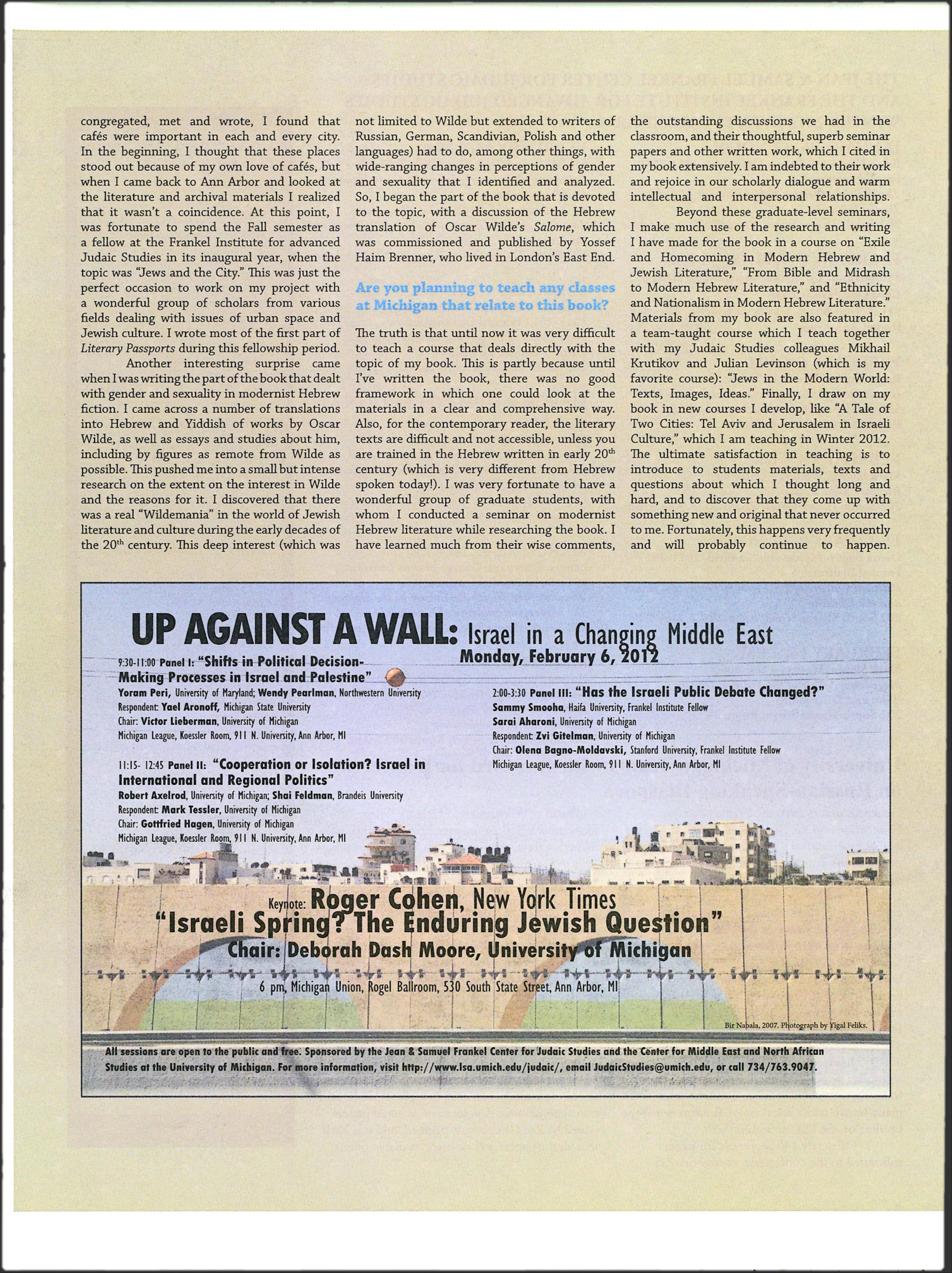
UP AGAINST A WALL:
"Shifts-in-Political Decision-
-Makiiig-frocesses in
and:Palestine"
—
930-11:00 -Panel h
Yoram Peri, University of Maryland; Wendy Pearlman, Northwestern University
Respondent Yael Aronoff, Michigan State University
Chair: Victor Lieberman, University of Michigan
Michigan League, Koessler Room, 911 N. University, Ann Arbor, MI
the outstanding discussions we had in the
classroom, and their thoughtful, superb seminar
papers and other written work, which I cited in
my book extensively. I am indebted to their work
and rejoice in our scholarly dialogue and warm
intellectual and interpersonal relationships.
Beyond these graduate-level seminars,
I make much use of the research and writing
I have made for the book in a course on "Exile
and Homecoming in Modern Hebrew and
Jewish Literature," "From Bible and Midrash
to Modern Hebrew Literature," and "Ethnicity
and Nationalism in Modern Hebrew Literature."
Materials from my book are also featured in
a team-taught course which I teach together
with my Judaic Studies colleagues Mikhail
Krutikov and Julian Levinson (which is my
favorite course): "Jews in the Modern World:
Texts, Images, Ideas." Finally, I draw on my
book in new courses I develop, like "A Tale of
Two Cities: Tel Aviv and Jerusalem in Israeli
Culture," which I am teaching in Winter 2012.
The ultimate satisfaction in teaching is to
introduce to students materials, texts and
questions about which I thought long and
hard, and to discover that they come up with
something new and original that never occurred
to me. Fortunately, this happens very frequently
and will probablj continue to happen.
Israel in a Changing Middle East
Monday, February 6, 2011
- --
2:00-3:30 Panel Ill: "Has the Israeli Public Debate Changed?"
Sammy Smooha, Haifa University, Frankel Institute Fellow
Sarni Aharoni, University of Michigan
Respondent Zvi Gitelman, University of Michigan
Chair: Olena Bagno Moldayski, Stanford University, Frankel Institute Fellow
Michigan League, Koessler Room, 911 N. University, Ann Arbor, MI
-
"Cooperation or Isolation? Israel in
International and Regional Politics"
11:15- 12:45 Panel II:
Robert Axelrod, University of Michigan; Shai Feldman, Brandeis University
Respondent Mark Tessler, University of Michigan
Chair: Gottfried Hagen, University of Michigan
Michigan League, Koessler Room, 911 N. University, Ann Arbor, MI
•■ 1.11%00,, Oli,
N
:Eike
Rkger Coheri, New Ydirk Times
Israeli SpiaingTThe Enduring Jewish Question"
.1
Keyrote:
air: Deborah Dash Moore, Universit
Michigan
6 prq, Michiga0 Union, !loge! Ballroom, 530 South :State Street, Ann Arbor, MI1
Bir Nal:ela, 2007. Pliotoaraph by Yigal Feliks.
All sessions are open iwthe public and
Studies at the University of Michigan. For
pihisiiieliby the Jean SidHittet'Ficinkel Cehtet for Judaic Studies mid thetenter for Middle East and North African
ore information, visit http://www.lsa.umich.edu/judaici, email JudaicStudies@umich.edu , or call 734/163.9047.