
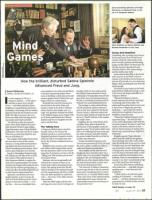

David Cronenberg (director) and Viggo
Mortensen, as Sigmund Freud, on the
set of A Dangerous Method
Keira Knightley as Sabina Spielrein and
Michael Fassbender as Carl Jung
U
Ea
How the brilliant, disturbed Sabina Spielrein
influenced Freud and Jung.
Naomi Pfefferman
Jewish Journal of Greater L.A.
I
t is the summer of 1912 in A
Dangerous Method — a film whose
storyline is drawn from real-life
events — and Sabina Spielrein (Keira
Knightley), a young Russian-Jewish psy-
choanalyst, is discussing with her mentor
Sigmund Freud the link between sex and
death. The talk soon turns to her own
destructive affair with Carl Jung, her for-
mer analyst and Freud's archrival.
"I'm afraid your idea of a mystical
union with a blond Siegfried was inevi-
tably doomed:' Freud (a cigar-puffing
Viggo Mortensen) says of Jung (Michael
Fassbender)."Put your trust not in Aryans.
We're Jews, my dear Miss Spielrein, and
Jews we will always be:'
The complex relationship between Jews
and non-Jews in turn-of-the-century
Europe is a strong undercurrent pressur-
ing intellectual and carnal tensions in
David Cronenberg's period drama, sched-
uled to open Friday, Jan. 20, in Detroit.
Based on Christopher Hampton's play,
The Talking Cure, the film draws on John
Kerr's dense 1994 nonfiction tome, A
Most Dangerous Method, to explore the
early years of psychoanalysis. The drama
examines the fraught relationship between
Freud and his wayward protege, Jung, as
well as the effect the brilliant Spielrein had
on their theories and personal lives.
Spielrein's contributions have been
largely forgotten, in part because she
died at 56 in the Holocaust in her native
Rostov-on-Don. But in reality — as in
the film — she was a formidable force,
overcoming her own violent mental illness
to become a pioneering analyst whose
views of the libido as both destructive and
creative sparked Freud's "death drive" and
Jung's outlook on transformation.
Eventually she married a Russian Jew,
moved back to the Soviet Union and
became a leader in the field of child psy-
chiatry, but the entire family came to a
tragic end. Spielrein's husband was killed
in the Stalinist purges, and in August 1942
an SS death squad herded the widowed
Spielrein and her two daughters into the
streets and shot them.
The Talking Cure
A Dangerous Method opens some four
decades earlier as the 18-year-old
Spielrein speeds in a coach toward the
Burgholzli psychiatric hospital in Zurich,
where her well-to-do parents have sent
her for the Victorian condition known as
"hysteria:
Knightley's face contorts as she screams
and writhes while being forcibly carried
into the institution, where Dr. Carl Gustav
Jung, then 29, decides to use her to test the
"talking cure" that had been put forward
by Freud in Vienna.
Spielrein, who was exceptionally well
educated for a woman of that era, can
barely speak without dissolving into gro-
tesque, chin-jutting facial ticks. But her
disease unravels as she explores her guilt
over the sexual pleasure she felt as a child
when her father spanked her naked but-
tocks — the source of her adult, masoch-
istic sexuality.
When her affair begins with the mar-
ried Jung, the scenes involve beatings and
bondage; while it is now well accepted
that Spielrein had some kind of sexual
relationship with Jung (they may not have
gone all the way), the sadomasochism in
the film is something Cronenberg said he
"defends" but cannot definitively prove.
The bondage is, rather, deduced from
real-life statements made by observers
such as Otto Gross (played in the film by
Vincent Cassel), a depraved analyst who
becomes Jung's patient and urges the good
doctor to "thrash" Spielrein in the manner
she clearly craves.
Knightley, the star of the Pirates of the
Caribbean films, almost declined the
role because of these graphic scenes, but
signed on when "David said he didn't want
them to be titillating and sexy in any way,
but rather gruesome and quite clinical:
the actress recalled from the set of her lat-
est film, Anna Karenina.
Because the kinkier sequences were
"not my own personal cup of tee she said,
the actress spoke to analysts in order to
understand Spielrein's motivation.
"Most helpful was the idea that even
though she was a masochist, there was a
sadistic side to her personality," Knightley
explained. "She was looking for Jung to
fulfill the role of her abusive father, whom
she both loved and hated, so there was a
level of provoking him into that"
"The character of Sabina is submissive
in some ways, but she is also in control in
many ways:' Cronenberg said, in a recent
interview at L.A.'s Beverly Wilshire Hotel.
"That is the nature of the sadomasochistic
relationship, and it maps well onto the
relationship between Jews and Aryans in
that particular time'
Facing Anti-Semitism
Cronenberg, who is perhaps most famous
for his psychosexual and "body horror"
cinema, which has created some of the
most viscerally repulsive and disturbing
images on film (think The Brood and The
Fly) also has been fascinated by anti-
Semitism, both in 19th-century Europe
and the modern-day world.
In his satirical short film At the Suicide
of the Last Jew in the World in the Last
Cinema in the World, he moves the gun in
and out of his mouth, in a sort of perverse
fellatio, while pondering the end of his life
and his people.
The Jewish-Aryan tension in the Freud-
Jung-Spielrein intellectual menage-a-trois
is less covert, but deeply embedded in A
Dangerous Method.
"Sabina's Jewishness is tremen-
dously important for both her and Jung;
Cronenberg said of their affair. The
patient and her analyst bond, in part, over
a shared love of Wagnerian opera and
mythology — particularly the myth in
which the hero Siegfried is born out of a
forbidden, incestuous tryst.
"Sabina had Siegfried fantasies revolv-
ing around Jung — the idea that their
secret, sinful relationship would yield this
Germanic progeny: the director said. "And
Freud, in our movie, nails her on that —
tells her that her fantasy of mating with a
blond Aryan and producing a Siegfried is
delusional."
Knightley agreed: "Quite often she
talked about the child she was going to
have with Jung, who in her words would
unite the Jewish and Aryan races in a kind
of mythic way: she said. "And Freud, who
was ostracized in many circles because
of being Jewish, was also looking for Jung
to be this kind of Christian leader, so that
people would find psychoanalysis more
palatable. That's an extraordinarily weird
concept to me. But it was obviously a huge
part of the world they were living in."
In the early 20th century, Cronenberg
said, intellectuals — especially German-
speaking ones — were obsessed with
Jewishness.
"I think it had to do with their under-
standing of Christianity — was Christ
Jewish? — and their puzzlement over the
preponderance of Jewish artists and intel-
lectuals," he said.
Mind Games on page 38
January 12 2012
•
•
37
•