

arts & entertainment
"The path to
maintaining or
regaining health is not
the same for everyone,"
write the authors.
Doctors encourage building up "health literacy" to navigate
the "gray zone" of personal medical decision-making.
Masha Rifkin
JointMedia News Service
p
erhaps doctor doesn't know best.
In their new book, Your Medical
Mind: How To Decide What is
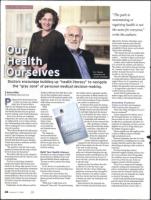
Right For You (Penguin Press), husband-
wife physician team Jerome Groopman
and Pamela Hartzband lay the ground-
work for making sound medical decisions.
None of our choices are completely
independent, the authors say; rather, they
are influenced by a set of values and his-
tory. Understanding what makes us tick is
vital in making the correct medical deci-
sions for ourselves.
"We're all just flooded with information
about health and conflicting advice from
experts:' says Groopman, an oncologist
and chief of experimental medicine at
Boston's Beth Israel Deaconess Medical
Center who writes on medicine and biol-
ogy for the New Yorker.
"We wanted to write the book to give
people the framework, the tools, to make
the best choice for themselves?'
The authors offer four main categories
that people tend to fall into when it comes
to medical bias.
The first is technology orientation
(people who believe that the best treat-
ments lie in cutting-edge research or new
procedures) versus naturalism orientation
(people who feel that the body can heal
itself if supplemented by herbs and other
natural products). There are also the max-
imalists (who believe the more treatment
the better) versus the minimalists (who
say less is more).
Finally, there are the believers and the
28
January 5 . 2012
doubters. Believers have faith that a solu-
tion for their problem exists, whereas
doubters view all treatment options with
skepticism. Some of us are risk averse
while others are more prone to
taking risks.
While
doubters
tend to be
risk averse,
naturalists can
be maximalists
(think of that
friend who takes
every herbal tea
and vitamin known
to man).
The categories
aren't necessarily lin-
ear, but it is important
to understand which we
fall into to gain more clar-
ity and control over our
decision-making.
Build Your Health Literacy
Hartzband, an endocrinologist at Beth
Israel Deaconess Medical Center and
Harvard Medical School, emphasizes,
"Doctors as well as patients have these
mindsets:'
So, if a doctor is a maximalist, he or
she may be prone to recommending more
treatment than necessary.
To assess your own and your doc-
tor's biases, the authors recommend you
inform yourself and build your "health
literacy."
"What does it really mean to be
informed?" they write. "It means knowing
the numbers about a particular medica-
tion or procedure, its likely benefits and
side effects, but it also means being alert
to how the presentation of these numbers
can confuse or mislead you."
To illustrate their point, the authors
present the case of Susan, a generally
healthy woman who discovered she
had high cholesterol. Her doctors
recommended she take a statin, a
very common drug, but Susan —
a minimalist and naturalist —
decided to do her research first.
After speaking to a friend,
Susan discovered that statins
could have a side effect of
muscle pain. When she
voiced this concern to her
doctor, he emphasized
that that side effect
seemed relatively insignificant
compared to the 30 percent reduction in
risk for heart attack over the next 10 years
if she were to take the drug.
Susan returned to her research, went
online and calculated that given her age,
cholesterol number and lifestyle, her risk
for having a heart attack in the next 10
years was only 1 percent. She decided not
to take the drug.
Susan's process, the authors describe,
is reflective of a few key ways to get
informed. The No. 1 factor influencing
preference is stories we hear of people in
similar situations. The authors caution
that these stories also have the potential
to distort our vision "by making the rare
appear routine."
Susan learned of the potential side
effects of statins from her friend, and it
affected her decision. Nowadays, many
of the stories we hear come from the
Internet. According to Hartzband, the
availability of these stories can be benefi-
cial, but also misleading.
"The Internet has lots of excellent infor-
mation, and there's also a lot of misinfor-
mation ... you have to figure out how that
information applies to you and doesn't."
Another way to build our health literacy
is to research the numbers and statistics.
The authors particularly advocate learning
the "number needed to treat." This is the
number of people that need to be treated
in order to cure one person.
They also advocate "flipping the frame
or seeing information in both positive and
negative forms. So, if a treatment is said
to have a success rate of 35 percent — a
number that generally seems encouraging
— it's important to note that it is unsuc-
cessful 65 percent of the time.
Armed with this information, the
authors argue, you'll be in a better posi-
tion to make a well-informed decision.
Evaluating Treatment
"Anyone can do this:' says Groopman.
"Even someone who's not good at it.
"Start with: What will happen to me if I
have no treatment?"
A final component the authors note is
the "focusing illusion," our tendency to
focus on how one part in our life would
be affected by a particular side effect of a
treatment. In doing that, we fail to see how
adaptive we can be to living without per-
fect health, Groopman argues.
Various models now ask people to place
a value on different aspects of health:
sight, sexual potency, etc.
However, Groopman says that it is near-
ly impossible for a healthy person to really
imagine what life would be like without
those things so placing a value on them is
irrelevant.
For those facing these choices,
Hartzband suggests finding someone sim-
ilar to you, someone who is living under
the conditions you are concerned about,
and to see, as best you can, if you can
imagine yourself in his/her position.
"Each of us is unique in the interplay
of genetic makeup and environment. The
path to maintaining or regaining health is
not the same for everyone. Choices made
in this gray zone are frequently not simple
or obvious:' the authors write.
In their book, Hartzband and Groopman
pave the way for doctors and patients alike
to traverse this gray zone and make the
medical decisions they can live with.