
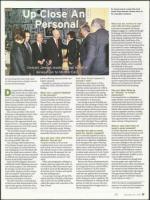

Dr. Conrad and Dr. Lynda Giles flank
Israeli Prime Minister Shimon Peres at
his Jerusalem residence.
ad national
Detroit Jewish leade
delegation to Middle East.
JN Contributing Editor Robert Sklar edited
this Giles report, based on a lengthier overview
presented to JCPA leadership.
D
r. Conrad Giles of Bloomfield
Hills and his wife, Dr. Lynda Giles,
led a 16-member delegation of
American Jewish community leaders to
Israel for meetings with Israeli President
Shimon Peres, Palestinian Prime Minister
Salaam Fayyad, members and advisers of
the Israeli government, academics, and
religious and social leaders.
Giles, former president of the Jewish
Federation of Metropolitan Detroit, chairs
the Jewish Council for Public Affairs
(JCPA), the Washington-based public
affairs arm of the organized Jewish corn-
munity. The Dec. 4-8 meetings were held
within the framework of the JCPA annual
leadership mission to Israel.
"The incredible amount of information
and analysis shared with our leadership
will enable the JCPA to play a more effec-
tive role in shaping policy and strategy in
the coming months:' Giles said.
"Our meetings with President Peres,
Prime Minister Fayyad, who is the archi-
tect of the largely successful Palestinian
state-building plan in the West Bank, offi-
cials in the Israeli prime minister's office,
members of Knesset and others elucidated
the difficult road ahead for peacemaking
between Israel and the Palestinians."
Topics the JCPA delegation discussed
included the Israeli-Palestinian peace pro-
cess and the progress of the Palestinians;
the strategic security threat posed by
Iran's nuclear program; Israel's economy
and last summer's social protests; and
Knesset legislation affecting Israel's
minorities and freedom of speech.
The JCPA will hold its annual plenum
in Detroit next May. Representatives from
major Jewish agencies and leaders from
125 communities will convene to vote on
policies reflecting American Jewish com-
munity consensus.
Herewith is a summary of Conrad and
Lynda Giles' JCPA Leadership Mission
findings:
What was a special highlight
of the journey?
Being welcomed into the beautiful home
of Israeli President and Nobel Laureate
Shimon Peres, who expressed the hope
that negotiations between Israel and
the Palestinians will commence soon.
Volatility in the Arab world, he observed,
makes reaching a final peace agreement
that much more important.
Nothing is perfect, he asserted, and
while you can't change people, it is pos-
sible to change situations. Hasbara (public
diplomacy) is a matter of perception.
Israel is inevitably perceived as the occu-
pier of the Palestinian people. Nothing
other than peace, Peres maintained, fun-
damentally will alter this perception.
How did your visit with Prime
Minister Fayyad go?
The prime minister, by all accounts
including Israeli sources, has successfully
built security and economic institutions
that will help sustain a future independent
Palestinian state. He expressed the view
that the Palestinians, according to key
international bodies, already are "state-
ready."
While acknowledging the challenges in
forging a final peace agreement under cur-
rent conditions, efforts that remain impor-
tant both to Israel and the Palestinians, he
stressed the need to continue and expand
the state-building project.
As in previous meetings with the JCPA,
Fayyad noted that, ultimately, a Palestinian
state could not be successfully launched
without the support and cooperation of the
State of Israel.
How does Israel respond to
Fayyad's take?
Ron Dermer, senior adviser to Prime
Minister Netanyahu, told us that while
Israel has certain expectations or redlines
with respect to its security needs, there are
absolutely no preconditions for starting
talks with the Palestinian leadership. All it
seeks is a partner across the table that is
not committed to its destruction.
Iran, through its proxies Hezbollah and
Hamas, has taken advantage of Israel's with-
drawals from southern Lebanon and Gaza.
Israel's courageous risks for peace, Dermer
asserted, have only been met with violence
and a buildup of weaponry on its borders.
Israel knows that "three strikes and you're
out" — and it cannot risk Iran also seizing
control of the West Bank. These conditions
not only present challenges to Israel's secu-
rity, he stressed, but also to Israel's survival.
Describe the talk on Iran's
quest for nuclear weapons?
Iran is universally regarded not only as
the greatest strategic threat facing Israel
today, but also a significant destabilizing
factor throughout the region. Following
last month's International Atomic Energy
Agency report confirming Iran's drive
toward nuclear weapons capability, efforts
to initiate tough sanctions on Iran's Central
Bank have become the focus to intensify
the pressure on the regime in Tehran to end
its illicit nuclear activities.
However, the Obama administration has
expressed some concerns with this particu-
lar strategy. Matt Eussen, a political officer
in the U.S. Embassy in Tel Aviv, warned
us that sanctioning Iran's Central Bank
could have the opposite effect by boosting
oil prices and benefiting Iran financially,
further feeding its nuclear capabilities. The
Obama administration is working with key
partners to tackle the concerns and move
forward appropriately and aggressively on
effective sanctions.
What was the context of your
visit with Christian leaders?
In the heart of Jerusalem's Old City, the
delegation engaged in a candid and thought-
ful exchange with Christian leaders from
many churches, which was hosted by the
Latin Patriarch Archbishop Fuad Twal and
facilitated by Rabbi David Rosen of the
American Jewish Committee. We learned
that receiving permits for housing projects
in Jerusalem is a major challenge facing
this community. In many cases, Christian
families are outgrowing their homes and
receiving permission from the Israeli
government for this construction is dif-
ficult. They appealed to us for our help
in communicating their concerns to the
appropriate officials, and we committed
our leadership to this cause.
In recent years, the JCPA has been deeply
concerned by instances in which clerics
and others wearing crosses have been spat
upon in the Old City, apparently by Jewish
students. We readily advocated for a more
assertive response from Israeli government
officials; we were heartened to hear that
these incidents have been decreasing.
How are sides lining up
on "threats" to Israel's
democracy?
It was important for our delegation to
explore whether recent Knesset bills were
endangering Israel's democracy. Some indi-
viduals passionately defended the strength
of Israel's democracy, particularly Justice
Minister Yakov Neeman. Others fiercely criti-
cized these legislative initiatives, including
Professor Mordechai Kremnitzer and Amir
Fuchs of the Israel Democracy Institute.
They argued that these were attempts to
silence criticism of the government.
What is your takeaway on
Israel's social protests?
At Tel Aviv University, we met with student
leaders from this summer's protests as well
as with Professor Dan Ben-David, who
gave an analysis of social, employment and
education trends that, if they continue, will
pose major challenges in the years ahead.
Israel's cost of living, particularly housing,
exceeds other Organization for Economic
Cooperation and Development countries,
wages for employees are far less and there
has been a deterioration of public services,
such as health and education.
This is the situation even though Israel
has more people, more capital and more
productivity. In essence, these circumstances
drove the social justice protest movement
this summer in Israel. Professor Ben-David
fears that increasingly Israelis will emigrate
if the gap between what they will receive
abroad, as opposed to what they will get in
Israel, continues to widen.
JCPA is the national coordinating/advisory
network for 14 national and 125 local agencies
in the field of Jewish community relations.
December 29 s 2011
17