

MEI >> on the cover
book titled On the Wings of Healing
(Heliographis, Ltd.), and numerous maga-
zine and journal articles.
"I want my legacy to be more than bar
mitzvahs and budgets',' Schwartz said.
The day-to-day operations of the temple
will be handled by Schwartz's colleagues,
Rabbis Michael Moskowitz and Daniel
Schwartz (no relation), and Executive
Director Andre Douville. Schwartz equates
the transition to a parent sending his adult
child out into the world.
"Sometimes the best thing a parent can
do is let the child go, but still be around for
counsel',' he said.
Early Days
According to Schwartz, Temple Shir Shalom
was founded on "a hope and a prayer and
a dream." His vision took hold after leaving
his previous position at Temple Beth El in
Bloomfield Hills. He describes that experi-
ence in the matter-of-fact way that is his
trademark.
"I was fired," he said. "I thought I was a
partner. They thought I was an employee.
They were right. In the end, they did me the
biggest favor in the world. How many peo-
ple have the opportunity to do what I do?"
Finding himself without a congrega-
tion, Schwartz decided to create his own
institution, one that was mission-based
and different from anything that existed
in Metro Detroit. It was a bold move, made
with a handful of congregants and very few
resources.
"It was like calling a parade and hoping
there's going to be a parade," he said.
Shir Shalom began in a rented office
building near Maple and Orchard Lake
Road. High Holiday services were held in
the auditorium at West Bloomfield High
School. Schwartz describes the creation of
Shir Shalom as a transformative experi-
ence, one that imbued him with pride and
humility.
"It wasn't about the rabbi or the board
— it was about wonderful people sweating
blood and tears and being able to do things
with no money and making it work:' he
said.
After a needs assessment study revealed
that intermarried Jews felt they had no
place in the existing synagogues within
the community, Schwartz set out to create
a religious institution where intermarried
Jews would feel welcome and accepted.
"If you reach out to both sides, you create
a feeling that they're family," said Schwartz.
He placed a series of ads in the Jewish
News, one of which depicted the biblical fig-
ure Ruth, who was intermarried, with word-
ing stating that she and her family would
have been welcome at Shir Shalom.
"A lot of traditional Jews went berserk','
Schwartz said. "Back then you couldn't hold
a meeting about intermarriage in this com-
munity; it was considered encouragement:'
he said. "To me, a crisis was an opportu-
nity:'
10 December 22 • 2011
Pho tos by An dre Douv il le
CONTINUED FROM PAGE 1
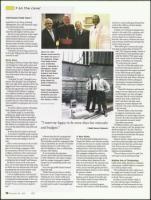
Above: At a Shir
Shalom event honoring
the rabbi's 40 years in
the rabbinate: Temple
Israel Rabbi Harold
Loss, Archbishop
John. C. Nienstedt of
Minneapolis, Temple
Shir Shalom Rabbi
Schwartz and Pastor
Robert Bailey of
Atlanta. The interfaith
group shows the
depth of Schwartz's
involvement.
Right: Rabbis Dannel
Schwartz and Michael
Moskowitz pose dur-
ing the construction of
Shir Shalom in 1995.
Photo courtesy of Shir Shalom
"I want my legacy to be more than bar mitzvahs
and budgets."
– Rabbi Dannel Schwartz
Schwartz describes the congregation's
growth as an "overnight phenomenon."
Thirty families joined the congregation that
May. By September, the number of member
families had grown to 500. Today more
than 950 families, or close to 4,000 people,
belong to Shir Shalom.
To accommodate the expansion,
Schwartz hired Rabbi Michael Moskowitz
in 1995. Moskowitz, who enjoys working
with the younger congregants, regards
Schwartz as an outstanding mentor and
role model.
Four years ago, Rabbi Daniel Schwartz
joined the staff.
"Rabbi Schwartz has been a wonder-
ful teacher to me:' Daniel Schwartz said,
"helping me to be a better rabbi and a
better person. He is always looking for
new and innovative ways to bring Judaism
to people and to make it meaningful and
relevant."
A New Home
The West Bloomfield building that houses
Temple Shir Shalom took only nine months
to build, but five years to conceive. Schwartz
envisioned a multipurpose facility that
would provide a warm and intimate set-
ting for groups ranging from 200 to 2,000.
The synagogue, designed by architects
Ken Neumann and Joel Smith, resembles
a Torah Scroll unfurling from right to left,
with a walkway that is patterned in the
form of an olive branch. The sanctuary has
a balcony that can be converted to class-
rooms, and an interfaith garden provides a
spiritual setting for outdoor services during
the summer months.
"He's an entrepreneur, an outside-the-box
thinker, a grand visionary," Douville said.
"Shir Shalom would not exist without his
vision and his perseverance."
He developed a preschool program,
housed at The Corners in West Bloomfield,
based on a camp model, geared toward the
needs of the children and their families
instead of the calendar.
Another one of Schwartz's popular inno-
vations is the weekly Tish, a question-and-
answer session that follows the Shabbat
services. Based on an Orthodox custom
from the 14th century, Schwartz saw it as a
way to increase involvement and make the
services more personal.
"Most rabbis give a sermon, ask a ques-
tion, give an answer, then say Amen'," he
said. "The Tish gives people a chance to
ask all kinds of crazy questions, espe-
cially the children." The topics range
from current events to why Jews put
stones on headstones in cemeteries.
"It's rarely about the sermon."
Guy Stern of West Bloomfield, who
has known Schwartz for almost 30
years, appreciates the support provided
by the rabbi during several signifi-
cant moments, including the death of
Stern's first wife, Judy Owens. Schwartz
also officiated at Stern's subsequent
remarriage to Susanna Piontek, and
supervised her conversion to Judaism
as well.
"I found his eloquence and internal-
izing of our own experiences so deep
and thorough; I was time and again
impressed with the way his intuition
worked. He is truly a rabbi for his
flock," said Stern, who also enjoys
engaging in scholarly dialogue with
Schwartz. "The scope of his learning is
truly amazing."
Schwartz makes it clear that while
he supports conversion for certain
individuals, it is not the right choice for
everyone. He said some people refrain
from conversion because it would
upset their own parents.
"In biblical tradition, we're supposed to
take care of people at risk, `the stranger who
dwells amongst you'," he said. "There are
those who have accepted Jewish people but
not necessarily the Jewish faith. My respon-
sibility is to protect them."
Schwartz said he is happy when he sees
teens from mixed marriages stay involved
in temple life after their bar and bat mitz-
vahs. He has even seen Christian grand-
parents attend services to be with their
children and grandchildren.
"There are times you lose,' he said, "but
you've got to suit up and keep trying."
Making Use of Technology
Unlike many rabbis, Schwartz is a talented
entrepreneur, a skill he believes is essential
for a rabbi in today's world.
"The traditional role of the rabbi was to
be a judge and a teacher',' he said."It wasn't
about business, but without bread there is
no Torah. This is a new age."
He plans to use his business skills in
his work with the Legacy Foundation, a
fundraising tool that incorporates the use
of technology to reach its audience and its