

arts & entertainment
.ammt
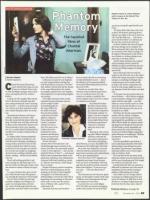
Delphine Seyrig in Jeanne Dielman,
which screens at the Detroit Film
Theatre on Nov. 26.
The haunted
films of
Chantal
Akerman.
Nicolas Rapold
Tablet Magazine
C
hantal Akerman's filmmaking
career started with a bang. As a fan
of Jean-Luc Godard's Pierrot le fou
in 1968, the Belgian teenager made a short
movie, starring herself, in her mother's
kitchen.
In Saute ma vale (roughly, "Blow Up My
Town"), she messes about the tiny tiled
space, doing nonsensical "chores" and sing-
ing to herself — and then turns up the gas.
Cue a black screen, then explosion sounds,
and a master European auteur was on her
way.
Akerman's most famous work, Jeanne
Dielman, 23 Quai du Commerce, 1080
Bruxelles, is more like the silence before the
bang. The three-hour 1975 film, which will
be shown at the Detroit Film Theatre in the
Detroit Institute of Arts 2 p.m. Saturday,
Nov. 26, is usually dubbed a landmark femi-
nist film but is actually a landmark film of
any stripe.
Its simple, really: Akerman attentively
chronicles three days in the life of a wid-
owed Brussels homemaker, including her
turning tricks to provide for her son (dis-
creetly, not Belle de Jour style). Its action-
packed, but for the most part not with the
sort of action you usually see: prepping a
chicken breast, scrubbing a bathtub, quiet
dinners, reading —all shot, lit and framed
with care.
There's still nothing quite like it, and
most amazing was Akerman's age: At 24,
she had written and directed a mature work
that seemed to contain a lifetime of experi-
ence.
In a sense Akerman does carry several
lives within her, like many of her genera-
tion, through the experiences of her family.
Born in 1950 to Polish Jews who had
resettled in Belgium, she belongs to the
ranks of second-generation survivors:
Her mother lived through Auschwitz; her
grandmother and other relatives were killed
there. (Her father spent the war in hiding.)
keen yet hands-off, with an overarching
In Brussels, her parents were shopkeep-
yet internally flexible conceit — shows
ers, and, caring and hard working, they
the influence of the ominously dubbed
took the position of trying not to "burden"
Structuralist filmmaking that had its hey-
their children with the past. But the trauma day in the 1970s.
of the camps filtered down. Her mother,
Ground zero was New York, where
for example, pushed food on her daughter,
Akerman visited and lived several times;
believing that her normal-looking daughter over a 17-month period in 1972, she
was anorexic.
worked as a waitress, a model for New
In her films, Akerman works out this
School sculpture classes and even a cashier
transmitted sense of phantom memory
at a midtown porn theater.
and the weight of inher-
She admired the diary-
ited autobiography. Yet
like films of Jonas Mekas,
the range of films she
himself a Lithuanian refu-
has made in the past
gee, which she compared to
three decades includes
"homemade cooking"; La
a mall musical (Golden
Region Centrale, an improb-
Eighties), a hypnotic
able work by Structuralist
Proust adaptation (La
heavyweight Michael Snow
Captive), a romantic
involving a programmed
comedy ( U/1 Divan a
camera on a mountain
New York) and a revue
peak, also stuck in her
of jokes and stories
mind.
performed by actors,
Teaming up with cinema-
amateurs and Akerman
tographer Babette Mangolte,
(American Stories/Food,
Akerman conducted her
Family, and Philosophy). Filmmaker Chant al Akerman
own austere experiment in
For her 1993 docu-
observation and lighting,
mentary D'Est ("From the East"), she
Hotel Monterey, at a since-demolished wel-
traveled through several countries in the
fare haunt on New York's Upper West Side.
former Soviet bloc. She consciously avoided
Yet as critic Amy Taubin has succinctly
a "back to roots" approach — she's said she
observed, Akerman ultimately took such
simply felt "drawn to 'there' — and instead impersonal constraints and combined them
filmed a dense, unannotated album of dis-
with an open, humanist heart.
parate faces and places: men walking down
News From Home (1977) elegantly and
a deserted twilit road, bundled-up crowds
poignantly punctuates the picturesque
in a Moscow train station, a child rolling a
worn-out streets of Manhattan with read-
toy car at home.
ings from her mother's sweetly concerned
Despite the historic period of transition,
letters from Belgium. ("It was nice to get
there's not a whole lot going on, strictly
your note ... I am sorry that it was so
speaking. As the title of Ivone Margulies'
short.")
monograph on the filmmaker puts it,
That Akerman does the voiceover, speak-
Nothing Happens. And yet the stuff of life is
ing for and through her mother (both exiles
happening, and, increasingly in Akerman's
of different sorts), demonstrates the layer-
recent work, we also sense the tectonic
ing of experience in her films.
forces of History with a capital "H',' too,
In an interview on a recent Belgian
underneath it all.
DVD of the film, her poised and engaging
Akerman's style here and elsewhere —
mother (who puzzles over the lack of get-
up-and-go among like-aged friends) puts
it best.
"It's funny, all her films have a bit of me
in them," she observes, puttering about a
kitchen very similar to the one in Saute ma
ville."Just like Hitchcock ... I also have a
part in all of her films." It is Akerman, by
the way, who conducts the interview.
In Jeanne Dielman, the sense of the past
that seeps through can be complex. The
film is commonly held to show the drudg-
ery of woman's work while according to it
the dignity of being shown at all. (There's
more drama to a cooking mishap at one
point than a visit from a john.)
And for Jeanne Dielman, who is played
with increasingly robotic serenity by
Delphine Seyrig, busywork keeps the anxi-
ety away; if nothing changes, everything
must be OK.
But in Akerman's interview with her
mother, as she draws her out on the subject
of life in the camps, the practice of routine
emerges as something terrifyingly vital,
a desperate goal. As her mother recalls,
so long as she and her companions were
forced to work, purges might not occur;
any departures from this routine were final
ones.
At the same time, the routines shown in
Jeanne Dielman like Dielman wrapping
a scarf around her teenage son or unpack-
ing his sofa bed each night — are what
make up a sense of home. And so it is that
Akerman can describe the film as "an act
of love for those gestures that you are sur-
rounded by as a child."
Elsewhere, she also has connected this
routine with the comfort of religious
ritual and recalled the pleasure of pray-
ing alongside her grandfather as a small
child. With his death, her religious school-
ing stopped, and though she says her lack
of belief makes a return impossible, she
always missed the rituals and meaning
of prayer. (In Nothing Happens, Margulies
quotes Akerman as searching for "rhythms
of psalmody" in some of her lilting
voiceovers.)
From her grandfather's generation, it
is her maternal grandmother with whom
Akerman feels a special bond. An artist,
she painted "big canvasses',' according to
Akerman's mother, none of which appar-
ently survived her death.
But a text did survive: her diary, which
Akerman's mother preserved and inscribed
with her own loving memorial. (Her daugh-
ters would in turn add their own.)
Excerpts from this diary are central to a
2004 work by Akerman, one of the several
installations she has started creating in
addition to filmmaking and writing.
These reflect an ever-stronger interest
in opening up multiple perspectives and
voices; for instance, To Walk Next to One's
Shoelaces in an Empty Fridge features pro-
jected text from the diary and a video of
—
Phantom Memory on page 52
November 24 « 2011
49