

health & fitness
Hope For Parents
Family Circle Conference speaker focuses on strategies for difficult children.
Ronelle Grier
Contributing Writer
Levy also cited "entitlement" as the
most common problem exhibited by
today's children and teens. He said chil-
dren are only entitled to four things:
food, shelter, clothing and education. He
believes that non-necessities should be
earned rather than simply handed over.
"Kids 'need' things like iPads and iPhones;
they think they don't have to earn privileges
or abide by the rules of the house,' he said.
West Bloomfield child and adolescent
psychologist Steve Spector said Levy con-
firmed his belief about the importance of
a positive relationship between parents
and children.
"I came for support:' said Elaine Kahn,
an Oak Park mother of three boys. "I
learned it's good to look for the small
things — and that you should never give
up. It's hopeful."
A
ny parent who has faced down a
strong-willed or stubborn child
knows the frustrating battle
of wills that can ensue over the simplest
issues, such as homework or household
chores. In his presentation, "Mission
Possible: Motivating and Managing
Difficult Children and Teens," psycholo-
gist Ray Levy gave hope to the more
than 250 parents and professionals at the
17th Annual Anita Naftaly Family Circle
Conference at Congregation Shaarey Zedek
in Southfield on Oct. 30.
Levy, a private practitioner in Dallas
and a frequent lecturer nationwide, said
that even the most difficult child or teen
will respond to positive feedback over
time, and that a strong relationship is the
foundation of good parenting.
"Strong-willed, defiant kids can make
you feel like the most incompetent parent or
teacher," said Levy. "It's like hugging a cactus."
According to Levy, several myths keep
parents from being effective, such as the
belief that failing will lead to low self-
esteem. He said good parenting can be
summarized in five basic rules:
Rule 1: Experience is the best teaching
tool.
Levy said that parents often intervene in
their kids' lives to prevent them from fail-
ing, which robs them of valuable learning
experiences, both positive and negative.
"We want the best for our kids and, also,
we don't want to deal with our own anxi-
ety when our kids are hurt," he said. "If it's
not lethal, then it's usually a good thing if
they experience it:'
Rule 2: Over-scheduling leads to burn
out.
Parents enroll their children in a multitude
of extracurricular programs to give them
a competitive edge or prevent boredom,
according to Levy, but too much activity
can lead to other, more serious problems.
He has seen kids diagnosed with ADHD
(Attention Deficit Hyperactivity Disorder)
who are really suffering from over-sched-
uling.
"Kids need downtime,' he said, "or they
get burnt out."
Rule 3: Electronics should not rule our
lives.
Levy said it is detrimental when children
or adults are constantly connected to elec-
tronic devices such as phones, tablets and
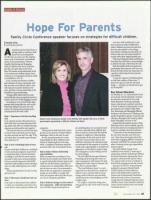
Family Circle Conference founder Anita Naftaly with speaker Ray Levy, a Dallas
psychologist specializing in difficult children and teens.
computers.
"Some parents think their kids cannot
go from soccer practice to home without
watching a video on the way,' he said.
He also warned parents not to take
responsibility for their children's enter-
tainment, harkening back to the days
when a complaint of boredom would be
answered with a list of household chores.
Rule 4: Rules without relationship
equal rebellion.
Rules are important, according to Levy,
but they do not usually work unless there
is a good relationship between parent and
child. He said that women typically con-
centrate more on relationships, while men
tend to focus on rules. He recommends a
blend of the two approaches, saying that
people are more likely to comply with
rules and requests when they like the per-
son who is setting the guidelines.
Rule 5: Behavior changes are the result of
two components – skills and motivation.
Levy said that simply knowing how to
do something does not necessarily result
in action, especially where difficult chil-
dren or teens are concerned. He used the
example of weight loss: Understanding
the principles of diet and exercise does
not lead to success unless there is also
sufficient motivation. He said that people
are motivated by the promise of a positive
result, such as good grades or an improved
appearance, or the desire to avoid a nega-
tive consequence, such as failing a test or
loss of privileges.
"We can't talk kids into good behavior.
Preaching and lecturing don't work; we
need consequences with impact:' he said,
adding that it takes more to motivate chil-
dren who are strong-willed.
"The Good Behavior Game" is a tech-
nique that Levy described as a simple yet
effective way to motivate kids by recog-
nizing positive behavior and providing
reinforcement by acknowledging even the
smallest steps.
"It's tough to catch them doing some-
thing good': he said. "Don't wait for the big
stuff."
Day School Educators
On Monday, Oct. 31, representatives from
six local day schools attended a seminar
for educators presented by Levy and
Rabbi Binyamin Ginsberg, nationally
known educational consultant and dean
of Torah Academy in Minneapolis. Levy's
presentation was entitled "Light Their
Fire: Motivating and Managing Difficult
Students in the Classroom." Ginsberg, who
speaks frequently to groups of parents and
educators throughout the country, talked
about "Discipline: As Easy as Pie."
Frankel Jewish Academy teacher Chaye
Kohl found Levy's advice helpful, especial-
ly his ideas about encouraging students to
practice acceptable classroom behavior.
"I have been in the teaching business
for over three decades and, in the pro-
cess, I have discovered approaches that
work when engaging different students in
learning," said Kohl. "It is always helpful
when a veteran teacher gets approbation
from an expert."
The Anita Naftaly Family Circle
Conference was started 17 years ago in
conjunction with the Federation's Alliance
for Jewish Education Opening the Doors
program, which provides special educa-
tion support and services to students at
local Jewish synagogues and day schools.
Sponsors for the Oct. 30 presentation
included Community Mental Health
(CMH) Oakland County Authority,
Henry Ford Health System Center for
Autism and Developmental Disabilities,
Oakland Family Services Community
Living, Macomb Oakland Regional Center
(MORC), Easter Seals, Kaufman Children's
Center, Jewish Family Service and Jewish
Vocational Service. Li
November 24 2011
31