

metro
Addressing Anxiety
Kadima's educational conference focuses on causes
and treatments for anxiety at a young age.
Ruthan Brodsky
Special to the Jewish News
I
t came as a complete surprise when
the Kadima educational conference
committee learned that its keynote
speaker, Dr. Daniel Pine, was Jewish. They
found out at the welcoming dinner on the
Thursday before the conference, the same
time Pine discovered that Kadima was a
Jewish organization. It was a heartfelt and
unplanned shiddach (match).
"We were surprised that many who
attended wrote notes of thanks on their
evaluation sheets, which make Kadima
and the Jewish community very proud we
could do this:' said Leah Foltyn, Kadima
Community Relations Coordinator.
Kadima's biennial educational con-
ference was held Nov. 4 at the Oakland
Schools Conference Center in Waterford.
This year it dealt with anxiety in chil-
dren, teens and young adults. Kadima is
a nonprofit, non-sectarian mental health
agency in Southfield that provides resi-
dential and support services for children
and adults with mental illness in Oakland
County.
Pine, a psychiatrist, directs the
research program on mood and anxiety
disorders of children and adolescents
at the National Institute of Mental
Health in Bethesda, Md. Pine also is the
recent recipient of the Ruane Prize for
Outstanding Achievement in Child and
Adolescent Psychiatric Research,
"The three things that are most impor-
tant to me Pine told the
audience in his intro-
duction,"are family,
Judaism and my mental
health research:' He let
the audience know that
his wife, Judith Brazenis,
is a Reform rabbi in
Washington, D.C., where they
live. His sister, Debby Pine,
and her husband, Andy Busch,
are both rabbis in Baltimore.
Describing himself as a
liberal in life but a
conservative
in medicine,
Pine let the
audience know
that there are huge
limits to science and that even with more
research, there are more questions than
there are known answers.
Three major areas were covered related
to anxiety in children, teens and young
adults. Targeted to an audience that con-
sisted of educators, counselors, psycholo-
gists and parents, the first part of his
three-hour discussion demonstrated that
the number of children diagnosed with
anxiety disorders has increased signifi-
cantly in the past 10 years.
"Kadima is proof of that:' says Lita
Zemmol, co-chair of this event. "Calls to
Kadima for help with children from par-
ents and schools continue to increase. We
plan to use Dr. Pine's insight and research
to help keep our services and programs
moving in the right direction."
Anxiety Can Be Treated
Pine pointed out the range of different
symptoms that children and teens display
when they have an anxiety disorder. All
of them, however, involve some level of
fear or nervousness and a tendency to feel
more afraid then most children are in that
same situation. It is this degree of anxiety
that gives them the designation of anxiety
disorder.
"The easiest way to differentiate
between two responses is if one child's
response interferes with his or her ability
to take action:' Pine said. "A fairly corn-
mon example is a 6-year-old so afraid of
school that he refuses to enter the build-
ing or a student too afraid to speak in
front of the class who receives a failing
grade."
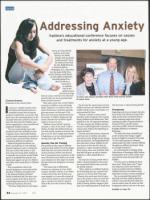
Co-chairs Lita Zemmol and Robin Tobin Murav flank keynote speaker
Dr. Daniel Pines.
The fact that the anxiety issues of most
children and teens are relatively mild and
readily treated was the second major con-
cept presented by Pines.
"Anxiety is similar to many mental
disorders in that symptoms often emerge
during childhood and adolescence Pine
explained to the 150 registered attendees.
"It is also common for children and ado-
lescents to exhibit high levels of anxiety at
various times without that signifying an
anxiety disorder."
The data show that between 10 percent
and 20 percent of children and adoles-
cents have periods of high anxiety during
their development. The longitudinal data
show that most of these children, by the
time they're in their late 20s, show no
symptoms or signs of anxiety problems.
Their anxiety issues were transient. More
than half will grow up with no anxiety
problems or other mental illness as
adults.
The response of many parents when a
child is extremely fearful is to be protec-
tive toward that child so they can avoid
the fearful situation.
"When children are inhibited and fear-
ful of attending day care, a parent's first
response is to rescue them:' Pine said.
"However, they need some level of expo-
sure to the anxiety so they can learn how
to manage their fear. In other words, it's
really by having children engage in their
fears and confronting them in small doses
that they learn to tolerate feeling fearful."
Treatments
Depending on the type of anxiety disorder,
the severity of the disorder, the age of the
child, and the home and school environ-
ments, treatment ranges from closely
watching the child to Cognitive Behavior
Therapy (CBT), to specific medica-
tions such as SSRIs (Selective Serotonin
Reuptake Inhibitors) or Attention
Retraining.
"The latest data show reasonably sup-
portive evidence that Omega 3 supple-
ments are helpful in treatment,' Pine said.
"So does small exposure to whatever
stimuli makes the child so fearful. Different
therapists use different treatments. Many
use multiple treatments."
As a retired teacher in Berkley, Robin
Tobin-Murav of Farmington Hills, Kadima
board member and co-chair of this event,
notes that the issues discussed affect all
families.
"I've been active in Kadima for about
three years," Tobin-Murav said. "I know
how important earlier intervention is
in the successful treatment of children.
Children don't have the toolbox to help
themselves, but they can learn techniques."
Pine recommends that parents first
find help from their child's pediatrician
if they're concerned that their child may
have an anxiety issue. He points out that
bringing the anxiety issue out in the open
Anxiety on page 36
34 November 17 2011