
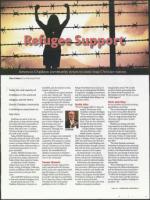

America's Chaldean community strives to assist Iraqi Christian natives.
Don Cohen Contributing Writer
Today, the vast majority of
Chaldeans in the world are
refugees, and the Metro
Detroit Chaldean community
is working on many fronts to
help them.
Chaldeans are native to the area
today known as Iraq and were among
the earliest Christian communities in
the world dating to the first century.
Before 2000, there were 1.2 million
Christians living in Iraq, primarily in
the south of the country.
Today, 300,000 Christians are
Internally Displaced People (IDP) with
most having moved to the north of the
country to escape Islamist violence in
the unstable nation, which provides no
constitutional guarantees to its reli-
gious minorities.
Another 300,000 Christians have
fled to other Middle Eastern countries,
primarily Syria, Jordan, Lebanon and
Turkey. Others have moved to Europe.
An additional 18,000 Chaldean
refugees have come to the United
States, settling in Michigan, California,
Arizona and Illinois. More than a third
have arrived here in the past three
years.
About 600,000 Christians are living
in fear and scattered throughout Iraq.
Joseph Kassab, director of the
Chaldean Federation of America in
Southfield, says the situation in Iraq
remains very serious.
"It is definitely not a good situation
at this time Kassab says. "They live
in fear and cannot live a normal life.
There is organized terrorism against
our people in Iraq by the Islamists
and the militias who target our clergy
and our places of worship."
Local resettlement is
primarily focused around
family reunification.
Chaldean community
institutions provide sup-
port to these refugees and
help leverage state and
national support. "Project
Bismoutha" (Healing) was Joe Kassab
begun in the past year
to provide free health
services to refugees and community
members by professionals in the
community. The program is similar
to the Jewish community's "Project
Chessed" (Kindness) run by Jewish
Family Service of Metropolitan
Detroit. The Southfield-based
Chaldean Community Foundation
also is instrumental in providing ser-
vices to the community.
Tenuous Moments
A legislative priority, supported by
major national and local Christian,
Jewish and secular organizations deal-
ing with refugees, is the Domestic
Refugee Reform and Modernization
Act of 2011 introduced in mid-March
by U.S. Rep. Gary Peters, D-Bloomfield
Township. The bill would update
guidelines for the U.S. Office of
Refugee Resettlement put in place 31
years ago, providing greater flexibility
to respond to changing circumstances
and directing more resources to states,
such as Michigart where refugees are
expected to move.
though Korkis noted, "We recently
received a family sponsorship from
the United Jewish Foundation [of
Metropolitan Detroit]. We are so proud
of that support:'
Quality Influx
But not all efforts are focused on bring-
ing Chaldeans out of Iraq.
"We are advocating for our people
to go back to Iraq and for those who
don't want to be resettled',' Kassab says.
"There is a large amount of fear that
Christians could be extinct in their
original lands."
Chaldeans are joining with other
Iraqi minorities to include protection
of the rights of religious and ethnic
minorities in the new Iraqi constitu-
tion. Kassab cites support of U.S. Sen.
Carl Levin, D-Mich., U.S. Rep. Sander
Levin, D-Royal Oak, and Rep. Peters in
this effort.
"The Iraqi Christian community
leadership is asking for some autonomy
near the Kurdistan area [on the Turkish
border] in the Nineveh Plain Province
Kassab says, even though it means Iraqi
Chaldeans will not be able to return to
their homes in southern Iraq, which the
large Shiite Muslim majority has made
inhospitable.
"We are lobbying the U.S. State
Department, the Obama administration
and the National Security Council for a
direct policy on the issue,' Kassab says.
"It will be for all religious minorities.
"Given the chance and the resources,
we are able and capable of making it a
paradise." BC
"We are bringing caliber to this corn-
mwiity," Kassab says of the
Chaldeans corning to Michigan.
"There are lots of professionals
and the majorities are college
graduates and high school stu-
dents. They are very urbanized,
just like the Russian Jewish
immigrants that came here?'
To help Chaldean refugees
who have fled Iraq to other
Middle Eastern countries,
the Chaldean Federation began the
"Adopt-A-Refugee-Family" program in
2007. Since that time, more than $1.5
million has been raised helping more
than 6,000 families through a partner-
ship with the Jesuit community in the
various countries of first-asylum.
All administrative costs, about
$3,000 each month, are paid for by
donors; 100 percent of donations go
directly to assist the affected families.
Sofia Korkis, who administers the
program for the Chaldean Federation,
says more than 2,000 donors provide
$100 per month for each family with
some donors sponsoring multiple
families. The program recently added
50 families in Lebanon in addition to
its work in Syria and Jordan.
Almost all of the funds come from
Chaldean community members,
Works Both Ways
October 2011
CHALDEAN NEWS I JEWISH NEWS 9
•
•