

• a
•
A
\ • t
•■
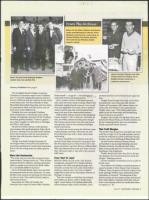
From The Archives
Below: At the 1966 Chatham distribution
center groundbreaking in Warren, Peter
Weisberg is perched on a land mover as
George Feinberg and Harold, Bernard,
Alvin and Harvey Weisberg huddle
around a shovel.
Above: Brothers Sharkey and Mike
George played an integral role in
building Melody Farms into a
Above: The Great Scott! braintrust Brothers
Leonard, Zach, Sam and Nate Fink
corporate powerhouse.
Grocery Tradition from page 6
The Southfield-based Chaldean American
Chamber of Commerce reports that Chaldeans
own 75 of the 85 independent grocery stores in
the city of Detroit and the majority of such stores
in the metro area. The Plum Markets in West
Bloomfield, Bloomfield Township and Ann Arbor
are operated by Matt and Marc Jonna, sons of
local wine maven Eddie Jonna.
Probably the most successful Chaldean
food entrepreneur in the Detroit area is Mike
George, the legendary patriarch of the Chaldean
American grocery business. "I wasn't a grocer. I
was a dairy supplier to 5,000 stores in Michigan
and Ohio," said George.
He and his brother started a milk distribut-
ing company after graduating from high school
and saw it develop into the well-known Melody
Farms dairy business, with the name based on
the fact that milk contains vitamin D, or the
mellow D."
George now heads George Enterprises of
Farmington Hills as he and his sons delve into
real estate, banking and myriad other businesses.
But he still has strong views on today's grocery
stores.
More Like Restaurants
"The stores now are more like restaurants than
supermarkets," George points out. "They all have
prepared foods for takeout, catering operations,
cafes for people to sit around and drink coffee.
It's a completely different business."
Karmo of Market Basket agrees, but also feels
the prepared foods are very necessary: "In many
families, both spouses are working and they have
no time to cook. They need hot food, ready to
take home and eat."
Meanwhile, Jim Hiller of Franklin, the
American-born owner of seven Hiller's Markets,
finds himself — at age 63 -- the patriarch
. of
what's left of the local Jewish grocers.
He's a modern version of the Jewish grocers
who came here from Eastern Europe, lived in the
old Jewish neighborhoods, arose at 4 a.m. to sell
fruit and vegetables from push carts or perform
various menial tasks. But several worked their
way to the top of the supermarket business.
Hiller's father, Sidney, started a then-Shopping
Center Market in 1941 in Detroit's old Polish dis-
trict. Jim Hiller, a lawyer-turned-grocer, bought
the business and turned it into the most promi-
nent grocery chain in the Southeast Michigan
Jewish community.
Survivors are scarce among the old-time super-
market families, and their memories are a bit
fuzzy. But they have a lilt in their voices when
reminiscing.
"It was a wonderful era in Detroit and we're
proud to have been among the many great fami-
lies who played such an instrumental role in the
grocery business," says Paul Borman of Bloomfield
Hills, who helmed the Farmer Jack chain of more
than 100 stores when it was sold to the national
A&P chain.
From 'Tom' To 'Jack'
Borman's father, Al, and uncle, Tom, Russian
immigrants, operated Tom's Quality Markets
starting in the 1920s and going through such
iterations as Food Fair and Lucky Stores before
settling on Farmer Jack. Tom's son is Federal
Judge Paul D. Borman for the Eastern District of
Michigan in Detroit.
"The men worked so hard that my husband
and I didn't eat dinner until 11 o'clock every
night," recalls Shirley Fink of Bloomfield Hills,
whose husband, Nate, and his brothers, Zach,
Leonard and Sam, had 53 Great Scott! supermar-
kets.
Wrigley Stores bought the Great Scott! chain,
boosting their store total past 100. Marilyn
Wolpin of Farmington Hills, whose father and
uncle, John and Nathan Lurie, operated the
Wrigley chain, says, "They really pulled them-
selves up by the bootstraps and worked long
hours to become successful!'
Wrigley's also bought the Big Bear chain, oper-
ated by the Shaye family, and Packer's Outlet, run
by the Grossberg family. Norman and Reuben
Cottler operated Dexter Davison.
Thin Profit Margins
"We worked very long hours and didn't get home
until late at night. So if my wife and kids wanted
to see me, they had to come to the store during
the day," says Alvin Weisberg of Bloomfield Hills.
He and brothers Bernard, Harvey, Harold
and brother-in-law George Feinberg operated
Chatham Markets, founded by their father,
Peter. It eventually grew to 51 markets and nine
Warehouse Way drugstores.
"Profits always have been very thin in the gro-
cery business, but we persevered and came out
all right," Weisberg intones.
Current Chaldean storeowners are on a path to
do the same.
The tradition of Chaldean and Jewish grocers is
a good example of what Wayne State University
Professor Mary Sengstock of Detroit means in her
book (Springer Media) Voices of Diversity: Multi-
Cuituralism in America: "The demands of the
diverse society are (to) respect others and accord
them their rights to maintain their lives and cul-
tures in the manner which we would want them
to respect us." BC
October 2011
CHALDEAN NEWS I JEWISH NEWS 7
6
<