
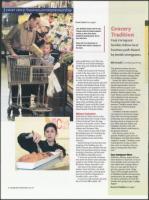

Farm Fresh
from page 5
Left: Gedaliah Cooper and his son,
Yehuda, shop the kosher products
section as does Sara Basya
Dougherty (background). All are
from Oak Park.
Below left: Cari Herskovitz of
Ferndale does kosher catering for
the store.
Grocery
Tradition
Iraqi immigrant
families follow local
business path blazed
by Jewish immigrants.
pens, people have to eat. They may
cut back on such impulse buying as
potato chips and candy, but they buy
the staples."
Denha says he puts in 60-70 hours
a week in the store, open 7 a.m. to 10
p.m. every day. There are 45 employees
to take care of 8,000 to 9,000 custom-
ers who visit the store weekly.
Denha always had separate aisles full
of kosher and Chaldean foods. But he
was surprised at the popularity of the
kosher foods, so he installed a separate
section in the 55,000-square-foot store
for kosher meats and groceries only,
costing about $3,500 a week to oper-
ate. "We provide 100 percent kosher
supervision, including a full-time
mashgiach," points out Rabbi Daniel
Neustadt, chairman of the Oak Park-
based Council of Orthodox Rabbis.
Midwest Customers
Rabbi Baruch Chaim says he comes
down from Flint twice a week to shop
at Farm Fresh and "loves the large
selection in the kosher section!' Other
customers come from as far away as
Indiana and Cincinnati, Ohio.
Closer to home, Franci Feld of West
Bloomfield praises the "friendly, help-
ful attitude of employees and the
store's cleanliness and wide kosher
selection."
Naomi Roberg of Oak Park has been
shopping at the building since the
Dexter-Davison days and likes that her
Farm Fresh purchases help buy stamps
resulting in donations and discounts
for 30 different charitable causes.
'A lot of our non-Jewish customers
even prefer the kosher meats and dairy
products," says Denha, "because they
feel they're cleaner and safer to eat!'
Like many of the modern super-
markets, Farm Fresh has a hot foods
takeout section, plus a catering opera-
tion run by Chef Cari Herskovitz of
Ferndale, with a crew of five.
As a service to all customers, the store
has a U.S. Post Office station. BC
6 CHALDEAN NEWS I JEWISH NEWS October 2011
Bill Carroll Contributing Writer
The grocery business has pro-
vided a common thread among
Chaldeans and Jews. But the Jewish
end of the thread is fraying, while
the Chaldean end gets stronger.
Except for Hiller's Markets,
almost all of the old-time, Jewish-
owned supermarket chains in
Metro Detroit are gone. Such
Chaldean grocery ventures as Plum
Markets, Market Square, Farm
Fresh Market and the Atisha family
with Lafayette Foods downtown
and three other area stores are
flourishing along with smaller inde-
pendent Chaldean stores. Many
occupy sites of former Jewish-
owned stores.
Chaldeans and Jews comprise
two segments of America's popu-
lation that are shining examples
of diversity and multiculturalism;
the Jews came to America in the
late 1800s and early 1900s, and
Chaldeans mostly in the mid-
1900s, Both found a safe haven in
the grocery business.
John Karmo, owner of the
popular Market Square stores in
Birmingham and West Bloomfield,
explains it simply: "Chaldeans were
mainly grocers in Iraq, so when
they came to America, they just
kept on doing what they knew
best."
Easy Immigrant Move
Adds Jerry Denha, owner of Farm
Fresh Market in Oak Park: "A lot of
those families were poor, plus the
men didn't have a proper educa-
tion, so it was easy for them to
get into a grocery store. Today,
many of the younger generation
of Chaldean families are becoming
professionals. My teenage daugh-
ter wants nothing to do with the
market; she's going to get a college
degree."
Grocery Tradition on page 7