

metro >> on the cover
Shofar, So Goo
Marvin Trimas reveals the secret to playing well: Practice!
Allan Nahajewski I Special to the Jewish News
CONTINUED FROM PAGE 1
A: Forty years. We have a wonderful rabbi, Aaron
Bergman, and a cantor, Daniel Gross, who is extraordi-
narily talented, as is his wife, Lauren, who is a fantastic
opera singer with a booming, gorgeous voice. She also
blows the shofar, and she's extremely good. We have an
excellent choir.
Q: How did you learn the shofar?
A: In New Jersey in 1964, a new synagogue needed a
shofar player. I was a musician, but I played woodwind
instruments, which use a reed. That's a lot different from
a shofar, which is a bone, usually a ram's horn. It would
be easier for trumpet players to learn. But I picked one
up and tried it. I wasn't good, but kept at it. I still thought
that if I couldn't make it sound awesome and do what it
was supposed to, I didn't want to play it. So I just kept at it
and, with a lot of practice, I taught myself.
Q: Where do you get a shofar?
A: At Judaic gift shops. I bought the large one in Israel
right where they make them. I didn't speak Hebrew, but I
was with a person fluent in Hebrew, and he bartered back
and forth, and we bought it. I purchased the one I use
most often from the cantor of our synagogue. They were
looking for a shofar blower here, and this is what I audi-
tioned on. It played well the first time I picked it up, so I
said that's the one for me.
Q: Do you need to hold your mouth a certain
way to play it?
A: With the kind of shofar I play, you put it on the side of
your mouth and purse your lips, like you're going to blow
a trumpet. With the larger shofar, you put it in the front of
your mouth. Where you get the best sound, that's where
you place your mouth. The horn cannot be changed. You
can't change the opening. You can't put a mouthpiece on
it. That's Jewish law. It has to be strictly the bone of the
animal.
Q: Do people applaud?
A: Some have, but they really shouldn't. It's embar-
rassing.
Q: When you play, do you try to outdo
yourself each time?
A: No, I really don't want a lot of attention on me.
I'm the announcer proclaiming to all that you bet-
ter change your ways, you better turn to God, you
better start doing things right. I focus on making
that awesome sound. I want everyone to get the
mitzvah, the blessing of the shofar.
Q: Do people tell you they want to learn
how to play?
A: All the time. And I love to help — especially the
children.
Q: What do you tell them?
A: I just let them know that 99 percent of playing
the shofar properly is practice. Boring, hard prac-
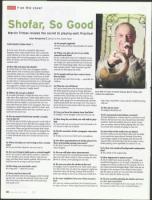
Even after 47 years of shofar blowing, Marvin Trimas still
tice, year after year, day after day. A lot of kids won't relishes the experience.
commit to that. They'll start, do it for a day or two,
then give up, which is just too bad. But it's the same
thing if you're going to be an extremely good musician.
had a dog, I would blow a note, and she would howl along
Unfortunately, that's the way it's got to be. The same in
with me.
sports. It's great to have innate talent, but you've still got
to put it in practice.
Q: Was she in tune?
A: (laughs) Absolutely not.
Q: Can you learn the shofar from YouTube?
A: (laughs) I never thought of that, but I bet you can.
Q: Do you practice just before a service?
A: Rosh Hashanah is a solemn day. You can't blow it at all
Q: How long do you think you will still be play-
that day. The last time you can is the previous day before
ing?
sundown. That's the problem. You see, if you're a musi-
A: I just want to go on as long as I have the breath to do
cian, you always warm up before playing. Here you can't.
it. I exercise. I take care of myself.
So you just blow and pray it's going to come out.
Q: Do the acoustics of the synagogue come into
play?
A: It helps. Lets just say I don't need a microphone.
Q: When you play, are you trying to hit a certain
note?
A: No, you can blow whatever note you want to.
Q: Are there organizations of shofar players? Is
there networking among your peers?
A: Not that I know of. We don't have a shofar players'
union. (laughs)
Q: Are you trying to hold notes a certain length?
A: Yes, one sound is called tekiah; another is called she-
varim. Another one is teruah, which is nine staccato
notes. And then there's tekiah gedolah, which means you
hold that note for as long as you have breath.
Q: Do you still play other instruments?
A: I love the piano. It's a beautiful instrument. When you
play, you're the whole orchestra. When you play the saxo-
phone or clarinet, you're playing just one note.
Q: How long can you hold a note?
A: A long time — about 45 seconds.
Q: Does your face turn red?
A: Oh, absolutely. And in the synagogue, while I'm hold-
ing the note, I can hear the buzzing. People start to talk
after 20 seconds, a little louder after 30 seconds, then
even louder at 45.
10 September 29 2011
Q: Any tricks of the trade you can share?
A: Here's a little secret: Just before I play, I put the shofar
in my mouth and warm the end. Because if you don't,
bone changes rapidly. It will expand, and the note will
expand while you're blowing it. But if you make it warm
before playing, you've expanded it as much as it can.
Q: Is that your medical background coming into
play?
A: No, I think it's the engineering.
Q: Do you ever play the shofar in the car?
A: (laughs) I have to admit that I do. That's where I prac-
tice. Most of the time, it's when I'm stopped at a light, but
sometimes when I'm driving. I always look around to
make sure nobody is next to me. If they are, I don't do it.
Q: How important is music to you?
A: Oh, If I didn't have music in my life ... It's the most
wonderful thing given to us. It's a gift. It absolutely is. It
changes your mood. It makes you very relaxed. I love it. I
had a dance band all through college. That's what got me
through. In the summers, I had a band in New Jersey. I
play the piano as much as I can. And when the holidays
draw near, I play the shofar every day.
Q: Do your neighbors hear you when you prac-
tice?
A: I close my windows and doors, but it's funny because
the dogs can hear it. When I play, they howl. And when we
Q: Do you consider playing the shofar an honor
as a Jew and a musician?
A: I consider it the highest honor you can get. I'm very
fortunate to be able to do it. It's a wonderful thing. 1,7]