

Holiday 101:
Rosh Hashanah
At A Glance
Elizabeth Applebaum
Special to the Jewish News
When We Celebrate
This year, Erev Rosh Hashanah falls on
Wednesday, Sept. 28. The holiday lasts
for two days, Thursday, Sept. 29, and
Friday, Sept. 30, among Conservative and
Orthodox Jews and one day among most
Reform and Reconstructionist Jews.
Why We Celebrate
Rosh ("head") Hashanah ("of the year")
marks the Jewish new year and commem-
orates the creation of the world.
The Torah commandment to observe
Rosh Hashanah is in Parshat Emor
(Leviticus 23:24), and Parshat Pinchas
(Numbers 29:1). The words "Rosh
Hashanah" are not stated in the Torah; the
name of the holiday was developed later.
Rosh Hashanah begins the three-week
holiday season that continues with Yom
Kippur, Sukkot, Shemini Atzeret and cul-
minates with Simchat Torah.
At The Synagogue
Like other Jewish holidays, Rosh
Hashanah features special prayers and
rituals. A unique feature of the day is
the practice of blowing the shofar, done
immediately before the congregation says
the silent Amidah prayer at Musaf
All congregants recite Psalm 47 seven
times. The shofar blower and the congre-
gation then responsively recite seven vers-
es drawn from Psalms and Lamentations.
The shofar blower next says two blessings,
after which he blows three sets of blasts.
This is followed by a responsive reading of
three verses from Psalm 89.
In the Ashkenazi rite, the shofar is again
blown during the cantor's repetition of the
Musaf Amidah; in the Sephardic rite, the
shofar is blown during the congregation's
silent Amidah prayer. The shofar is not
blown on Shabbat.
For the Torah reading, five persons
are called up. Except on Shabbat, the
Avinu Malkeinu prayer is recited after the
Amidah of the morning and afternoon
services.
Along with Yom Kippur, Rosh Hashanah
is the only day when we prostrate our-
selves in prayer, in a modified form,
as was done in the days of the Beit
HaMikdash, the Holy Temple. The prostra-
tion occurs during the Aleinu portion of
the Amidah.
Thematic Significance
Rosh Hashanah carries three main
themes. In addition to its importance as
the beginning of the calendar year, Rosh
Hashanah is regarded as the day of judg-
ment ( Yom HaDin), when God weighs the
acts of each person over the past year and
decides his fate.
Rosh Hashanah also is referred to as the
Day of Remembrance ( Yom HaZikaron),
when God remembers the world, and we
remember our relationship with Him. We
also reflect on our lives during the past
year, considering the right and wrong of
our thoughts and actions.
Rosh Hashanah is also the day on which
we publicly proclaim the sovereignty of
God.
Customs And Traditions
Rosh Hashanah is replete with symbolic
foods. A custom more than 1,500 years old
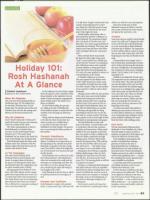
is to dip slices of apple in honey and recite
a prayer expressing hopes for a sweet
year. Many also dip their bread in honey
(instead of the usual salt) for the motzi
prayer that begins the meal.
Jewish families enjoy honey cake or
lekach (literally "portion" in Hebrew) on
Rosh Hashanah. The inspiration behind
this is the Book of Proverbs verse (4:2)
that reads: "For I give you good lekach, do
not forsake My teaching." The honey cake
reflects one's hope that those who follow
God's teachings will receive a "good por-
tion:'
Other symbolic foods may include
the head of a fish (a play on the word
"rosh"), carrots (based on a Yiddish pun
on the word for "increase") or pomegran-
ates (which have many seeds, symbolic
of many children or many good deeds.
Some also believe the pomegranate has
613 seeds, the same number of mitzvot, or
commandments, in the Torah).
A Chasidic tradition is to eat beets.
This was inspired by the Hebrew word
"selek," which means beet. Selek is said
to sound like sh'yistalku from the words
sh'y istlku oivaynu ("May we rid ourselves
of our enemies"), which is said on Rosh
Hashanah.
Though summer offers the best produce
of the entire year, some Jewish families
abstain from tasting any in those hot
months. Instead, they reserve enjoying
the first fruits of the season for the sec-
ond night of Rosh Hashanah, when one
may utter the Shehechiyanu, a brachah,
or blessing, said especially for doing
something for the first time (or, for the
first time in a certain season). The fruits
most popular on the second night of Rosh
Hashanah are pomegranates and grapes.
On Rosh Hashanah, we look with
hope to the future. A round bread is said
to symbolize a lifecycle that continues
unbroken and harmonious. While round
challah is the most popular on this holi-
day, some prefer to make a challah in the
form of a ladder, inspired by the High
Holiday prayer Unetaneh Tokef, which
includes the famous lines, "Who will live
and who will die/Who will be rich, and
who will be poor..." The ladder shows
one's hopes to rise on the ladder of life.
Among Jews from Ukraine, a popular
holiday challah shape is that of a bird,
echoing one's hope that God will watch
over the Jews. It is based on the Isaiah
verse (31:5): "As hovering birds, so will the
Lord protect Jerusalem."
Tzimmis is a traditional Rosh Hashanah
dish made with any variety of vegetables
and fruits, but always including honey and
carrots. In Yiddish, the word for carrot is
meiren, which also translates to "multiply:'
By eating carrots on Rosh Hashanah, we
hope that our blessings multiply in the
coming year.
Sliced carrots coated with honey fur-
ther are believed to resemble gold, which
reflects our wish for a year of prosperity.
Some Jews avoid nuts on Rosh
Hashanah because the Hebrew word for
nuts is egoz, which has the same numeri-
cal value as the word chet, or sin.
Tas
Some Jews observe tashlich, which literally
means "you shall cast." It begins late after-
noon on the first day of Rosh Hashanah,
or on the second day of Rosh Hashanah
if the first day is Shabbat. The inspiration
for this tradition reflects a desire to begin
the new year with a clean slate, with God
forgiving past sins that are literally tossed
away.
During tashlich, Jews assign "sins" to
bits of bread, then symbolically rid them-
selves of these by throwing the bread into
the water. Usually, this is accompanied by
the recitation of certain verses, including
Micah 7:18-20, Psalms 118:5-9 and 130,
and Isaiah 11:9.
Tashlich is not Halachah (Jewish Law).
The inspiration for the ceremony is Micah
7:19, which states: "You will cast all their
sins into the depths of the sea:' but little
is known about how the tradition began.
Some say it is an imitation of a pagan rite,
while others point out that fish, like God,
never close their eyes. (Thus, we should
remember that God's eyes are always
observing our actions.) Others note that
fish were among the first of God's cre-
ations, and so stood as witnesses to the
beginning of the world.
A custom associated with tashlich is
shaking out your pockets at the source
of water, likely in reference to a talmudic
verse comparing clean clothing to moral
purity. Another is adding a few verses
from the Zohar while reading psalms.
Fast Facts
The day immediately following Rosh
Hashanah is Tzom Gedaliah, one of four
fasts that begin at sunrise and end at
sundown (as opposed to Yom Kippur and
Tisha b'Av, which are 24-hour fasts).
Tzom Gedaliah commemorates the
murder of Gedaliah ben Achikam,
governor of Israel in the time of
King Nebuchadnezzar of Babylonia.
Nebuchadnezzar not only attacked and
destroyed much of Israel (including the
Temple sanctuary), he exiled virtually the
entire Jewish population there — except a
few, including the man he appointed gov-
ernor, Gedaliah ben Achikam.
A rival king ordered the assassination
of Gedaliah and hired as his hit man
Yishmael ben Netaniah, a Jew.
In their decision to institute a fast day
in his memory, the rabbis said, "The death
of the righteous is likened to the burn-
ing of the house of God." Today, some see
Tzom Gedaliah — a day on which one Jew
killed another Jew — as a response to fac-
tionalism, rivalry and hostility within the
Jewish community.
Septembe r 22 - 2011 83